Also
available from Continuum:
Being
and Event, Alain Badiou
Infinite
Thought: Truth and the Return of Philosophy, Alain Badiou
Think
Again: Alain Badiou and the Future of Philosophy,
edited by
Peter Hallward
Theoretical Writings
Alain Badiou
Edited and translated by Ray Brassier and Alberto Toscano
continuum
LONDON • NEW YORK
Continuum
The Tower Building 11 York Road London SE1 7NX
15 East 26th Street New York NY 10010
(C) Ray
Brassier and Alberto Toscano
2004
All rights
reserved. No part of this publication may be reproduced or transmitted in any
form or by any means, electronic or mechanical, including photocopying,
recording or any information storage or retrieval system, without prior
permission in writing from the publishers.
British
Library Cataloguing-in-Publication Data
A catalogue
record for this book is available from the British Library.
ISBN: HB: 0-8264-6145-X PB: 0-8264-6146-8
Typeset by
Acorn Bookwork Ltd, Salisbury, Wiltshire
Printed and
bound in Great Britain by MPG Books Ltd, Bodmin, Cornwall
For Sam
Gillespie (1970-2003), whose pioneering work and tenacious,
passionate intellect remain an abiding inspiration to both of us.
R.B and
A.T.
Contents
Mathematics and Philosophy The Grand Style and the Little Style
Platonism and Mathematical Ontology
One, Multiple, Multiplicities'
Truth: Forcing and the Unnameable1
NotesToward aThinking of Appearance
Contents
List of
Sources viii
Editors'
Note ix
Author's
Preface xiii
Section I.
Ontology is Mathematics
1. Mathematics and Philosophy: The
Grand Style and the Little Style 3
2. Philosophy and Mathematics: Infinity
and the End of Romanticism 21
3. The Question of Being Today 39
4. Platonism and Mathematical Ontology 49
5. The Being of Number 59
6. One, Multiple, Multiplicities 67
7. Spinoza's Closed Ontology 81
Section
II. The Subtraction of Truth
8. The Event as Trans-Being 97
9. On Subtraction 103
10. Truth: Forcing and the Unnameable 119
11. Kant's Subtractive Ontology 135
12. Eight Theses on the Universal 143
13. Politics as Truth Procedure 153
Section
III. Logics of Appearance
14. Being and Appearance 163
15. Notes Toward a Thinking of
Appearance 177
16. The Transcendental 189
17. Hegel and the Whole 221
18. Language, Thought, Poetry 233
Notes 243
Index of
Concepts 253
Index of
Names 255
List
of Sources
'Mathematics
and Philosophy: The Grand Style and the Little Style' is translated from an
unpublished manuscript; 'Philosophy and Mathematics: Infinity and the End of Romanticism'
originally appeared as 'Philosophie
et mathématique' in
Conditions (Paris: Seuil,
1992), pp. 157-78; 'The Question of Being Today' originally
appeared as 'La question de
l'être aujourd'hui' in Court traité
d'ontologie transitoire (Paris:
Seuil, 1998), pp. 25-38; 'Platonism and Mathematical Ontology' originally appeared in Court traité d'ontologie transitoire, pp. 95-119; 'The Being of Number' originally appeared in Court
traité
d'ontologie transitoire, pp. 141-51; 'One,
Multiple, Multiplicities' originally appeared as 'Un, multiple, multiplicité(s),
in multitudes 1 (2000), pp. 195-211; 'Spinoza's
Closed Ontology' originally appeared as 'L'ontologie fermée de Spinoza' in Court traité
d'ontologie transitoire, pp. 73-93; 'The Event as Trans-Being' is a revised and expanded
version of 'L'événement comme trans-être'
in Court traité d'ontologie transitoire, pp. 55-9; 'On Subtraction'
originally appeared as 'Conférence sur la soustraction' in
Conditions, pp. 179-95; 'Truth: Forcing and the Unnameable' originally
appeared as 'Vérité:
forçage et innomable' in Conditions, pp. 196-212; 'Kant's Subtractive Ontology'
originally appeared as 'L'ontologie
soustractive de Kant'
in Court traité
d'ontologie transitoire, pp. 153-64; 'Eight
Theses on the Universal' originally appeared as 'Huit thèses sur l'universel' in Universel,
singulier, sujet, éd. Jelica Sumic (Paris: Kimé, 2000), pp.
11-20; 'Politics as a
Truth Procedure' originally appeared in Abrégé de métapolitique (Paris: Seuil, 1998), pp. 155-67; 'Being and Appearance' originally
appeared as 'L'être et
l'apparaître' in Court traits d'ontologie transitoire, pp.
179-200; 'Notes Toward
a Thinking of Appearance' is translated from an unpublished manuscript; 'The
Transcendental' and 'Hegel and the Whole' are translated from a draft
manuscript of Logiques des
mondes (Paris: Seuil, forthcoming); 'Language, Thought, Poetry' is
translated from the author's manuscript, a Portuguese language version has been
published in Para uma Nova Teoria do Sujeito: Conferências Brasileiras (Rio de Janeiro: Relume-Dumarâ,
1994), pp. 75-86.
Editors'
Note
The purpose
of this volume is to distil the essential lineaments of Alain Badiou's philosophical doctrine. In spite of the plural 'writings' in our
title, this is not a reader, an overview or a representative selection. Anyone
already acquainted with Badiou's 'English' works, but not familiar with his
entire output, could be forgiven for mistaking him for a polemical essayist - gifted, insightful, provocative, but by no
means a thinker capable of recasting the existing parameters of philosophical
discourse. Those who have reacted sceptically to zealous claims made on his
behalf may feel legitimately entitled to their scepticism on the basis of the
evidence presented by Badiou's extant and forthcoming English publications
(these being, in chronological order: Manifesto for Philosophy; Deleuze;
Ethics; Infinite Thought; Saint Paul; On Beckett; Handbook of Inaesthetics; On Metapolitics). Notwithstanding the undeniable interest and
often striking originality of these works, without an adequate grasp of
Badiou's systematic doctrine, they can easily be (and indeed have been)
treated as works of polemical intervention, pedagogy, popularisation,
commentary ... in short, as works that might elicit
enthusiastic assent or virulent rejection, but which fail to command the
patient, disciplined engagement solicited by an unprecedented philosophical
project. What do we mean by an unprecedented philosophical project? Quite
simply, the one laid out in Badiou's Being and Event (1988) - a book which may yet turn out to have effected
the most profound and far-reaching renewal of the possibilities of philosophy
since Heidegger's Being and Time, regardless of one's eventual
evaluation of the desirability or ultimate worth of such a renewal. Just as one
does not have to be a Heideggerean to acknowledge the epochal importance of Being
and Time, one does not have to accept Badiou's startling claims in order to
acknowledge the astonishing depth and scope of the project initiated in Being
and Event, which is being extended and partially recast in the forthcoming
The Logics of Worlds (2005).
Theoretical
Writings provides a
concentrate of this project. Admittedly, it is a book assembled from a wide
variety of texts, some published, some unpublished: essays, book chapters,
lectures, conference papers, as well as two
Theoretical Writings
extracts
previewing The Logics of Worlds. In spite of the heterogeneity of the
sources, and the constraints these inevitably imposed, we have deliberately
assembled the material in such a way as to articulate and exhibit the fundamental
structure of Badiou's system. Accordingly, Theoretical Writings is
divided into three distinct sections, each section anchored in the preceding
one. Thus the book is explicitly designed to be read in sequential order. Each
section unfolds the content and ramifications of a core component of Badiou's
doctrine. Section I, Ontology is Mathematics, introduces the reader to
the grounding gesture behind Badiou's philosophical project, the identification
of ontology with mathematics. Section II, The Subtraction of Truth, puts
forward the link between the fundamental concepts of event, truth and subject
as they are articulated onto the ontological doctrine outlined in Section I.
Section III, Logics of Appearance, outlines the recent development in
Badiou of a theory of appearance that seeks to localize the truth-event within
the specific consistency, or transcendental logic, of what he calls a world. In
conformity with the architectonic just outlined, each section begins with
direct treatments of the relevant feature of Badiou's system (ontology and the
axiom; subjectivity, subtraction and the event; appearance, logic, world),
before going on to elaborate on these features through (1) targeted engagements with key philosophical interlocutors and/or rivals
(Deleuze on the status of the multiple; Spinoza on axiomatic ontology; Kant on
subtraction and subjectivity; Hegel on totality and appearance), and (2) brief exemplifications of philosophy's
engagement with its extra-philosophical conditions (emancipation and
universality; the numerical schematization of politics; the relation between
language and poetry).
Since we
consider Badiou's original material and our arrangement thereof to render any
further prefatory remarks a hindrance to the reader's engagement with the work
itself, we have chosen to confine our own remarks to a postface, which will try to gauge the consequences and
explicate the stakes of Badiou's project vis-à-vis the
wider philosophical landscape. Were the reader to encounter intractable
difficulties in navigating Badiou's conceptual apparatus, we strongly
recommend that he or she refers to what will undoubtedly remain the 'canonical'
commentary on Badiou's thought, Peter Hallward's Badiou: A Subject to Truth (Minneapolis:
Minnesota University Press, 2003),
complementing it if
needs be with writings from the burgeoning secondary literature.
We have
tried to keep editorial interventions to a strict minimum, providing
bibliographical references or clarifications wherever we deemed it necessary.
All notes in square brackets are ours.
The editors
would like to thank Tristan Palmer, who first commissioned this project, Hywel
Evans, Veronica Miller and Sarah Douglas at Con-
Editors' Note
tinuum, and
Keith Ansell Pearson for providing us with the initial contact. We would also
like to express our gratitude to those friends who have contributed, in one
way or another, to the conception and production of this volume, whether
through ongoing debate or editorial interventions: Jason Barker, Lorenzo
Chiesa, John Collins, Oliver Feltham, Peter Hallward, Nina Power and Damian
Veal. Most of all, our thanks go to Alain Badiou, whose
unstinting generosity and continuous support for this venture over the past
three years have proved vital.
R.B., A.T.
London, November 2003
Authors
Preface
Philosophical
works come in a peculiar variety of forms. Ultimately, however, they all seem to
fall somewhere between two fundamental but opposing tendencies. At one
extreme, we find the complete absence of writing and the espousal of oral
transmission and critical debate. This is the path chosen by Socrates, the
venerable inceptor. At the other extreme, we find the single 'great work',
perpetually reworked in solitude. This is basically the case with Schopenhauer
and his endlessly revised World as Will and Representation. Between
these two extremes, we find the classical alternation between precisely
focused essays and vast synoptic treatises. This is the case with Kant,
Descartes and many others. But we also encounter the aphoristic approach, much
used by Nietzsche, or the carefully orchestrated succession of works dealing
with problems in a clearly discernible sequence, as in Bergson. Alternatively, we have an amassing of brief but very dense texts,
without any attempt at systematic overview, as is the case with Leibniz; or a
disparate series of long, quasi-novelistic works (sometimes involving
pseudonyms), like those produced by Kierkegaard and also to a certain extent by
Jacques Derrida. We should also note the significant number of works that have
acquired a mythical status precisely because they were announced but never
finished: for example, Plato's dialogue, The Philosopher; Pascal's Pensées, the third volume of Marx's Capital,
part two of Heidegger's Sein und Zeit,
or Sartre's book
on morality. It is also important to note how many 'books' of philosophy are
in fact lecture notes, either kept by the lecturer himself and subsequently
published (this is the case for a major portion of Heidegger's work, but also
for figures like Jules
Lagneau, Merleau-Ponty and
others), or taken by students (this is the case for almost all the works by
Aristotle that have been handed down to us, but also for important parts of
Hegel's work, such as his aesthetics and his history of philosophy). Let's
round off this brief sketch by remarking that the philosophical corpus seems to
encompass every conceivable style of presentation: dramatic dialogue (Plato,
Malebranche, Schelling...); novelistic narrative (Rousseau, Hôlderlin, Nietzsche...); mathematical
treatises in the Euclidean manner (Descartes, Spinoza...); auto-
Theoretical Writings
biography (St.
Augustine, Kierkegaard...); expansive treatises for the purposes
of which the author has forged a new conceptual vocabulary (Kant, Fichte, Hegel...); poems (Parmenides, Lucretius...); as well as many others -basically, anything whatsoever that can be classified as 'writing'.
In other
words, it is impossible to provide a clear-cut criterion for what counts as a
book of philosophy. Consider then the case of these Theoretical Writings: in
what sense can this present book really be said to be one of my books?
Specifically, one of my books of philosophy? Is it not rather a book by my
friends Ray Brassier and Alberto
Toscano? After all,
they gathered and selected the texts from several different books, which for
the most part were not strictly speaking 'works' but rather collections of
essays. They decided that these texts merited the adjective 'theoretical'. And
they translated them into English, so that the end result can be said not to
have existed anywhere prior to this publication.
Basically,
I would like above all to thank these two friends, as well as Tristan Palmer
from Continuum, who agreed to publish all this work. I would like to thank them
because they have provided me, along with other readers, with the opportunity
of reading a new, previously unpublished book, apparently authored by someone
called 'Alain Badiou' — who is reputed to be none other than
myself.
What is the
principal interest of this new book? It is, I think, that it provides a new
formulation of what can be considered to be the fundamental core of my
philosophical doctrine - or 'theory', to adopt the term used
in the title of this book. Rather than linger over examples, details,
tangential hypotheses, the editors have co-ordinated the sequence of
fundamental concepts in such a way as to construct a framework for their
articulation. They try to show how, starting from an ontology whose paradigm is
mathematical, I am able to propose a new vision of what a truth is,
along with a new vision of what it is to be the subject of such a truth.
This
pairing of subject and truth goes back a long way. It is one of the oldest
pairings in the entire history of philosophy. Moreover, the idea that the root
of this pairing lies in a thinking of pure being, or being qua being, is not
exactly new either. But this is the whole point: Ray Brassier and Alberto Toscano are convinced that the way in which I
propose to link the three terms being, truth, and subject, is novel and
persuasive; perhaps because there are rigorously exacting conditions for
this linking. In order for being to be thinkable, it has to be considered on
the basis of the mathematical theory of multiplicities. In order for a truth to
come forth, a hazardous supplementing of being is required, a situated but
incalculable event. Lastly, in order for a subject to be constituted, what must
be deployed in the situation of this subject is a multiplicity that is
anonymous and egalitarian, which is to say, generic.
Author's Preface
xv
What these essays, which my two friends have
gathered and basically reinvented here, show - at least in my eyes - is that in order for the theoretical
triad of being, truth, and subject to hold, it is necessary to think the triad
that follows from it - which is to say the triad of the
multiple (along with the void), the event (along with its site) and the generic
(along with the new forms of knowledge which it allows us to force).
In other
words, what we have here is the theoretical core of my philosophy, because
this book exhibits, non-deductively, new technical concepts that allow us to
transcribe the classical problematic (being, truth, subject) into a conceptual
assemblage that is not only modern, but perhaps even 'more-than-modern' (given
that the adjective 'postmodern' has been evacuated of all content). These concepts
are: mathematical multiplicity, the plurality of infinities, the void as
proper name of being, the event as trans-being, fidelity, the subject of
enquiries, the generic and forcing. These concepts provide us with the
radically new terms required for a reformulation of Heidegger's fundamental
question: 'What is it to think?'
But one of
the aims of my translator friends is also to explain why my conception of
philosophy - and hence my answer to the question
about thinking - requires that philosophy remain
under the combined guard of the mathematical condition as well as the poetic
condition. Generally, the contemporary philosophies that place themselves
under the auspices of the poem (e.g. in the wake of Heidegger) differ
essentially from those that place themselves under the auspices of the matheme
(e.g. the various branches of analytical philosophy). One of the peculiar
characteristics of my own project is that it requires both the reference to
poetry and a basis in mathematics. It does so, moreover, through a combined
critique of the way in which Heidegger uses poetry and the way analytical
philosophers use mathematical logic. I believe that this double requirement
follows from the fact that at the core of my thinking lies a rational denial of
finitude, and the conviction that thinking, our thinking, is essentially tied
to the infinite. But the infinite as form of being is mathematical, while the
infinite as resource for the power of language is poetic.
For a long
time, Ray Brassier and Alberto
Toscano hoped the title
of this book would be The Stellar Matheme. Perhaps this is too esoteric
an expression. But it encapsulates what is essential to my thinking. Thought
is a 'matheme' insofar as the pure multiple is only thinkable through mathematical
inscription. But thought is a 'stellar matheme' in so far as, like the symbol
of the star in the poetry of Mallarmé, it
constitutes, beyond its own empirical limits, a reserve of eternity.
A.B Paris,
Spring 2003
SECTION I
Ontology
is Mathematics
CHAPTER
I
Mathematics
and Philosophy The Grand Style and the Little Style
In order to
address the relation between mathematics and philosophy, we must first
distinguish between the grand style and the little style.
The little
style painstakingly constructs mathematics as an object for philosophical
scrutiny. I call it 'the little style' because it assigns mathematics a
subservient role, as something whose only function seems to consist in helping
to perpetuate a well-defined area of philosophical specialization. This
area of specialization goes by the name 'philosophy of mathematics', where the
genitive 'of is objective. The philosophy of mathematics can in turn be
inscribed within an area of specialization that goes by the name 'epistemology
and history of science'; an area possessing its own specialized bureaucracy in
those academic committees and bodies whose role it is to manage a personnel
comprising teachers and researchers.
But in
philosophy, specialization invariably gives rise to the little style. In Lacanian
terms, we could say that it collapses the discourse of the Master -which is rooted in the master-signifier, the Sl that gives rise to a
signifying chain - onto the discourse of the University,
that perpetual commentary which is well represented by the second moment of all
speech, the S2 which exists by making the Master disappear through the
usurpation of commentary.
The little
style, which is characteristic of the philosophy and epistemology of
mathematics, strives to dissolve the ontological sovereignty of mathematics,
its aristocratic self-sufficiency, its unrivalled mastery, by confining its
dramatic, almost baffling existence to a stale compartment of academic
specialization.
The most
telling feature of the little style is the manner in which it exerts its grip
upon its object through historicization and classification. We could
characterize this object as a neutered mathematics, one which is the exclusive
preserve of the little style precisely because it has been created by it.
When the
goal is to eliminate a frightening master-signifier, classification and
historicization are the hallmarks of a very little style.
4 Theoretical
Writings
Let me straightaway
provide a genuinely worthy instance of the little style; in other words, a
great example of the little style. I refer to the 'philosophical remarks' that
conclude a truly remarkable work entitled Foundations of Set-Theory, whose
second edition, from which I am quoting here, dates from 1973. I call it great because, among other things, it was written by three
first-rate logicians and mathematicians: Abraham Fraenkel, Yehoshua Bar-Hillel
and Azriel Levy. This book's concluding philosophical paragraph baldly states
that:
Our first
problem regards the ontological status of sets - not of this or the other set, but sets in general. Since sets, as
ordinarily understood, are what philosophers call universals, our
present problem is part of the well-known and amply discussed problem of the ontological
status of universals.1
Let us
immediately note three features of this brief paragraph, with which any adept
of the little style would unhesitatingly concur.
Firstly,
what is at stake is not what mathematics might entail for ontology, but rather
the specific ontology of mathematics. In other words, mathematics here simply
represents a particular instance of a ready-made philosophical question, rather
than something capable of challenging or undermining that question, and still
less something capable of providing a paradoxical or dramatic solution for it.
Secondly,
what is this ready-made philosophical question? It is actually a question
concerning logic, or the capacities of language. In short, the question of uni versais. Only by way of a preliminary reduction of
mathematical problems to logical and linguistic problems does one become able
to shoehorn mathematics into the realm of philosophical questioning and transform
it into a specialized objective region subsumed by philosophy. This particular
move is a fundamental hallmark of the little style.
Thirdly,
the philosophical problem is in no sense sparked or provoked by the
mathematical problem; it has an independent history and, as the authors remind
us, featured prominently in 'the scholastic debates of the middle ages'. It is
a classical problem, with regard to which mathematics represents an opportunity
for an updated, regional adjustment.
This
becomes apparent when we consider the classificatory zeal exhibited by the
authors when they come to outline the possible responses to the problem:
The three
main traditional answers to the problem of universals, stemming from medieval
discussions, are known as realism, nominalism, and conceptualism. We
shall not deal here with these lines of thought in their traditional
Mathematics and Philosophy
version but
only with their modern counterparts known as Platonism, neo-nominalism, and
neo-conceptualism (though we shall mostly omit the prefix 'neo-' since
we shall have no opportunity to deal with the older versions). In addition, we
shall deal with a fourth attitude which regards the whole problem of the
ontological status of universals in general and of sets in particular as a
metaphysical pseudo-problem.
Clearly,
the philosophical incorporation of mathematics carried out by the little style
amounts to a neo-classical operation pure and simple. It assumes that
mathematics can be treated as a particular area of philosophical concern; that
this treatment necessarily proceeds through a consideration of logic and
language; that it is entirely compatible with ready-made philosophical categories;
and that it leads to a classification of doctrines in terms of proper names.
There is an
old technical term in philosophy for this kind of neo-classicist approach:
scholasticism.
Where
mathematics is concerned, the little style amounts to a regional scholasticism.
We find a
perfect example of this regional scholasticism in an intervention by Pascal
Engel, Professor at the Sorbonne, in a book called Mathematical Objectivity.3
In the course of a grammatical excursus concerning the status of
statements, Engel manages to use no less than twenty-five classificatory
syntagms. These are, in their order of appearance in this little jewel of scholasticism:
Platonism, ontological realism, nominalism, phenomenalism, reductionism,
fictionalism, instrumentalism, ontological antirealism, semantic realism,
semantic antirealism, intuitionism, idealism, verificationism, formalism,
constructivism, agnosticism, ontological reductionism, ontological
inflationism, semantic atomism, holism, logicism, ontological neutralism,
conceptualism, empirical realism and conceptual Platonism. Moreover, remarkable
though it is, Engel's compulsive labelling in no way exhausts the possible
categorial permutations. These are probably infinite, which is why
scholasticism is assured of a busy future, even if, in conformity with the
scholastic injunction to intellectual 'seriousness', its work is invariably
carried out in teams.
Nevertheless,
it is possible to sketch a brief survey of modern scholasticism in the company
of Fraenkel, Bar-Hillel and Levy. First, they propose definitions for each of
the fundamental approaches. Then they cautiously point out that, as we have
already seen with Engel, there are all sorts of intermediary positions.
Finally, they designate the purest standard-bearers for each of the four
positions.
Let's take
a closer look.
6 Theoretical
Writings
First, the
definitions. In the following passage, the word 'set' is to be understood as
designating any mathematical configuration that can be defined in rigorous
language:
A Platonist
is convinced that corresponding to each well-defined (monadic) condition
there exists, in general, a set, or class, which comprises all and only those
entities that fulfil this condition and which is an entity in its own right of
an ontological status similar to that of its members. A neo-nominalist declares
himself unable to understand what other people mean when they are talking about
sets unless he is able to interpret their talk as a façon de parler. The only language he professes
himself to understand is a calculus of individuals, constructed as a first-order
theory.
There are
authors who are attracted neither by the luscious jungle flora of Platonism nor
by the ascetic desert landscape of neo-nominalism. They prefer to live in the
well-designed and perspicuous orchards of neoconceptualism. They claim
to understand what sets are, though the metaphor they prefer is that of constructing
(or inventing) rather than that of singling out (or discovering),
which is the one cherished by the Plato-nists ... [T]hey are not ready to accept axioms or theorems that would force them
to admit the existence of sets which are not constructively characterizable.4
Thus the
Platonist admits the existence of entities that are indifferent to the limits
of language and transcend human constructive capacities; the nominalist only admits
the existence of verifiable individuals fulfilling a transparent syntactic
form; and the conceptualist demands that all existence be subordinated to an
effective construction, which is itself dependent upon the existence of
entities that are either already evident or constructed.
Church or Gôdel can be invoked as uncompromising Platonists;
Hilbert or Brouwer as unequivocal conceptualists; and Goodman as a rabid
nominalist.
We have yet
to mention the approach which remains radically agnostic, the one that always
comes in fourth place. Following thesis 1 ('Sets have a
real existence as ideal entities independent of the mind'), thesis 2 ('Sets exist only as individual entities
validating linguistic expressions'), and thesis 3 ('Sets exist as mental constructions'), comes thesis 4, the supernumerary thesis: 'The question about
the way in which sets exist has no meaning outside a given theoretical
context':
The
prevalent opinions [i.e. Platonism, nominalism and conceptualism] are caused by
a fusion of, and confusion between, two different questions: the
Mathematics and Philosophy
one whether
certain existential sentences can be proved, or disproved, or shown to be
undecidable, within a given theory, the other whether this theory as a
whole should be accepted.5
Carnap, the
theoretician most representative of this clarificatory approach, suggests that
the first problem, which depends on the resources of the theory in question, is
a purely technical one, and that the second problem boils down to a practical issue
that can only be decided according to various criteria, which Fraenkel et al. summarize as:
[L]ikelihood
of being consistent, ease of maneuverability, effectiveness in deriving
classical analysis, teachability, perhaps possession of standard models, etc.6
It is by
failing to distinguish between these two questions that one ends up formulating
meaningless metaphysical problems such as: 'Are there non-denumerable infinite
sets?' - a question that can only lead to
irresolvable and ultimately sterile controversies because it mistakenly invokes
existence in an absolute rather than merely theory-relative sense.
Clearly
then, the little style encompasses all four of these options, and holds sway
whether one adopts a realist, linguistic, constructivist or purely relativist
stance vis-à-vis the existence of mathematical
entities.
But this is
because one has already presupposed that philosophy relates to mathematics
through a critical examination of its objects, that it is the mode of existence
of these objects that has to be interrogated, and that there are ultimately
four ways of conceiving of that existence: as intrinsic; as nothing but the
correlate of a name; as a mental construction; or as a variable pragmatic
correlate.
The grand
style is entirely different. It stipulates that mathematics provides a direct
illumination of philosophy, rather than the opposite, and that this
illumination is carried out through a forced or even violent intervention at
the core of these issues.
I will now
run through five majestic examples of the grand style: Descartes, Spinoza,
Kant, Hegel and Lautréamont.
First
example: Descartes, Regulae ad directionem ingenii, 'Rules for the
Direction of the Mind', Rule II:
This
furnishes us with an evident explanation of the great superiority in certitude
of Arithmetic and Geometry to other sciences. The former alone deal with an
object so pure and uncomplicated, that they need make no assumptions at all
which experience renders uncertain, but wholly consist
8 Theoretical
Writings
in the rational
deduction of consequences. They are on that account much the easiest and
clearest of all, and possess an object such as we require, for in them it is
scarce humanly possible for anyone to err except by inadvertence. ...
But one conclusion
now emerges out of these considerations, viz, not indeed, that Arithmetic and
Geometry are the sole sciences to be studied, but only that in our search for
the direct road towards truth we should busy ourselves with no object about
which we cannot attain a certitude equal to that of the demonstrations of
Arithmetic and Geometry.7
For
Descartes, mathematics clearly provides the paradigm for philosophy, a paradigm
of certainty. But it is important not to confuse the latter with a logical
paradigm. It is not proof that lies behind the paradigmatic value of
mathematics for the philosopher. Rather, it is the absolute simplicity and
clarity of the mathematical object.
Second
example: Spinoza, appendix to Book One of the Ethics, a text dear to
Louis Althusser:
So they
maintained it as certain that the judgments of the gods far surpass man's
grasp. This alone, of course, would have caused the truth to be hidden from the
human race to eternity, if mathematics, which is concerned not with ends, but
only with the essences and properties of figures, had not shown men another
standard of truth.... That is why we have such sayings as:
'So many heads, so many attitudes', 'everyone finds his own judgment more than
enough', and 'there are as many differences of brains as of palates'. These
proverbs show sufficiently that men judge things according to the disposition
of their brain, and imagine, rather than understand them. For if men had
understood them, the things would at least convince them all, even if they did
not attract them all, as the example of mathematics shows.8
It would be
no exaggeration to say that, for Spinoza, mathematics governs the historial
destiny of knowledge, and hence the economy of freedom, or beatitude. Without
mathematics, humanity languishes in the night of superstition, which can be
summarized by the maxim: there is something we cannot think. To which it is
necessary to add that mathematics also teaches us something essential: that
whatever is thought truly is immediately shared. Mathematics shows that
whatever is understood is radically undivided. To know is to be absolutely and
universally convinced.
Third
example: Kant, Critique of Pure Reason, Preface to the second edition:
Mathematics and Philosophy
In the
earliest times to which the history of human reason extends, mathematics, among
that wonderful people, the Greeks, had already entered upon the sure path of
science. But it must not be supposed that it was as easy for mathematics as it
was for logic - in which reason has to deal with
itself alone - to light upon, or rather construct
for itself, that royal road. On the contrary, I believe that it long remained,
especially among the Egyptians, in the groping stage, and that the
transformation must have been due to a revolution brought about by the
happy thought of a single man, the experiments which he devised marking out the
path upon which the science must enter, and by following which, secure progress
throughout all time and in endless expansion is infallibly secured ... A new light flashed upon the mind of the first
man (be he Thaïes or some other) who demonstrated the
properties of the isosceles triangle. The true method, so he found, was not to
inspect what he discerned either in the figure, or in the bare concept of it,
and from this, as it were, to read off its properties; but to bring out what
was necessarily implied in the concepts that he has himself formed a priori and
had put into the figure in the construction by which he presented it to
himself.9
Thus Kant
thinks, firstly, that mathematics secured for itself from its very origin the
sure path of a science. Secondly, that the creation of mathematics is
tantamount to an absolute historical singularity, a 'revolution' - so much so that its emergence deserves to be
singularized: it was due to the felicitous thought of a single man. Nothing
could be further from a historicist or culturalist explanation. Thirdly, Kant
thinks that, once opened up, the path is infinite, in time as well as in space.
This universalism is a concrete universalism because it is the universalism of
a trajectory of thought that can always be retraced, irrespective of the time
or the place. And fourthly, Kant sees in mathematics something that marks the
perpetual rediscovery of its paradigmatic function, the inaugural conception
of a type of knowledge that is neither empirical (it is not what can be
discerned in the figure), nor formal (it does not consist in the pure, static,
identifiable properties of the concept). Thus mathematics paves the way for the
critical representation of thinking, which consists in seeing knowledge as an
instance of non-empirical production or construction, a sensible construction
that is adequate to the constituting a priori. In other words, 'Thaïes' is the putative name for a revolution that
extends to the entirety of philosophy - which is to say
that Kant's critical project amounts to an examination of the conditions of
possibility that underlie Thaïes'
construction.
Fourth
example: Hegel, Science of Logic, the lengthy Remark that follows the
explication of the infinity of the quantum:
10
Theoretical Writings
[I]n a
philosophical respect the mathematical infinite is important because underlying
it, in fact, is the notion of the genuine infinite and it is far superior to
the ordinary so-called metaphysical infinite on which are based the
objections to the mathematical infinite. ...
It is
worthwhile considering more closely the mathematical concept of the infinite
together with the most noteworthy of the attempts aimed at justifying its use
and eliminating the difficulty with which the method feels itself burdened. The
consideration of these justifications and characteristics of the mathematical
infinite which I shall undertake at some length in this Remark will at the same
time throw the best light on the nature of the true Notion itself and show how
this latter was vaguely present as a basis for those procedures.
The
decisive point here is that, for Hegel, mathematics and philosophical
speculation share a fundamental concept: the concept of the infinite. More
particularly, the destitution of the metaphysical concept of infinity - in other words, the destitution of classical
theology - is initially undertaken through the
determination of the mathematical concept of the infinite. Hegel obviously has
in mind the creation of the differential and integral calculus during the
seventeenth and eighteenth centuries. He wants to show how the true (i.e.
dialectical) conception of the infinite makes its historical appearance under
the auspices of mathematics. His method is remarkable: it consists in examining
the contradictory labour of the Notion in so far as the latter can be seen to
be at work within the mathematical text itself. The Notion is both active and
manifest, it ruins the transcendent theological concept of the infinite, but it
is not yet the conscious knowledge of its own activity. Unlike the metaphysical
infinite, the mathematical infinite is the same as the good infinite of the
dialectic. But it is the same only according to the difference whereby it does
not yet know itself as the same. In this instance, as in Plato or in my own
work, philosophy's role consists in informing mathematics of its own
speculative grandeur. In Hegel, this takes the form of a detailed examination
of what he refers to as the 'justifications and characteristics' of the
mathematical concept of the infinite; an examination which, for him, consists
in carrying out a meticulous analysis of the ideas of Euler and Lagrange.
Through this analysis, one sees how the mathematical conception of the
infinite, which for Hegel is still hampered by 'the difficulty with which the
method feels itself burdened', harbours within itself the affirmative resource
of a genuinely absolute conception of quantity.
It seems
fitting that we should conclude this survey of the grand style with a figure
who straddles the margin between philosophy and the poem: Isidore Ducasse, aka
the Comte de
Lautréamont. Like
Rimbaud and Nietzsche,
Mathematics and Philosophy
Lautréamont,
using the post-Romantic
name 'Maldoror', wants to bring about a denaturing of
man, a transmigration of his essence, a positive becoming-monster. In other
words, he wants to carry out an ontological deregulation of all the categories
of humanism. Mathematics plays a crucial auxiliary role in this task. Here is a
passage from Book II of Maldoror:
O rigorous
mathematics, I have not forgotten you since your wise lessons, sweeter than
honey, filtered into my heart like a refreshing wave. Instinctively, from the
cradle, I had longed to drink from your source, older than the sun, and I
continue to tread the sacred sanctuary of your solemn temple, I, the most
faithful of your devotees. There was a vagueness in my mind, something thick as
smoke; but I managed to mount the steps which lead to your altar, and you drove
away this dark veil, as the wind blows the draught-board. You replaced it with
excessive coldness, consummate prudence and implacable logic. ... Arithmetic! Algebra! Geometry! Awe-inspiring
trinity! Luminous triangle! He who has not known you is a fool! He would
deserve the ordeals of the greatest tortures; for there is blind disdain in his
ignorant indifference ... But you, concise mathematics, by the
rigorous sequence of your unshakeable propositions and the constancy of your
iron rules, give to the dazzled eyes a powerful reflection of that supreme
truth whose imprint can be seen in the order of the universe. ... Your modest pyramids will last longer than the
pyramids of Egypt, those anthills raised by stupidity and slavery. And at the
end of all the centuries you will stand on the ruins of time, with your
cabbalistic ciphers, your laconic equations and your sculpted lines, on the
avenging right of the Almighty, whereas the stars will plunge despairingly,
like whirlwinds in the eternity of horrible and universal night, and grimacing
mankind will think of settling its accounts at the Last Judgment. Thank you for
the countless services you have done me. Thank you for the alien qualities with
which you enriched my intellect. Without you in my struggle against man I would
perhaps have been defeated.11
This is an
arresting text. It develops around mathematics a kind of icy consecration,
fairly reminiscent of the dialectical significance of the great Mallarméan symbols: the star, 'cold from forgetfulness and
obsolescence';12 the mirror, 'frozen in [its] frame';13
the tomb, 'the solid sepulchre wherein all things harmful lie';14
and the 'hard lake haunted beneath the ice by the transparent glaciers of
flights never flown'.15 All of which seems to evoke a glacial
anti-humanism. But in Lautréamont,
the 'excessive
coldness' of mathematics is coupled with a monumental aspect, a sort of Masonic
symbolism of eternity: the 'luminous triangle', the 'constancy of iron rules',
the pyramid...
12
Theoretical Writings
Just as
Nietzsche wished to surpass Christ and announce the advent of Dionysus by
having Zarathustra speak in the language of the Gospels ('in truth', 'I say
unto you', etc.), Lautréamont,
by coupling Masonic esotericism
with Old Testament language, wants to delineate the monstrous becoming to which
an exhausted, defiled mankind is destined. In this regard, mathematics, which
is divided into algebra, arithmetic and geometry - i.e. 'laconic equations', 'cabbalistic ciphers' and 'sculpted lines' - renders an indispensable service: it imposes
on us a kind of implacable eternity which directly challenges the humanist
conception of man. Mathematics is, in effect, 'older than the sun' and will
remain intact 'on the ruins of time'. Mathematics is the discipline and the
severity, the immutability and the image of 'that supreme truth'. This is only
a short step away from saying that mathematics inscribes being as such; a step
which, as you know, I have taken. But for Lautréamont, mathematics is something even better: it is
what furnishes the intellect with 'alien qualities'. This is an essential
point: there is no intrinsic harmony between mathematics and the human
intellect. The exercise of mathematics, the lessons - 'sweeter than honey' -
that it teaches, is the
exercise of an alteration, an estrangement of intelligence. And it is first and
foremost through this resource of strangeness that mathematical eternity
subverts ordinary thinking. Here we have the profound reason why, without
mathematics, without the infection of conventional thinking by mathematics, Maldoror would not have prevailed in his fundamental
struggle against humanist man, in his struggle to bring forth the free monster
beyond humanity of which man is capable.
On all
these points, from glacial anti-humanism to the trans-human advent of truths, I
think I may well be Isidore Ducasse's one and only genuine disciple. Why then
do I call myself a Platonist rather than a Ducassean or a son of Maldoror?
Because Plato
says exactly the same thing.
Like
Isidore Ducasse, Plato claims that mathematics undoes doxa and defeats the
sophist. Without mathematics there could never arise, beyond existing humanity,
those philosopher-kings who represent the overman's allegorical name in the
conceptual city erected by Plato. If there is to be any chance of seeing these
philosopher-kings appear, the young must be taught arithmetic, plane geometry,
solid geometry and astronomy for at least ten years. For Plato, what is
admirable about mathematics is not just that, as is well known, it sets its
sights on pure essences, on the idea as such, but also that its utility can be
explicated in terms of the only pragmatics of any worth for a man who has risen
beyond man, which is to say, in terms of war. Consider for example this passage
from The Republic, Book 7, 525c (which I
have taken the liberty to retranslate):
Mathematics and Philosophy
13
Socrates:
So our overman must be both philosopher and soldier? Glaucon: Of course.
Socrates:
Then a law must be passed - immediately. Glaucon: A law? Why a
law, in God's name? What law? Socrates: A law stipulating the teaching of
higher arithmetic, you dullard. But we'll have trouble. Glaucon: Trouble? Why?
Socrates:
Take a young fellow who wants to become admiral of the fleet, or minister, or
president, or something of that ilk. A young hotshot straight out of the LSE or
Yale. Do you imagine he'll be rushing to enrol at the institute of higher
arithmetic? We'll have some serious convincing to do, let me tell you.
Glaucon: I
can't imagine what we're going to tell him. Socrates: The truth. Something
harsh. For example: 'My dear fellow, if you want to become minister or admiral,
first you have to stop being such an agreeable young man, a common yuppie. Take
numbers, for instance, do you know what numbers are? I'm not talking about what
you need to know to carry out your petty little business transactions, or count
whatever it is you're flogging on the market! I'm talking about number in so
far as you contemplate it in its eternal essence through the sheer power of
your yuppie intellect, which I promise to de-yuppify! Number such as it exists
in war, in the terrible reckoning of weapons and corpses. But above all, number
as what brings about a complete upheaval in thinking, as what erases approximation
and becoming to make way for being as such, as well as its truth.' Glaucon:
After hearing your little speech, I think our yuppie friend will run like hell,
scared out of his wits.
This is
what I mean by the grand style: arithmetic as an instance of stellar and
warlike inhumanity!
It should
come as no surprise, then, that today we see mathematics being attacked
systematically from all sides. Just as politics is being systematically
attacked in the name of economic and state management; or art systematically
attacked in the name of cultural relativity; or love systematically attacked in
the name of a pragmatics of sex. The little style of epistemological specialization
is merely an unwitting pawn in this attack. So we have no choice: if we are to
defend ourselves - 'we' who speak on behalf of
philosophy itself and of the supplementary step it can and must take - we have to find the new terms required for the
grand style.
But let us first
recapitulate the teaching of our admirable predecessors.
It is
obvious that for each of them, the confrontation with mathematics is an
absolutely indispensable condition for philosophy as such; a condition that
14
Theoretical Writings
is at once
descriptively external and prescriptively immanent for philosophy. This holds
even where there are enormous divergences as to what constitutes the
fundamental project of philosophy. For Plato, it consists in creating a new
conception of politics. For Descartes, in enlarging the scope of absolute
certainty to encompass the essential questions of life. For Spinoza, in
attaining the intellectual love of God. For Kant, in knowing exactly where to
draw the line between faith and knowledge. For Hegel, in showing the
becoming-subject of the absolute. For Lautréamont, in
disfiguring and overcoming humanist man. But in each case, it is a question of
giving thanks to 'rigorous mathematics'. It doesn't matter whether philosophy
is conceived of as a rationalism tied to transcendence, as it is from Descartes
to Lacan; as a vitalist immanentism, as it is from
Spinoza to Deleuze; as pious criticism, as it is from Kant to Ricoeur; as a
dialectic of the absolute, as it is from Hegel to Mao Zedong; or an
aestheticist creationism, as it is from Lautréamont to
Nietzsche. For the founders of each of these lineages, it still remains the
case that the cold radicality of mathematics is the necessary exercise through
which is forged a thinking subject adequate to the transformations he will be
forced to undergo.
Exactly the
same holds in my case. I have assigned philosophy the task of constructing
thought's embrace of its own time, of refracting newborn truths through the
unique prism of concepts. Philosophy must intensify and gather together, under
the aegis of systematic thinking, not just what its time imagines itself to be,
but what its time is - albeit unknowingly - capable of. And in order to do this, I too had
to laboriously set down my own lengthy 'thank you' to rigorous mathematics.
Let me put
it as bluntly as possible: if there is no grand style in the way philosophy
relates to mathematics, then there is no grand style in philosophy full stop.
In 1973, Lacan, using a 'we' that, for all its imperiousness,
included both psychoanalysts and psychoanalysis, declared: 'Mathematical
formalization is our goal, our ideal.'16 Using the same rhetoric,
and a 'we' that now includes both philosophers and philosophy, I say:
'Mathematics is our obligation, our alteration.'
None of the
partisans of the grand style ever believed that the philosophical
identification of mathematics had to proceed by way of a logicizing or
linguistic reduction. Suffice it to say that for Descartes, it is the intuitive
clarity of ideas that founds the mathematical paradigm, not the automatic
character of the deductive process, which is merely the uninteresting, scho-
Mathematics and Philosophy
15
lastic
aspect of mathematics. Similarly, for Kant, the historial destiny of mathematics
as construction of the concept in intuition constitutes a revolution that is
entirely independent of the destiny of logic, which is already complete and has
simply been treading water since the time of its founder, Aristotle. Hegel
examines the foundation of a concept, that of the infinite, and disregards the
apparel of proof. And although Lautréamont certainly
appreciates the iron necessity of the deductive process and the coherence of
figures, what is most important for him in mathematics is its icy discipline
and power of eternal survival. As for Spinoza, he sees salvation as residing in
the ontology that underlies mathematics, which is to say, in a conception of
being shorn of every appeal to meaning or purpose, and prizing only the cohesiveness
of consequences.
There is
not a single mention of language in all this.
Let us be
blunt and remark in passing that, in this regard, Wittgenstein, despite the
cunning of his sterilized loquacity and despite the undeniable formal beauty of
the Tractatus - without doubt one of the
masterpieces of anti-philosophy - must be counted
among the architects of the little style, whose principle he sets out with his
customary brutality. Thus, in proposition 6.21 of the Tractatus, he declares: 'A proposition of mathematics does
not express a thought.'17 Or worse still, in his Remarks on the
Foundations of Mathematics, we find this sort of trite pragmatism, which is
very fashionable nowadays:
I should
like to ask something like: 'Does every calculation lead you to something
useful? In that case, you have avoided contradiction. And if it does not lead
you to anything useful then what difference does it make if you run into a
contradiction?'18
We can
forgive Wittgenstein. But not those who shelter behind his aesthetic cunning
(whose entire impetus is ethical, i.e. religious) the better to adopt the
little style once and for all and (vainly) try to throw to the modern lions of
indifference those determined to remain faithful to the grand style.
In any
case, our maxim is: philosophy must enter into logic via mathematics, not
into mathematics via logic.
In my work
this translates into: mathematics is the science of being qua being. Logic
pertains to the coherence of appearance. And if the study of appearance also
mobilizes certain areas of mathematics, this is simply because, following an
insight formalized by Hegel but which actually goes back to Plato, it is of the
essence of being to appear. This is what maintains the form of all appearing
within a mathematizable transcendental order. But here, once again,
transcendental logic, which is a part of mathematics tied to
16
Theoretical Writings
contemporary
sheaf theory, holds sway over formal or linguistic logic, which is ultimately
no more than a superficial translation of the former.
Reiterating
the 'we' I used earlier, I will say: Mathematics teaches us about what must be
said concerning what is; not about what it is permissible to say
concerning what we think there is.
Mathematics
provides philosophy with a weapon, a fearsome machine of thought, a catapult
aimed at the bastions of ignorance, superstition and mental servitude. It is
not a docile grammatical region. For Plato, mathematics is what allows us to
break free from the sophistical dictatorship of linguistic immediacy. For Lautréamont, it is what releases us from the
moribund figure of the human. For Spinoza, it is what breaks with superstition.
But you have read their texts. Some today would have us believe that
mathematics itself is relative, prejudiced and inconsistent, needlessly aristocratic,
or alternately, subservient to technology. You should be aware that this
propaganda is trying to undermine what has always been most implacably opposed
to spiritualist approximation and gaudy scepticism, the sickly allies of
flamboyant nihilism. For the truth is that mathematics does not understand the
meaning of the claim 'I cannot know'. The mathematical realm does not
acknowledge the existence of spiritualist categories such as those of the
unthinkable and the unthought, supposedly exceeding the meagre resources of
human reason; or of those sceptical categories which claim we cannot ever
provide a definitive solution to a problem or a definitive answer to a serious
question.
The other
sciences are not so reliable in this regard. Quentin Meillassoux has convincingly argued that physics provides
no bulwark against spiritualist (which is to say obscurantist) speculation, and
biology - that wild empiricism disguised as
science - even less so. Only in mathematics
can one unequivocally maintain that if thought can formulate a problem, it can
and will solve it, regardless of how long it takes. For it is also in
mathematics that the maxim 'Keep going!', the only maxim required in ethics, has
the greatest weight. How else are we to explain the fact that the solution to a
problem formulated by Fermât
more than three
centuries ago can be discovered today? Or that today's mathematicians are still
actively engaged in proving or disproving conjectures first proposed by the
Greeks more than two thousand years ago? There can be no doubt that mathematics
conceived in the grand style is warlike, polemical, fearsome. And it is by
donning the contemporary matheme like a coat of armour that I have undertaken,
alone at first, to undo the disastrous consequences of philosophy's 'linguistic
turn'; to demarcate
Mathematics and Philosophy
17
philosophy
from phenomenological religiosity; to re-found the metaphysical triad of being,
event and subject; to take a stand against poetic prophesying; to identify
generic multiplicities as the ontological form of the true; to assign a place
to Lacanian formalism; and, more recently, to articulate the logic of
appearing.
Let's say
that, as far as we're concerned, mathematics is always more or less equivalent
to the bulldozer with which we remove the rubble that prevents us from
constructing new edifices in the open air.
The
principal difficulty probably resides in the assumption that mathematical
competence requires years of initiation. Whence the temptation, for the
philosophical demagogue, either to ignore mathematics altogether or act as if
the most primitive rudiments are enough in order to understand what is going on
there. In this regard, Kant set a very bad example by encouraging generations
of philosophers to believe that they could grasp the essence of mathematical
judgement through a single example like 7 + 5 = 12. This is
a bit like someone saying that one can grasp the relation between philosophy
and poetry by reciting:
Humpty
Dumpty sat on the wall, Humpty Dumpty had a great fall. All the king's horses
and all the king's men Couldn't put Humpty together again!
After all,
this is just a bunch of verses, just as 7 + 5 = 12 is just
a bunch of numbers.
It is
striking that, whether one considers a philosophical text written in the little
style or one written in the grand style, no justification whatsoever seems to
be required for quoting poetry, but no-one would ever dream of quoting a piece
of mathematical reasoning. No-one seems to consider it acceptable to dispense
with Holderlin or Rimbaud or Pessoa in favour of Humpty Dumpty, or to ditch
Wagner for Julio Iglesias.
But as soon as it is a
question of mathematics, the reader either simply loses interest or immediately
associates it with the little style, which is to say, with epistemology, the
history of science, specialization.
This was
not Plato's point of view, nor that of any of the great philosophers. Plato
very often quotes poetry, but he also quotes theorems, ones which are probably
deemed relatively easy by today's standards, but were certainly demanding when
Plato was writing: thus, in the Meno for instance, the construction of
the square whose surface is double that of a given square.
I claim the
right to quote instances of mathematical reasoning, provided they are
appropriate to the philosophical theses in the context of which they
18
Theoretical Writings
are being
inscribed, and the knowledge required for understanding them has already been made
available to the reader. Give us an example, I hear you say. But I'm not going
to give you an example of an example, because I've already provided hundreds of
real examples, integrated into the movement of thought. So I will mention two
of these movements instead: the presentation of Dedekind's doctrine of number
in Chapter 4 of Number and Numbers,19 and
the consideration of the point of excess in Meditation 7 of Being and Event.20 Consult them, read them, using
the reminders, cross-references and the glossary I have provided in each book.
And anyone who still claims not to understand should write to me telling me exactly
what it is they don't understand - otherwise, I
fear, we're simply dealing with excuses for the reader's laziness. Philosophers
are able to understand a fragment by Anaxi-mander, an elegy by Rilke, a seminar on the real by Lacan, but not the 2,500-year-old proof that there are an
infinity of prime numbers. This is an unacceptable, anti-philosophical state of
affairs; one which only serves the interests of the partisans of the little
style.
I have
spoken of bulldozers and rubble. Which contemporary ruins do I have in mind? I
think Hegel saw it before anyone else: ultimately, mathematics proposes a new
concept of the infinite. And on the basis of this concept, it allows for an
immanentization of the infinité,
separating it from the
One of theology. Hegel also saw that the algebraists of his time, like Euler
and Lagrange, had not quite grasped this: it is only with Baron Cauchy that the
thorny issue of the limit of a series is finally settled, and not until Cantor
that light is finally thrown on the august question of the actual infinite.
Hegel thought this confusion was due to the fact that the 'true' concept of the
infinite belonged to speculation, so that mathematics was merely its
unconscious bearer, its unwitting midwife. The truth is that the mathematical
revolution - the rendering explicit of what had
always been implicit within mathematics since the time of the Greeks, which is
to say, the thorough-going rationalization of the infinite - was yet to come, and in a sense will always be
yet to come, since we still do not know how to effect a reasonable 'forcing' of
the kind of infinity proper to the continuum. Nevertheless, we do know why
mathematics radically subverts both empiricist moderation and elegant
scepticism: mathematics teaches us that there is no reason whatsoever to
confine thinking within the ambit of finitude. With mathematics we know that,
as Hegel would have said, the infinite is nearby.
Yet someone
might object: 'Well then, since we already know the result, why not just be
satisfied with it and leave it at that? Why continue with the arid labour of
familiarizing ourselves with new axioms, unprecedented proofs, difficult concepts
and inconceivably abstract theories?' Because the infinite, such as mathematics
renders it amenable to the philosophical will, is
Mathematics and Philosophy
19
not a fixed
and irreversible acquisition. The historicity of mathematics is nothing but the
labour of the infinite, its ongoing and unpredictable re-exposition. A
revolution, whether French or Bolshevik, cannot exhaust the formal concept of
emancipation, even though it presents its real; similarly, the mathematical
avatars of the thought of the infinite do not exhaust the speculative concept
of infinite thought. The confrontation with mathematics must constantly be
reconstituted because the idea of the infinite only manifests itself through
the moving surface of its mathematical reconfigurations. This is all the more
essential given that our ideas of the finite, and hence of the philosophical
virtualities latent in finitude, become retroactively displaced and
reinvigorated through those crises, revolutions and changes of heart that
affect the mathematical schema of the infinite. The latter is a moving front, a
struggle as silent as it is relentless, where nothing - no more there than elsewhere - announces the
advent of perpetual peace.
What do the
following notions have in common as regards their subtlest consequences for
thinking: the infinity of prime numbers as conceived by the Greeks, the fact
that a function tends toward infinity, the infinitely small in non-standard
analysis, regular or singular infinite cardinals, the existence of a number-object
in a topos, the way in which an operator grasps and projects an untotalizable
collection of algebraic structures onto a family of sets - not to mention hundreds of other theoretical formulations, concepts,
models and determinations? Probably something that has to do with the fact that
the infinite is the intimate law of thought, its naturally anti-natural medium.
But in another regard, they have nothing at all in common. Nothing that would
allow one merely to reiterate and maintain a simplified, allusive relation with
mathematics. This is because, in the words of my late friend Gilles Chatelet, the mathematical elaboration of thought is not
of the order of a mere linear unfolding or straightforward logical consequence.
It comprises decisive but previously unknown gestures.21 One must
begin again, because mathematics is always beginning again and transforming its
abstract panoply of concepts. One has to begin studying, writing and
understanding again that which is in fact the hardest thing in the world to
understand and whose abstraction is the most insolent, because the
philosophical struggle against the alliance of finitude and obscurantism will
only be rekindled through this recommencement.
This is why
Mallarmé was wrong on at least one point. Like
every great poet, Mallarmé
was engaged in a tacit
rivalry with mathematics. He was trying to show that a densely imagistic poetic
line, when articulated within the bare cadences of thinking, comprises as much
if not more truth than the extra-linguistic inscription of the matheme. This is
why he could write, in a sketch for Igitur:
20
Theoretical Writings
Infinity is
born of chance, which you have denied. You, expired mathematicians - I, absolute projection. Should end in Infinity.22
The idea is
clear: Mallarmé accuses mathematicians of denying
chance and thereby of fixing the infinite in the hereditary rigidity of
calculation. In Igitur, that rigidity is symbolized by the family.
Whence the poetic, anti-mathematical operation which, Mallarmé believes, binds infinity to chance and is
symbolized by the dice-throw. Once the dice have been cast, and regardless of
the results, 'infinity escapes the family'.23 This is why the mathematicians
expire, and the abstract conception of the infinite along with them, in favour
of that impersonal absolute now represented by the hero.
But what Mallarmé has failed to see is how the operations through
which mathematics has reconfigured the conception of the infinite are
constantly affirming chance through the contingency of their recommencement. It
is up to philosophy to gather together or conjoin the poetic affirmation of
infinity drawn metaphorically from chance, and the mathematical construction of
the infinite, drawn formally from an axiomatic intuition. As a result, the
injunction to mathematical beauty intersects with the injunction to poetic
truth. And vice versa.
There is a
very brief poem by Âlvaro
De Campos, one of the
heteronyms used by Fernando Pessoa. De Campos is a
scientist and engineer and his poem succinctly summarizes everything I have
been saying. You should be able to memorize it right away. Here it is:
Newton's
binomial is as beautiful as the Venus de Milo. The truth
is few people notice it.24
Style - grand style — simply consists in noticing it.
CHAPTER
2
Philosophy
and Mathematics
Infinity
and the End of
Romanticism
What does
the title 'philosophy and mathematics' imply about the relation between these
two disciplines? Does it indicate a difference? An influence? A boundary? Or
perhaps an indifference? For me it implies none of these. I understand it as
implying an identification of the modalities according to which mathematics,
ever since its Greek inception, has been a condition for philosophy; an
identification of the figures that have historically entangled mathematics in
the determination of the space proper to philosophy.
From a
purely descriptive perspective, three of these modalities or figures can be
distinguished:
- Operating from the perspective of
philosophy, the first modality sees in mathematics an approximation, or
preliminary pedagogy, for questions that are otherwise the province of
philosophy. One acknowledges in mathematics a certain aptitude for thinking
'first principles', or for knowledge of being and truth; an aptitude that becomes
fully realized in philosophy. We will call this the ontological modality
of the relation between philosophy and mathematics.
- The second modality is the one that
treats mathematics as a regional discipline, an area of cognition in general.
Philosophy then sets out to examine what grounds this regional character of
mathematics. It will both classify mathematics within a table of forms of
knowledge, and reflect on the guarantees (of truth or correctness) for the
discipline that has been so classified. We will call this the epistemological
modality.
Finally,
the third modality posits that mathematics is entirely disconnected from the
questions, or questioning, proper to philosophy. According to this vision of
things, mathematics is a register of language games, a formal type, or a
singular grammar. In any case, mathematics does not think anything. In
its most radical form, this orientation subsumes mathematics within a
generalized technics that carries out an unthinking manipulation of being, a
levelling of being as pure standing-
22
Theoretical Writings
reserve.
We will call this
modality the critical modality, because it accomplishes a critical
disjunction between the realm proper to mathematics on the one hand, and that
of thinking as what is at stake in philosophy on the other.
The
question I would like to ask is the following: how do things stand today as far
as the articulation of these three modalities is concerned? How are we to situate
philosophy's mathematical condition from the perspective of philosophy? And
the thesis I wish to uphold takes the form of a gesture whereby mathematics is
to be re-entangled into philosophy's innermost structure; a structure
from which it has, in actuality, been excluded.1 What is required
today is a new conditioning of philosophy by mathematics, a conditioning which
we are doubly late in putting into place: both late with respect to what
mathematics itself indicates, and late with respect to the minimal requirements
necessary for the continuation of philosophy. What is ultimately at stake here
can be formulated in terms of the following question, which weighs upon us and
threatens to exhaust us: can we be delivered, finally delivered, from
our subjection to Romanticism?
1. THE DISJUNCTION OF MATHEMATICS AS
PHILOSOPHICALLY
CONSTITUTIVE OF
ROMANTICISM
Up to and
including Kant, mathematics and philosophy were reciprocally entangled, to the
extent that Kant himself (following Descartes, Leibniz, Spinoza, and many
others) still sees in the mythic name of Thaïes a common
origin for mathematics and knowledge in general. For all these philosophers, it
is absolutely clear that mathematics alone allowed the inaugural break with superstition
and ignorance. Mathematics is for them that singular form of thinking which has
interrupted the sovereignty of myth. We owe to it the first form of
self-sufficient thinking, independent of any sacred posture of enunciation; in
other words, the first form of entirely secularized thinking.
But the
philosophy of Romanticism - and Hegel is decisive in this regard
-carried out an almost complete disentanglement
of philosophy and mathematics. It shaped the conviction that philosophy can
and must deploy a thinking that does not at any moment internalize mathematics
as condition for that deployment. I maintain that this disentanglement can be
identified as the Romantic speculative gesture par excellence; to the point
that it retroactively determined the Classical age of philosophy as one in
which the
Philosophy and Mathematics
23
philosophical
text continued to be intrinsically conditioned by mathematics in various ways.
The
positivist and empiricist approaches, which have been highly influential during
the last two centuries, merely invert the Romantic speculative gesture. The
claim that science constitutes the one and only paradigm for the positivity of
knowledge can be made only from within the completed disentanglement of
philosophy and the sciences. The anti-philosophical verdict returned by the
various forms of positivism overturns the anti-scientific verdict returned by
the various forms of Romantic philosophy, but fails to interrogate its initial
premise. It is striking that Heidegger and Carnap disagree about everything,
except the idea that it is incumbent upon us to inhabit and activate the end of
metaphysics. This is because for both Heidegger and Carnap, the name
'metaphysics' designates the Classical era of philosophy, the era in which mathematics
and philosophy were still reciprocally entangled in a general representation
of the operations of thought. Carnap wants to purify the scientific
operation, while Heidegger wishes to oppose to science - in which he perceives the nihilist manifestation
of metaphysics - a path of thinking modelled on
poetry. In this sense, both remain heirs to the Romantic gesture of
disentanglement, albeit in different registers.
This
perspective sheds light on the way in which various forms of positivism and
empiricism - as well as that refined form of
sophistry represented by Wittgenstein - remain incapable
of identifying mathematics as a type of thinking, even at a time when
any attempt to characterize it as something else (as a game, a grammar, etc.)
constitutes an affront to the available evidence as well as to the sensibility
of every mathematician. Essentially, both logical positivism and Anglo-American
linguistic sophistry claim - but without the Romantic force that
would accompany a lucid awareness of their claim - that science is a technique for which mathematics provides the grammar,
or that mathematics is a game and the only important thing is to identify its
rule. Whatever the case may be, mathematics does not think. The only major
difference between the Romantic founders of what I would call the second modern
era (the first being the Classical one) and the positivists or modern sophists,
is that the former preserve the ideal of thinking (in art, or philosophy),
while the latter only admit forms of knowledge.
A
significant aspect of the issue is that, for a great sophist like Wittgenstein,
it is pointless to enter into mathematics. Wittgenstein, more casual in
this respect than Hegel, proposes merely to 'brush up against' mathematics, to
cast an eye upon it from afar, the way an artist might gaze upon some chess
players:
24
Theoretical Writings
The
philosopher must twist and turn about so as to pass by the mathematical
problems, and not run up against one - which would have
to be solved before he could go further.
His labour
in philosophy is as it were an idleness in mathematics. It is not that a new
building has to be erected, or that a new bridge has to be built, but that the
geography as it now is, has to be described.2
But the
trouble is that mathematics, which is an exemplary discipline of
thought, does not lend itself to any kind of description and is not
represen-table in terms of the cartographic metaphor of a country to which one
could pay a quick visit. And in any case, it is impossible to be lazy in
mathematics. It is possibly the only kind of thinking in which the slightest
lapse in concentration entails the disappearance, pure and simple, of what is
being thought about. Whence the fact that Wittgenstein is continuously speaking
of something other than mathematics. He speaks of the impression he has
of it from afar and, more profoundly, of its symptomatic role in his own
itinerary. But this descriptive and symptomatological treatment takes it for
granted that philosophy can keep mathematics at a distance. This is exactly the
standard effect that the Romantic gesture of disentanglement seeks to achieve.
What is the
crucial presupposition for the gesture whereby Hegel and his successors managed
to effect this long-lasting disjunction between mathematics on the one hand
and philosophical discourse on the other? In my opinion, this presupposition is
that of historicism, which is to say, the tempor-alization of the
concept. It was the newfound certainty that infinite or true being could only
be apprehended through its own temporality that led the Romantics to depose
mathematics from its localization as a condition for philosophy. Thus the ideal
and atemporal character of mathematical thinking figured as the central
argument in this deposition. Romantic speculation opposes time and life as
temporal ecstasis to the abstract and empty eternity of mathematics. If time is
the 'existence of the concept', then mathematics is unworthy of that concept.
It could
also be said that German Romantic philosophy, which produced the philosophical
means and the techniques of thought required for historicism, established the
idea that the genuine infinite only manifests itself as a horizonal structure for
the historicity of the finitude of existence. But both the representation
of the limit as a horizon and the theme of finitude are entirely foreign to
mathematics, whose own concept of the limit is that of a present-point and
whose thinking requires the presupposition of the infinity of its site. For
historicism, of which Romanticism is the philosopheme, mathematics, which
links the infinite to the bounded power of the letter and whose very acts
repeal any invocation of time, could no longer be accorded a para-
Philosophy and Mathematics
25
digmatic
status, whether it be with regard to certainty or with regard to truth.
We will
here call 'Romantic' any disposition of thinking which determines the infinite
within the Open, or as horizonal correlate for a historicity of finitude. Today
in particular, what essentially subsists of Romanticism is the theme of
finitude. To re-intricate mathematics and philosophy is also, and perhaps above
all, to have done with finitude, which is the principal contemporary residue
of the Romantic speculative gesture.
2. ROMANTICISM CONTINUES TO BE THE SITE
FOR
OUR
THINKING TODAY, AND THIS CONTINUATION
RENDERS
THE THEME OF THE DEATH OF GOD
INEFFECTUAL
The
question of mathematics, and of its localization by philosophy, has the
singular merit of providing us with a profound insight into the nature of our
own time. Beyond the claims -
not so much heroic as
empty - about an 'irreducible modernity', a
'novelty still needing to be thought', the persistence of the disjunction
between mathematics and philosophy seems to indicate that Romanticism's
historicist core continues to function as the fundamental horizon for our
thinking. The Romantic gesture still holds sway over us insofar as the infinite
continues to function as a horizonal correlative and opening for the
historicity of finitude. Our modernity is Romantic to the extent that it
remains caught up in the temporal identification of the concept. As a result,
mathematics is here represented as a condition for philosophy only from the
standpoint of a radical disjunctive gesture, which persists in opposing the
historical life of thought and the concept to the empty and formal eternity of
mathematics.
Basically,
if one considers the status ascribed to poetry and mathematics by Plato, one
sees how, ever since Romanticism, they have swapped places as conditions. Plato
wanted to banish poets and only allow geometers access to philosophy. Today, it
is the poem that lies at the heart of the philosophical disposition and the
matheme that is excluded from it. In our time, it is mathematics which,
although acknowledged in its scientific (i.e. technical) aspect, is left to
languish in a condition of exile and neglect by philosophers. Mathematics has
been reduced to a grammatical shell wherein sophists can pursue their linguistic
exercises, or to a morose area of specialization for cobwebbed epistemologists.
Meanwhile, the aura of the poem - seemingly since
Nietzsche, but actually since Hegel - glows ever
brighter. Nothing illuminates contemporary philosophy's fundamental anti-Platonism
more
26
Theoretical Writings
vividly
than its patent reversal of the Platonic system of conditions for philosophy.
But if this
is the case, then the question that concerns us here has nothing to do with
postmodernism. For the modern epoch comprises two periods, the Classical and
the Romantic, and our question regards post-romanticism. How can we get out of
Romanticism without lapsing into a neoclassical reaction? This is the real
problem, one whose genuine pertinence becomes apparent once we start to see
how, behind the theme of 'the end of the avant-gardes', the postmodern merely
dissimulates a classical-romantic eclecticism. If we wish for a more precise
formulation of this particular problem, an examination of the link between
philosophy and mathematics is the only valid path I know of. It is the only
standpoint from which one has a chance of cutting straight to the heart of the
matter, which is nothing other than the critique of finitude.
That this
critique is urgently required is confirmed by the spectacle - also very Romantic - of the increasing collusion between philosophy (or what passes for
philosophy) and religions of all kinds, since the collapse of Marxist politics.
Can we really be surprised at so-and-so's rabbinical Judaism, or so-and-so's
conversion to Islam, or another's thinly veiled Christian devotion, given that
everything we hear boils down to this: that we are 'consigned to finitude' and
are 'essentially mortal'? When it comes to crushing the infamy of
superstition, it has always been necessary to invoke the solid secular eternity
of the sciences. But how can this be done within philosophy if the
disentanglement of mathematics and philosophy leaves behind Presence and the
Sacred as the only things that make our being-mortal bearable?
The truth
is that this disentanglement defuses the Nietzschean proclamation of the death
of God. We do not possess the wherewithal to be atheists so long as the theme
of finitude governs our thinking.
In the
deployment of the Romantic figure, the infinite, which becomes the Open as site
for the temporalization of finitude, remains beholden to the One because it
remains beholden to history. As long as finitude remains the ultimate
determination of existence, God abides. He abides as that whose disappearance
continues to hold sway over us, in the form of the abandonment, the
dereliction, or the leaving-behind of Being.
There is a
very tenacious and profound link between the disentanglement of mathematics and
philosophy and the preservation, in the inverted or diverted form of finitude,
of a non-appropriable or unnameable horizon of immortal divinity. 'Only a God
can save us', Heidegger courageously proclaims, but once mathematics has been
deposed, even those without his courage continue to maintain a tacit God
through the lack of being engendered by our co-extensiveness with time.
Philosophy and Mathematics
27
Descartes
was more of an atheist than we are, because eternity was not something he lacked.
Little by little, a generalized historicism is smothering us beneath a
disgusting veneer of sanctification.
When it
comes to the effectiveness, if not the proclamation of the death of God, the
contemporary quandary in which we find outselves is a function of the fact that
philosophy's neglect of mathematical thinking delivers the infinite, through
the medium of history, over to a new avatar of the One.
Only by
relating the infinite back to a neutral banality, by inscribing eternity in the
matheme alone, by simultaneously abandoning historicism and finitude, does it
become possible to think within a radically deconsecrated realm. Henceforth,
the finite, which continues to be in thrall to an ethical aura and to be
grasped in the pathos of mortal-being, must only be conceived of as a truth's
differential incision within the banal fabric of infinity.
The
contemporary prerequisite for a desecration of thought - which, it is all too apparent, remains to be accomplished - resides in a complete dismantling of the
historicist schema. The infinite must be submitted to the matheme's simple and
transparent deductive chains, subtracted from all jurisdiction by the One,
stripped of its horizonal function as the correlate of finitude and released
from the metaphor of the Open.
And it is
at this point, in which thought is subjected to extreme tension, that
mathematics summons us. Our imperative consists in forging a new modality for
the entanglement of mathematics and philosophy, a modality through which the
Romantic gesture that continues to govern us will be terminated.
Mathematics
has shown that it has the resources to deploy a perfectly precise conception of
the infinite as indifferent multiplicity. This 'indifferen-tiation' of the
infinite, its post-Cantorian treatment as mere number, the pluralization of its
concept (there are an infinity of different infinities) - all this has rendered the infinite banal; it has terminated the pregnant
latency of finitude and allowed us to realize that every situation (ourselves included)
is infinite. And it is this éventai
capacity proper to
mathematical thought that finally enjoins us to link it to the philosophical
proposition.
It is in
this sense that I have invoked a 'Platonism of the multiple' as a programme for
philosophy today.
The use of
the term 'Platonism' is a provocation, or banner, through which to proclaim the
closure of the Romantic gesture and the necessity of declaring once more: 'May
no-one who is not a geometry enter here' - once it has been
acknowledged that the non-geometer remains in thrall to the tenets of Romantic
disjunction and the pathos of finitude.
The use of
the term 'multiple' indicates that the infinite must be understood as
indifferent multiplicity, as the pure material of being.
The
conjunction of these two terms proclaims that the death of God can be
28
Theoretical Writings
rendered
operative without privation, that the infinite can be untethered from the One,
that historicism is terminated, and that eternity can be regained within time
without the need for consecration.
In order to
inaugurate such a programme, we will have to look back toward the history of
the question. I shall punctuate this history at the two extremities of its
arch: at one extreme stands Plato, who exiles the poem and promotes the
matheme; while at the other stands Hegel, who invents the Romantic gesture in
philosophy and is the thinker of the abasement of mathematics.
3. PLATO CARRIES OUT A PHILOSOPHICAL
DEPLOYMENT OF MATHEMATICS AT THE FRONTIER
BETWEEN THOUGHT
AND THE FREEDOM OF
THOUGHT
Plato is
obviously the one who deployed a fundamental entanglement of mathematics and
philosophy in all its ramifications. He produced a matrix for conditioning in
which the three modalities of the mathematics/philosophy relation with which I
began are already implicitly contained.
We will use
Book 6 of The Republic as our point
of reference. This text is canonical for our question because it contains an
account of the relations between mathematics and the dialectic.
Let us
examine the following passage from it. Socrates asks Glaucon, his interlocutor,
if he has understood him correctly. In order to check, he invites him to
provide a synopsis of the preceding discussion. Having reiterated, as is
customary, that this is all very difficult, that he is not sure whether he has
properly understood, and so on, Glaucon carries on and his synopsis meets with
Socrates' approval:
The
theorizing concerning being and the intelligible which is sustained by the
science [épistémè]
of the dialectic is
clearer than that sustained by what are known as the sciences [techne]. It
is certainly the case that those who theorize according to these sciences,
which have hypotheses as their principles, are obliged to proceed discursively
rather than empirically. But because their intuiting remains dependent on these
hypotheses and has no means of accessing the principle, they do not seem to you
to possess the intellection of what they theorize, which nevertheless, in so
far as it is illuminated by the principle, concerns the intelligibility of the
entity. It seems to me you characterize the procedure of geometers and their
ilk as discur-
Philosophy and Mathematics
29
sive [dianoia],
which is not how you characterize intellection. This discursiveness lies
midway between [metaxu] opinion [doxa] and intellect [nous].3
In
examining what is of significance for us in this text - i.e. the relation of conjunction/disjunction between mathematics and
philosophy - I will proceed by delineating the
four fundamental characteristics that structure the matrix for every
conceivable relation between these two dispositions of thought.
1. For Plato, mathematics is a
condition for thinking or theorizing in general because it constitutes a break
with doxa or opinion. This much is familiar. But what needs to be
emphasized is that mathematics is the only point of rupture with doxa that
is given as existing, or constituted. The existence of mathematics is
ultimately what constitutes its absolute singularity. Everything else that
exists remains prisoner to opinion, but not mathematics. So the effective,
historical, independent existence of mathematics provides a paradigm for the possibility
of breaking with opinion.
Of course,
there is dialectical conversion, which for Plato is a superior form of breaking
with doxa. But no one can say whether dialectical conversion, which is
the essence of the philosophical disposition, exists. It is held up as a
proposal or project, rather than as something actually existing. Dialectics is
a programme, or initiation, while mathematics is an existing, available
procedure. Dialectical conversion is the (eventual) point at which the Platonic
text touches the real. But the only point of external support for the break
with doxa - in the form of something that
already exists - is constituted by mathematics and
mathematics alone.
Having said
this, the singularity of mathematics constantly and unfailingly provokes
opinion, which is the reign of the doxa. Whence the constant broadsides
against the 'abstract' or 'inhuman' nature of mathematics. Whenever one seeks
a real, existing basis for a thinking that breaks with every form of opinion,
one can always resort to mathematics. Ultimately, this singularity proper to
mathematics is consensual, because everyone recognizes there isn't - and cannot be - such a thing as mathematical opinion (which is not to rule out the
existence of opinions, generally unfavourable, about mathematics - quite the contrary). Mathematics exhibits - and therein lies its 'aristocratic' aspect - an irremediable discontinuity with regard to
every sort of immediacy proper to doxa.
Conversely,
it may legitimately be assumed that every negative opinion about mathematics
constitutes, whether explicitly or implicitly, a defence of the rights of
opinion, a plea for the immediate sovereignty of doxa. Romanticism, I
believe, is guilty of this sin. As historicism, it has no
30
Theoretical Writings
choice but
to turn the opinions of an era into the truth of that era. Temporalization
submerges the concept in the immediacy of historicized representations. The
Romantic project implies the ousting of mathematics, because one of its
effects is to render philosophy homogeneous with the historical power of
opinion. Philosophy as the conceptual capture of 'the spirit of the times'
cannot encompass an atemporal break with the regime of established discourses.
Yet it is
precisely this ability to effect a real break with the circulating immediacy of
doxa that Plato prizes in the mathematical capacity.
2. Having noted what Plato admires
about mathematics, it is necessary to address the twists in his argument. What
Plato sets out to explain to us is that, however radical it may seem, the
mathematical break with opinion is limited because it represents a. forced break.
Those who practise the mathematical sciences are 'forced' to proceed according
to the intelligible, rather than according to the sensible or to doxa. They
are forced - this implies that their break with
opinion is, to some extent, involuntary, unapparent to itself, and above all
devoid of freedom.
That
mathematics is hypothetical, that it makes use of axioms it cannot legitimate,
is an outward sign of what could be called its forced commandeering of the
intelligible. The mathematical rupture is carried out under the constraint of
deductive chains that are themselves dependent upon a fixed point which is
stipulated in audioritarian fashion.
There is
something implicitly violent about Plato's conception of mathematics, something
which opposes it to the contemplative serenity of the dialectic. Mathematics
does not ground thinking itself in the sovereign freedom of its proper
disposition. Plato believes, or experiments with the possibility, as do I, that
every break with opinion, every founding discontinuity of thought can and
probably must resort to mathematics, but also that there is something obscure
and violent in that recourse.
The
philosophical localization of mathematics conjoins (a) the permanent
paradigmatic availability of a discontinuity, (b) a grounding of thought
outside opinion, and (c) a forced obscurity that cannot be appropriated
or illuminated from within mathematics itself.
3. Since the mathematical break, which
has the advantage of being supported by a historical real ('mathematicians and
mathematical statements exist'), also has the disadvantage of being obscure
and forced, the elucidation of this break with opinion requires a second
break. For Plato, this second break, which traverses the ineluctable
opacity of the first, is constituted by the access to a principle, whose name
is 'dialectics'. In the philosophical apparatus proper to Plato, this gives
rise to an opposition between the hypothesis (that which is presupposed or
assumed in an
Philosophy and Mathematics
31
authoritarian
gesture) and the principle (that which is at once originary, a beginning, and
illuminatingly authoritative, a command).
Ultimately,
dialectics or philosophy is the light shed by a second break on the obscurity
of the first, whose point of contact with the real is mathematics. If we can
succeed in illuminating the hypothesis by the principle, then even in
mathematics we shall enjoy thought's freedom or mobility with regard to its
own break with opinion.
Although
mathematics genuinely encapsulates the discontinuity with doxa, only
philosophy can allow thought to establish itself in such a way as to assert the
principle of this discontinuity. Philosophy suspends the violence of the
mathematical break. It establishes a peace of the discontinuous.
4. Consequently, mathematics is metaxu:
its topology, the site of its thinking, situates it in an intermediary
position. This theme will prove hugely influential throughout Classical philosophy
(which maintains the Platonic entanglement of philosophy and mathematics).
Mathematics will always be simultaneously eminent (on account of its readily
available capacity for breaking with the immediacy of opinions) and
insufficient (on account of the constrictive character which its own obscure
violence imposes upon it). Thus, mathematics will be a truth that fails to
achieve the form of wisdom.
It seems at
first glance - and this is usually as far as the
analysis goes -that mathematics is metaxu because
it breaks with opinion without attaining the serenity of the principle. In this
sense, mathematics is located between opinion and intellection, or between the
immediacy of doxa and the unconditioned principle sought by the
dialectic. More fundamentally perhaps, we will say that mathematics amounts to
an in-between in thinking as such; that it intimates a gap which lies even
beyond the break with opinion. This gap is the one between the general
requirement of discontinuity and the illumination of this requirement.
But every
elucidation of discontinuity serves to establish the idea of a continuity. If
mathematics is animated by an obscure violence, it is because the only thing
that makes it superior to opinion is its discontinuity. Dialectics, which
grasps the intelligible as a
whole, rather than just the discontinuous
edge that separates the intelligible from the sensible, integrates mathematics
into a higher continuity. The position of mathematics as metaxu represents,
in a certain sense, the in-between for the thinking of the discontinuous and
the continuous. Mathematics emerges at the point where what demands to be
thought is, on the one hand, the relation between that which is violently
discontinuous within thought as such, and on the other, the sovereign freedom
that illuminates and incorporates this very violence.
32
Theoretical Writings
Mathematics
is the in-between of truth and the freedom of truth. It is the truth that is still bound
by unfreedom, yet which is required by the violent gesture through which the
immediate is repudiated. Mathematics belongs to truth, but to a constrained
form of it. Above and beyond this constrained figure of truth stands its free
figure which elucidates discontinuity: philosophy.
For
centuries, this positioning of mathematics at the precise point where truth and
the freedom of truth enter into relation proved to be of determining historical
importance as far the entanglement of mathematics and philosophy is concerned.
Mathematics
is paradigmatic, because it cannot be subordinated to the regime of opinion.
But the fact that this insubordination entails an impossibility also means
that mathematics is incapable of shedding light on its own paradigmatic status.
That philosophy is obliged to ground mathematics always signifies it
must name and think the 'paradigmatic' nature of the paradigm, establish the
illumination of the continuous at the moment of discontinuity, at the point
where all mathematics has to offer is its blind, stubborn inability to propose
anything other than the intelligible, and the break.
From this
moment on, Classical philosophy will continually oscillate between the
acknowledgement of the salutary function of mathematics with respect to the
destiny of truth (this is the ontological mode of conditioning), and the
obligation to ground the essence of that function elsewhere, which is
to say, in philosophy (this is the epistemological mode). The centre of gravity
for this oscillation can be captured in the following terms: mathematics is too
violently true to be free, or it is too violently free (i.e. discontinuous) to
be absolutely true.
4. HEGEL DEPOSES MATHEMATICS BECAUSE HE
INITIATES
A RIVALRY BETWEEN IT AND
PHILOSOPHY
WITH REGARD TO THE SAME
CONCEPT,
THAT OF THE INFINITE
Hegel
discusses the relation between philosophy and mathematics in a detailed and
technically informed manner in the massive Remark that follows the account of
the infinity of the quantum in The Science of Logic. Although Hegel's
conceptual methodology is far removed from Plato's, we only have to look at a
few extracts to see that the movement of oscillation initiated by the Greeks
(mathematics produces a break, but does not illuminate it) continues to govern
Hegel's text:
Philosophy and Mathematics
33
But in a
philosophical perspective the mathematical infinite is important because
underlying it, in fact, is the notion of the genuine infinite and it is far
superior to the ordinary so-called metaphysical infinite on which are
based the objections to the mathematical infinite ...
It is
worthwhile considering more closely the mathematical concept of the infinite
together with the most noteworthy of the attempts aimed at justifying its use
and eliminating the difficulty with which the method feels itself burdened. The
consideration of these justifications and characteristics of the mathematical
infinite which I shall undertake at some length in this Remark will at the same
time throw the best light on the nature of the true Notion itself and show how
this latter was vaguely present as a basis for those procedures.4
The four
characteristics we highlighted in Plato's text are all basically present in
Hegel's analytical programme.
1. The mathematical concept of the
infinite was historically decisive in the break with the ordinary metaphysical
concept of the infinite. Since in his doctrine every break is a sublation or
overcoming (Aufhebung), Hegel means to tell us that the mathematical
concept of the infinite effectively sublates the metaphysical concept of the
infinite, which is to say, the concept of the infinite in dogmatic theology.
It is in
any case entirely legitimate to consider 'metaphysics' as indicating a zone of
opinion or doxa within philosophy itself, one which Hegel declares to be
untrue (since it does not possess the true concept of the infinite). As in
Plato, mathematics constitutes a positive break with the untrue concept of
dogmatic opinion. Mathematics has the efficacy proper to a sublating-break with
regard to the question of the infinite.
2. Nevertheless, this break is blind;
it is not illuminated by its own operation. At the very beginning of his
Remark Hegel says this:
The
mathematical infinite has a twofold interest. On the one hand its introduction
into mathematics has led to an expansion of the science and to important
results; but on the other hand it is remarkable that mathematics has not yet
succeeded in justifying its use of this infinite by the Notion ....
It is fair
to say that we re-encounter here the Platonic theme: we recognize in this
success, in these 'important results', the force of existence proper to
mathematics, the fully deployed availability of a break. But this success is
immediately balanced by the absence of justification, and hence by an essential
obscurity.
34
Theoretical Writings
A little
later, Hegel will state that 'Success does not justify by itself the style of
procedure.'6 The existence of a mathematics of the infinite has all
the real force of a genuine success. Nevertheless, one criterion stands higher
than success: that of 'the style of procedure' used to accomplish it. Only
philosophy can elucidate this style. But was not 'dialectics' in Plato's sense
already a question of style? Of the style of thinking?
3. Thus just as for Plato the access to
principle, which calls for the dialectical procedure, must sublate the violent
use of hypotheses, similarly for Hegel a concept of the genuine infinite must
sublate and ground the mathematical concept, which is endowed only with its own
success.
4. Lastly, as far as the concept of the
infinite is concerned, mathematics finds itself in an intermediary or mediating
position: it is metaxu.
- On the one hand, mathematics is
paradigmatic for this particular concept because it 'throws the best light on
the nature of the true Notion itself.
- But on the other, it is still
necessary to 'justify its use and eliminate difficulties' - something that mathematics is incapable of doing. The philosopher
assumes his traditional role as a kind of mechanic for mathematics: mathematics
works, but since it doesn't know why it works, it needs to be taken apart and
checked. It's almost certain the engine will need replacing. This is because
mathematics lies between the metaphysical or dogmatic concept of the infinite,
which modernity characterizes as a mere concept of opinion, and its true
concept, which dialectics alone (in Hegel's sense) is capable of conceiving.
But if the
four characteristics that singularized the mathematics/philosophy pair in
Plato turn up again in Hegel, what has changed? Why does the Hegelian text,
which provides the 'technical' foundation for the Romantic gesture of
disentanglement, effect a philosophical abasement of mathematics, when the
Platonic text, on the contrary, guaranteed its paradigmatic value for
centuries? Why does this major Remark, which is informed, attentive and still
learned (a learnedness that Nietzsche and Heidegger would later dispense
with) function as an abandoning of mathematics, rather than as a new positive
form of its entanglement with philosophy? Why do we feel, or know, that after
Hegel's assiduousness, our era's Romantic dive into the temporalization of the
concept will abandon mathematics to the specialists?
Well, what
has changed is that, for Hegel, the centre of gravity of mathematics, and the
reason why it is deserving of philosophical examination, must be represented as
a concept, the concept of the infinite, rather than as a domain of objects.
Philosophy and Mathematics
35
Mathematics
for Plato means geometry and arithmetic, the objects of which are figures and
numbers. That is why he is able to designate these types of thinking, or
'sciences', with the word technè, understood
as an activity of thought whose object is determined in advance. The break with
opinion is localizable; the domain in which it is exercised singular.
Hegel does
not understand mathematics as the singular thought that pertains to a specific
domain of objects, but rather as the determination of a concept, and even, one
could say, as the determination of that which is the Romantic concept above all
others: the infinite.
The
consequences of this seemingly innocuous displacement are incalculable. For
Plato, the fact that mathematics restricted itself to a realm of objects, that
it dealt in figures and numbers rather than constituting a generic concept
devoid of objects, determined mathematics as a figure of thought that was
always singular, as a particular realm or procedure which did not need to rival
the overarching ambition of philosophy.
But because
Hegel posits that the paradigmatic essence of mathematics is tied to one of the
central concepts of philosophy itself (i.e. the concept of the infinite), he
has no choice but to transform the invariably singular relation of entanglement
between philosophy and mathematics into a relation of rivalry before the
tribunal of Truth. Moreover, since the true concept of the infinite is the
philosophical one, and this concept contains and grounds whatever is acceptable
in its mathematical counterpart, philosophy ultimately proclaims the
uselessness of the mathematical concept as far as thinking is concerned.
It is
certainly the case that the thinkers of the Classical era already considered
mathematics as a partially useless activity, since it merely dealt with objects
that did not have much 'worth', such as figures. But this depreciation, which
operated indirectly through an evaluation of the singular objects of
mathematics, did not call into question the extent of the mathematical break
with opinion. It merely indicated its local character. The uselessness attributed
to mathematics remained relative, since once thinking was established within
the narrow realm of the objects in question, it remained absolutely true that
the break with doxa enjoyed paradigmatic worth.
Hegel turns
this judgement of the extrinsic uselessness of mathematics into a judgement of
its intrinsic uselessness. Once instructed by philosophy as to the true
concept of the infinite, we see that its mathematical concept is no more than a
crude, dispensable stage on the way to the former. This is the price to be paid
for the temporalization of the concept: everything which has been sieved and
sublated is henceforth dead for thought. For Plato, by way of contrast,
mathematics and dialectics are two relations that can be juxtaposed, albeit
hierarchically, in an eternal configuration of being.
36
Theoretical Writings
If Romantic
philosophy after Hegel was able to carry out a radical disentanglement of
mathematics from philosophy, this is because it proclaimed that philosophy
dealt with the same thing as mathematics. The Romantic gesture is based
on an identification, not a differentiation. In the realm of the concept of the
infinite, Hegelian philosophy claims to constitute a superior mathematics,
which is to say, a mathematics that has sublated, overtaken, or left behind its
own restricted mathematicity and produced the ultimate philosopheme of its
concept.
5. THE RE-ENTANGLEMENT OF MATHEMATICS
AND PHILOSOPHY AIMS AT A DISSOLUTION OF THE ROMANTIC CONCEPT OF FINITUDE AND AT
THE ESTABLISHMENT OF AN EVENTAL PHILOSOPHY
OF TRUTH
In the
final analysis, we can say that what is at stake in the complete disjunction
of philosophy and mathematics carried out by the Romantic gesture is the
localization of the infinite.
Romantic
philosophy localizes the infinite in the temporalization of the concept as a
historial envelopment of finitude.
At the same
time, in what is henceforth its own parallel but separate and isolated
development, mathematics localizes a plurality of infinités in the indifference of the pure
multiple. It has processed the actual infinite via the banality of cardinal
number. It has neutralized and completely deconsecrated the infinite,
subtracting it from the metaphorical register of the tendency, the horizon,
becoming. It has torn it from the realm of the One in order to disseminate it - whether as infinitely small or infinitely large
- in the aura-free typology of
multiplicities. By initiating a thinking in which the infinite is irrevocably
separated from every instance of the One, mathematics has, in its own domain,
successfully consummated the death of God.
Mathematics
now treats the finite as a special case whose concept is derived from that of
the infinite. The infinite is no longer that sacred exception coordinating an
excess over the finite, or a negation, a sublation of finitude. For
contemporary mathematics, it is the infinite that admits of a simple, positive
definition, since it represents the ordinary form of multiplicities, while it
is the finite that is deduced from the infinite by means of negation or
limitation. If one places philosophy under the condition of such a mathematics,
it becomes impossible to maintain the discourse of the pathos of finitude. 'We'
are infinite, like every multiple-situation, and the finite is a lacunal
abstraction. Death itself merely inscribes us within the natural form of
infinite
Philosophy and Mathematics
37
being-multiple,
that of the limit ordinal, which punctuates the recapitulation of our infinity
in a pure, external 'dying'.
This is
where we find ourselves. On one hand, the ethical pathos of finitude, which
operates under the banner of death, presupposes the infinite through
temporalization, and cannot dispense with all those sacred, precarious and
defensive representations concerning the promise of a God who would come to
cauterize the indifferent wound which the world inflicts on the Romantic
trembling of the Open. On the other, an ontology of indifferent multiplicity
that can withstand the disjunction and abasement brought about by Hegel; one
that secularizes and disperses the infinite, grasps us humans in terms of this
dispersion, and advances the prospect of a world evacuated of every tutelary
figure of the One.
The gap
between these two options configures the site of our initial question, which
concerned the possibility of an exit from Romanticism, a genuine
post-romanticism, the decomposition of the theme of finitude, and the bracing
acceptance of the infinity of every situation. The re-entanglement of
mathematics and philosophy is the operation that must be carried out by whoever
wants to terminate the power of myths, whatever they may be. This includes the
myth of errancy and the Law, the myth of the immemorial, and even - for, as Hegel would say, it is the style of
procedure that counts - the myth of the painful absence of
myth.
In order
for thought to carry out the decisive rupture with Romanticism (and the question
is also political, because there have been historicist, and hence Romantic,
elements in revolutionary politics), we cannot do without the recourse - which will perhaps once again be blind,
possibly stamped with a certain constraint or violence - to the injunctions of mathematics. We philosophers, whose duty consists
in thinking this time of ours beyond that which has led to its devastation,
must subject ourselves to the condition of mathematics.
It is clear
that the statement in terms of which I propose to re-entangle mathematics and
philosophy cannot be characterized by the caution proper to the epistemological
modality. It is imperative to cut straight to the onto-logical destiny of
mathematics. Thus the statement will initially declare: there is nothing but
infinite multiplicity, which in turn presents infinite multiplicity, and the
one and only halting point in this presentation presents nothing. Ultimately,
this halting point is the void, not the One. God is dead at the heart of
presentation.
But since
mathematics patently has a century's head start in the secularization of the
infinite, and since the only available conception of multiplicity as infinitely
weaving the void of its own inconsistency is what mathematics since Cantor
claims to be its own site, we shall also make the provocative and
38
Theoretical Writings
therapeutic
claim that mathematics is ontology in
the strict sense, which is to say, the infinite development of what can be said
of being qua being.
Finally, if
the traversal and suspension of historicism, including Heidegger's historial
framework, is carried out by siding with Cantor and Dedekind against Hegel as
regards the dialectic of finite and infinite, and if the statement
'mathematics is ontology' today succeeds in putting philosophy under condition,
the question that concerns us becomes the following: what happens to truth?
Will it
consist in a dialectic, as it did for Plato and Hegel? Will there be (but this
can no longer be a matter of ontology) a higher, foundational, illuminating
mode of intellection, one that will be appropriate to the brutality of such a
break? Is there something that supplements the multiple indifference of
being? These questions belong to another order of enquiry, one that will fuel
the continuation of philosophy by going beyond the morose topic of its 'end',
in which it has been ensnared by the exhausted Romanticism of finitude. The
core of such a philosophical proposition, conditioned by modern mathematics,
is to render truths dependent on éventai localizations
and subtract them from the sophistical tyranny of language.
Whatever
the case, it is incumbent on us to put an end to historicism and dismantle all
those myths nourished by the temporalization of the concept. In doing so,
resorting to mathematics in its courageous, solitary existence will prove
necessary, for in banishing every instance of the sacred and the void of every
God, mathematics is nothing but the human history of eternity.
CHAPTER
3
The
Question of BeingToday
There is no
doubt we are indebted to Heidegger for having yoked philosophy once more to the
question of being. We are also indebted to him for giving a name to the era of
the forgetting of this question, a forgetting whose history, beginning with
Plato, is the history of philosophy as such.
But what,
in the final analysis, is the denning characteristic of metaphysics, which
Heidegger conceives as the history of the withdrawal of being? We know that the
Platonic gesture subordinates aletheia to the idea: the delineation
of the Idea as the singular presence of the thinkable establishes the
predominance of the entity over the initial or inaugural movement of the
disclosure of being. Unveiling and unconcealment are thereby assigned the
function of fixing a presence; but what is probably most important is that this
fixation exposes the being of the entity to the power of a count, a
counting-as-one. That through which 'what is' is what it is, is also that
through which it is one. The paradigm of the thinkable is the unification of a
singular entity through the power of the one; it is this paradigm, this normative
power of the one, which erases being's coming to itself or withdrawal into
itself as phusis. The theme of quiddity - the determination of the being of the entity through the unity of its quid
- is what seals being's entry into a
properly metaphysical normative register. In other words, it is what destines
being to the predominance of the entity.
Heidegger
sums up this movement in a series of notes entitled 'Sketches for a History of
Being as Metaphysics':
The
predominance of quiddity brings forth the predominance of the entity itself
each time in what it is. The predominance of the entity fixes being as koinôn (the common) on the basis of the hen (the
one). The distinctive feature of metaphysics is decided. The one as unifying
unity takes on a normative function for the subsequent determination of being.1
Thus it is
because of the normative function of the one in deciding being that being is
reduced to the common, to empty generality, and is forced to endure the
metaphysical predominance of the entity.
40
Theoretical Writings
We can
therefore define metaphysics as the commandeering of being by the one. The most
appropriate synthetic maxim for metaphysics is Leibniz's, which establishes the
reciprocity between being and the one: 'That which is not one being is
not a being.'
Consequently,
the starting point for my speculative claim could be formulated as follows:
can one undo this bond between being and the one, break with the one's
metaphysical domination of being, without thereby ensnaring oneself in
Heidegger's destinai apparatus, without handing thinking
over to the unfounded promise of a saving reversal? For in Heidegger himself
the characterization of metaphysics as history of being is inseparable from a
proclamation whose ultimate expression, it has to be admitted, is that 'only a
God can save us'.
Can
thinking attain this deliverance - or has thinking
in reality always saved itself, by which I mean: delivered itself from the
normative power of the one - without it being necessary to resort
to prophesying the return of the gods?
In his Introduction
to Metaphysics, Heidegger declares that 'a darkening of the world comes
about on Earth'.2 He goes on to list the essential components of
this darkening: 'the flight of the gods, the destruction of the Earth, the
vulgarization of man, the preponderance of the mediocre'.3 All these
themes are coherent with the identification of metaphysics as the exacerbation
of the normative power of the one.
Yet
although it is philosophical thinking that deploys the normative power of the
one, philosophy is also that which, through an originary sundering of its
disposition, has always concurrently mobilized the resistance to this power,
the subtraction from it. Accordingly, and countering Heidegger, we should
declare: the illumination of the world has always accompanied its immemorial
darkening. Thus the flight of the gods is also the beneficial event of men's
taking-leave of them; the destruction of the Earth is also the conversion that
renders it amenable to active thinking; the vulgarization of man is also the
egalitarian irruption of the masses onto the stage of history; and the
preponderance of the mediocre is also the dense lustre of what Mallarmé called 'restrained action'.
Thus my
problem can be formulated as follows: what name can thinking give to its own
immemorial attempt to subtract being from the grip of the one? Can we learn to
recognize that, although there was Parmenides, there was also Democritus, in
whom, through dissemination and recourse to the void, the one is set aside? Can
we learn to mobilize those figures who so obviously exempt themselves from
Heidegger's destinai apparatus? Figures such as the
magnificent Lucretius, in whom the power of the poem, far from maintaining the
recourse to the Open in the midst of epochal distress, tries
The Question of BeingToday
41
instead to
subtract thinking from every return of the gods and firmly establish it within
the certitude of the multiple? Lucretius is he who confronts thinking directly
with that subtraction from the one constituted by inconsistent infinity, which
nothing can envelop:
Therefore
the nature of space and the extent of the deep is so great that neither bright lightnings
can traverse it in their course, though they glide onwards through endless
tracts of time; nor can they by all their traveling make their journey any the
less to go: so widely spreads the great store of space in the universe all
around without limit in every direction.4
To invent a
contemporary fidelity to that which has never been subject to the historial
constraint of onto-theology or the commanding power of the one - such has been and remains, my aim.
The initial
decision then consists in holding that what is thinkable of being takes the
form of radical multiplicity, a multiplicity that is not subordinated to the
power of the one, and which, in Being and Event, I called the
multiple-without-oneness.
But in order
to maintain this principle, it is necessary to abide by some very complex
requirements.
- First of all, pure multiplicity - the multiplicity deploying the limitless
resources of being in so far as it is subtracted from the power of the one -cannot consist in and of itself. Like Lucretius, we must effectively
assume that the deployment of the multiple is not constrained by the immanence
of a limit. For it is only too obvious that such a constraint would confirm the
power of the one as the foundation for the multiple itself.
- Therefore, it is necessary to assume
that multiplicity, envisaged as the exposure of being to the thinkable, is not
available in the form of a consistent delimitation. Or again: that ontology, if
it exists, must be the theory of inconsistent multiplicities as such. This also
entails that what is thought within ontology is the multiple shorn of every
predicate other than its multiplicity.
- More radically still, a genuinely
subtractive science of being qua being must corroborate the powerlessness of
the one from within itself. A merely external refutation is insufficient
evidence for the multiple's without-oneness. It is the inconsistent composition
of the multiple itself which points to the undoing of the one.
In the Parmenides,
Plato grasped this point in all its patent difficulty by examining the
consequences of the following hypothesis: the one is not. This
42
Theoretical Writings
hypothesis
is especially interesting as far as Heidegger's determination of the
distinctive character of metaphysics is concerned. What does Plato say? First,
that if the one is not, it follows that the multiple's immanent alterity gives
rise to a process of limitless self-differentiation. This is expressed in the
striking formula: ta alla
etera estin, which
could be translated as: the others are Others, with a small 'o' for the first
other, and a capital 'O', which I would call Lacanian, for the second. Since
the one is not, it follows that the other is Other as absolutely pure
multiplicity, intrinsic self-dissemination. This is the hallmark of
inconsistent multiplicity.
Next, Plato
shows that this inconsistency dissolves any supposed power of the one at its
root, including even the power of its withdrawal or non-existence: every
apparent exposition of the one immediately reduces it to an infinite
multiplicity. I quote:
For he who
considers the matter closely and with acuity, then lacking oneness, since the
one is not, each one appears as limitless multiplicity.5
What can
this mean, if not that, subtracted from the one's metaphysical grip, the
multiple cannot be exposed to the thinkable as a multiple composed of ones? It
is necessary to posit that the multiple is only ever composed of multiples.
Every multiple is a multiple of multiples.
And even if
a multiple (an entity) is not a multiple of multiples, it will nevertheless be
necessary to push subtraction all the way. We shall refuse to concede that such
a multiple is the one, or even composed of ones. It will then, unavoidably, be
a multiple of nothing.
For
subtraction also consists in this: rather than conceding that if there is no
multiple there is the one, we affirm that if there is no multiple, there is
nothing. In so doing, we obviously re-encounter Lucretius. Lucretius effectively
excludes the possibility that between the void and the multiple compositions
of atoms, the one might be attributed to some kind of third principle:
Therefore
besides void and bodies, no third nature can be left self-existing in the sum
of things - neither one that can ever at any
time come within our senses, nor one that any man can grasp by the reasoning of
the mind.6
This is
what governs Lucretius' critique of those cosmologies subordinated to a unitary
principle, such as Heraclitus' Fire. Lucretius clearly sees that to subtract
oneself from the fear of the gods requires that beneath the multiple, there be
nothing. And that beyond the multiple, there be only the multiple once again.
The Question of BeingToday
43
- Finally.- a third consequence of the
subtractive commitment consists in excluding the possibility of there being a définition of the multiple. Heideggerean
analysis comes to our aid on this point: the genuinely Socratic method of
delineating the Idea consists in grasping a definition. The method of
definition is opposed to the imperative of the poem precisely to the extent
that it establishes the normative power of the one within language itself. The
entity will be thought in its being in so far as it is delineated or isolated
through the dialectical resource of definition. Definition is the linguistic
way of establishing the predominance of the entity.
Yet by
claiming to access the multiple-exposition of being from the perspective of a
definition, or dialectically, by means of successive delimitations, one is in
fact already operating in the ambit of the metaphysical power of the one.
The
thinking of the multiple-without-oneness, or of inconsistent multiplicity,
cannot therefore proceed by means of definition.
Ontology
faces the difficult dilemma of having to set out the thinkable character of the
pure multiple without being able to state under what conditions a multiple can
be recognized as such. Even this negative requirement cannot be explicitly
stated. One cannot, for example, say that thinking is devoted to the multiple
and to nothing but the intrinsic multiplicity of the multiple. For this thought
itself, because of its recourse to a delimiting norm, would already enter into
what Heidegger called the process of the limitation of being. And the one would
thereby be reinstated.
Consequently,
it is neither possible to define the multiple nor to explain this absence of
definition. The truth is that the thinking of the pure multiple must be such as
to never mention the word 'multiple' anywhere, whether it be in order to state
what it designates, in accordance with the one; or to state, again in
accordance the one, what it is powerless to designate.
But what
kind of thinking never defines what it thinks and never expounds it as an
object? What do you call a thinking which, even in the writing that binds it to
the thinkable, refuses to ascribe any kind of name to the thinkable? The answer
is obviously axiomatic thinking. Axiomatic thinking grasps the
disposition of undefined terms. It never encounters either a definition of its
terms or a serviceable explanation of what they are not. The primordial statements
of such an approach expound the thinkable without thematizing it. No doubt the
primitive term or terms are inscribed. But if they are, it is not in the sense
of a naming whose réfèrent
would need to be
represented, but rather in the sense of being laid out in a series wherein the
term subsists only through the ordered play of its founding connections.
44
Theoretical Writings
The most crucial
requirement for a subtractive ontology is that its explicit presentation take
the form of the axiom, which prescribes without naming, rather than that of the
dialectical definition.
It is on
the basis of this requirement that it becomes necessary to reinterpret the
famous passage in the Republic where Plato opposes mathematics to the
dialectic.
Let us
reread how Glaucon, one of Socrates' interlocutors, summarizes his master's
thinking on this point:
The
theorizing concerning being and the intelligible which is sustained by the
science [épistémè]
of the dialectic is
clearer than that sustained by what are known as the sciences [techne]. It
is certainly the case that those who theorize according to these sciences,
which have hypotheses as their principles, are obliged to proceed discursively
rather than empirically. But because their intuiting remains dependent on these
hypotheses and has no means of accessing the principle, they do not seem to you
to possess the intellection of what they theorize, which nevertheless, in so
far as it is illuminated by the principle, concerns the intelligibility of the
entity. It seems to me you characterize the procedure of geometers and their
ilk as discursive [dianoia], while you do not characterize intellection
thus, in so far as that discursiveness is established between [metaxu] opinion
[doxa] and intellect [nous].7
It is
perfectly apparent that for Plato the axiom is precisely what is wrong with
mathematics. Why? Because the axiom remains external to the thinkable.
Geometers are obliged to proceed discursively precisely because they do not
have access to the normative power of the one, whose name is principle. What's
more, this constraint confirms their exteriority relative to the principal norm
of the thinkable. For Plato, once again, the axiom is the bearer of an obscure
violence, resulting from the fact that it does not conform to the dialectical
and definitional norm of the one. Although thought is certainly present in
mathematics and in the axiom, it is not yet as the freedom of thought, which
the axiom subordinates to the paradigm or norm of the one.
On this
point, my conclusion is obviously the opposite of Plato's. The value of the
axiom consists precisely in the fact that it remains subtracted from the
normative power of the one. And unlike Plato, I do not regard the axiomatic
constraint as a sign that a unifying, grounding illumination is lacking.
Rather, I see in it the necessity of the subtractive gesture as such, that is,
of the movement whereby thought - albeit at the
price of the inexplicit or of the impotence of nominations - tears itself from everything that
The Question of BeingToday
45
still ties
it to the commonplace, to generality, which is the root of its own metaphysical
temptation. And it is in this tearing away that I perceive thought's freedom
with regard to its destinai constraint, what could be called its
metaphysical tendency.
We could
say that once ontology embraces the axiomatic approach or institutes a
thinking of pure inconsistent multiplicity, it has to abandon every appeal to
principles. And conversely, that every attempt to establish a principle
prevents the multiple from being exhibited exclusively in accordance with the
immanence of its multiplicity.
Thus we now
possess five conditions for any ontology of pure multiplicity as
discontinuation of the power of the one; or for any ontology faithful to what,
in philosophy itself, has always struggled against its own metaphysical
tendency.
1. Ontology is the thinking of
inconsistent multiplicity, of multiplicity characterized - without immanent unification - solely in terms
of the predicate of its multiplicity.
2. The multiple is radically
without-oneness, in that it itself comprises multiples alone. What there is
exposes itself to the thinkable in terms of multiples of multiples, in
accordance with the strict requirement of the 'there is'. In other words, there
are only multiples of multiples.
3. Since there is no immanent limit
anchored in the one that could determine multiplicity as such, there is no
originary principle of finitude. The multiple can therefore be thought as
in-finite. Or even: infinity is another name for multiplicity as such. And
since it is also the case that no principle binds the infinite to the one, it
is necessary to maintain that there are an infinity of infinites, an infinite
dissemination of infinite multiplicities.
4. Even in the exceptional case where
it is possible to think a multiple as not being a multiple of multiples, we
will not concede the necessity of reintro-ducing the one. We will say it is a
multiple of nothing. And just as with every other multiple, this nothing will
remain entirely devoid of consistency.
5. Every effective ontological
presentation is necessarily axiomatic.
At this
point, enlightened by Cantor's refounding of mathematics, it becomes possible
to state: ontology is nothing other than mathematics as such. What's more, this
has been the case ever since its Greek origin; even if, from the moment of its
inception up until now, as it struggled internally against the metaphysical
temptation, mathematics only managed with difficulty, through painful efforts
and transformations, to secure for itself the free play of its own conditions.
46
Theoretical Writings
With Cantor
we move from a restricted ontology, in which the multiple is still tied to the
metaphysical theme of the representation of objects, numbers and figures, to a
general ontology, in which the cornerstone and goal of all mathematics becomes
thought's free apprehension of multiplicity as such, and the thinkable is
definitively untethered from the restricted dimension of the object.
We can now
briefly elucidate how post-Cantorian mathematics becomes in a certain sense
equal to its conditions.
1. A set, in Cantor's sense of the
word, has no essence besides that of being a multiplicity; it is without
external determination because there is nothing to restrict its apprehension
with reference to something else; and it is without internal determination
because what it gathers as multiple is indifferent.
2. In the version of set-theory
established by Zermelo and Fraenkel, there is no other undefined primitive term
or possible value for the variables besides that of sets. Thus every element of
a set is itself a set. This is the realization of the idea that every multiple
is a multiple of multiples, without reference to unities of any kind.
3. Cantor fully acknowledges not only
the existence of infinite sets, but the existence of an infinity of such sets.
This is an absolutely open infinity, sealed only by the point of impossibility
and hence by the real that renders it inconsistent, which amounts to the fact
that there cannot be a set of all sets. This is something that was already
acknowledged in Lucretius' a-cosmism.
4. There does in fact exist a set of
nothing, or a set possessing no multiple as an element. This is the empty set,
which is a pure mark and out of which it can be demonstrated that all multiples
of multiples are woven. Thus the equivalence of being and the letter is
achieved once we have subtracted ourselves from the normative power of the one.
Recall Lucretius' powerful anticipation of this point in Book I, verses 910 and following:
A small
transposition is sufficient for atoms to create igneous or ligneous bodies.
Likewise, in the case of words, a slight alteration in the letters allows us to
distinguish ligneous from igneous.8
It is in
this agency of the letter, to take up Lacan's expression (an agency here
constituted by the mark of the void), that the thought of what lets itself be
mathematically exhibited as the immemorial figure of being unfolds
without-oneness, which is to say, without-metaphysics. 5. What lies at the heart of the presentation of set-theory is simply its
body of axioms. The word 'set' plays no part in the theory. Nor does the
defini-
The Question of BeingToday
47
tion of
such a word. This demonstrates how, in its essence, the thought of the pure
multiple requires no dialectical principle, and how in this regard the freedom of
that thinking which accords with being resides in axiomatic decision, not in
the intuition of a norm.
Moreover,
since it was subsequently established that Cantor's achievement lay not so much
in elaborating a particular theory as in providing the very site for what is
mathematically thinkable (the famous 'paradise' evoked by Hilbert), it becomes
possible to state by way of retroactive generalization that, ever since the
Greek origin of ontology, being has been persistently inscribed through the
deployment of pure mathematics. Consequently, thinking has been subtracting
itself from the normative power of the one ever since philosophy began. From
Plato to Husserl and Wittgenstein, the striking
incision which mathematics carries out within philosophy should be interpreted
as a singular condition: the condition whereby philosophy experiences a process
which is not that of being's subjugation at the hands of the one. Thus under
its mathematical condition, philosophy has always been the site of a disparate
or divided project. It is true that philosophy exposes the category of truth to
the unifying, metaphysical power of the one. But it is also true that
philosophy in turn also exposes this power to the subtractive defection of
mathematics. Thus every singular philosophy is less an effectuation of
metaphysical destiny than an attempt to subtract itself from the latter under
the condition of mathematics. The philosophical category of truth results both
from a normativity inherited from the Platonic gesture and from grasping the
mathematical condition that undoes this norm. This is true even in the case of
Plato himself: the gradual multiplication or mixing of the supreme Ideas in the
Sophist or Philebus, like the reductio ad absurdum of the
theme of the one in the Parmenides, indicate the extent to which the
choice between definition and axiom, principle and decision, unification and
dissemination, remains fluid and indecisive.
More
generally, if ontology or what is sayable of being qua being is coextensive
with mathematics, what are the tasks of philosophy?
The first
one probably consists in philosophy humbling itself, against its own latent
wishes, before mathematics by acknowledging that mathematics is in effect the
thinking of pure being, of being qua being.
I say
against its own latent wishes, for in its actual development philosophy has
manifested a stubborn tendency to yield to the sophistical injunction and to
claim that although an analysis of mathematics might be necessary to the
existence of philosophy, the former cannot lay claim to the rank of genuine
thinking. Philosophy is partly responsible for the reduction of mathematics to
the status of mere calculation or technique. This is a ruinous image, to
48
Theoretical Writings
which
mathematics is reduced by current opinion with the aristocratic complicity of
mathematicians themselves, who are all too willing to accept that, in any case,
the rabble will never be able to understand their science.
It is
therefore incumbent upon philosophy to maintain - as it has very often attempted to, even as it obliterated that very
attempt - that mathematics thinks.
CHAPTER
4
Platonism
and Mathematical Ontology
In the
introduction to The Philosophy of Mathematics, a collection of texts
edited by Benacerraf and Putnam, we find the following claim:
In general,
the platonists will be those who consider mathematics as the discovery of
truths about structures which exist independently of the activity or thought of
mathematicians.1
This
criterion of the exteriority (or transcendence) of mathematical structures (or
objects) results in a diagnosis of 'Platonism' for almost all works belonging
to the 'philosophy of science'. But this diagnosis is undoubtedly wrong. It is
wrong because it presupposes that the 'Platonist' espouses a distinction
between internal and external, knowing subject and known 'object'; a
distinction which is utterly foreign to the genuine Platonic framework.
However firmly established this distinction may be in contemporary
epistemology, however fundamental the theme of the objectivity of the object
and the subjectivity of the subject may be for it, one cannot but entirely fail
to grasp the thought-process at work in Plato on the basis of such
presuppositions.
First of
all, it should be noted that the 'independent existence' of mathematical
structures is entirely relative for Plato. What the metaphor of anamnesis
designates is precisely that thought is never confronted with 'objectivities'
from which it is supposedly separated. The Idea is always already there and
would remain unthinkable were one not able to 'activate' it in thought.
Furthermore, where mathematical ideas in particular are concerned, the whole
aim of the concrete demonstration provided in the Meno is to establish
their presence even in the least educated, most anonymous instance of thought - that of the slave.
Plato's
fundamental concern is to declare the immanent identity, the co-belonging, of
the knowing mind and the known, their essential ontological commensurability.
If there is a sense in which he remains heir to Parmenides, who declared 'it is
the same to think and to be', it is to be found in this
50
Theoretical Writings
declaration.
In so far as it touches on being, mathematics intrinsically thinks. By the same
token, if mathematics thinks, it accesses being intrinsically. The theme of a
knowing subject who has to 'aim' at an external object - a theme whose origins lie in empiricism, even when the putative object
is ideal - is entirely ill-suited to the
philosophical use to which Plato puts the existence of mathematics.
Moreover,
Plato is even less concerned with mathematical structures existing 'in
themselves'. There are two reasons for this:
1. 'Ideality' is the general name given
to what is thinkable, and is in no way the exclusive province of mathematics.
As the old Parmenides points out to the young Socrates, in so far as we think
mud or hair, we must acknowledge the idea of mud and the idea of hair. In fact,
'Idea' is the name given to what is thought, in so far as it is thought. The
Platonic theme consists precisely in rendering immanence and transcendence
indiscernible, in taking up a position in a site of thinking wherein this
distinction is inoperative. A mathematical idea is neither subjective ('the
activity of the mathematician'), nor objective ('independently existing
structures'). In one and the same gesture, it breaks with the sensible and
posits the intelligible. In other words, it is an instance of thinking.
2. It is not the status of so-called
mathematical 'objects' that Plato is interested in, but the movement of
thought, because in the final analysis mathematics is invoked only in order to
be contrasted with dialectics. But in the realm of the thinkable, everything is
an Idea. Thus it is pointless to look to 'objectivity' to provide a basis for
some sort of difference between kinds of thinking. Only the singularity of
their respective movements (that of proceeding from hypotheses or of seeking
out a principle) allows one to delimit mathematical dianoia from
dialectical (or philosophical) intellection. The separation of 'objects' is
secondary and always obscure. It is an auxiliary categorization 'in being'
elaborated on the basis of clues provided by thought.
Finally,
only one thing is certain: mathematics thinks (meaning, in the language of
Plato, that it constitutes a break with perceptual immediacy), dialectics also
thinks, and considered in their protocols, these two thoughts differ.
On this
basis, we can attempt to define Plato's inscription of the mathematical condition
for 'philosophizing' as follows:
We call
Platonic the recognition of mathematics as a form of thinking that is
intransitive to perceptual and linguistic experience, and which depends on a
Platonism and Mathematical Ontology
51
decision
that makes room for the undecidable and assumes that everything which is
consistent exists.
In order to
gauge the polemical charge of this 'definition' of Platonism, let us contrast
it to the one proposed by Fraenkel and Bar-Hillel in The Foundations of Set-Theory:
A Platonist is convinced that corresponding to each well-defined
(monadic)
condition
[which is to say, the attribution of a predicate to a variable, in
the form
P(x)] there exists, in general, a set, or class, which comprises all
and only
those entities that fulfil this condition and which is an entity in its
own right
of an ontological status similar to that of its members.2
I do not
believe a Platonist can be convinced of anything of the sort. Plato himself continuously
takes pains to show that the correlate of a well-defined concept or proposition
can be empty or inconsistent; or that its corresponding 'entity' may
necessitate ascribing an exorbitant ontological status to everything invoked in
the initial expression. Thus the correlate of the Good, however limpid the
definition of its notion, however obvious its practical instantiation, requires
an exemption from the status of Idea (the Good is 'beyond' the Idea). The
explicit goal of the Parmenides is to demonstrate how, in the case of
perfectly clear statements such as 'the one is' and 'the one is not', no matter
what assumption we make about the correlate of the one and those things that
are 'other than one', we come up against a contradiction. Which, after all, is
the first example, albeit in a purely philosophical register, of an argument
proceeding in terms of absolute undecidability.
Contrary to
what Fraenkel and Bar-Hillel declare, I maintain that the undecidable
constitutes a crucial category for Platonism, and that we can
never know
in advance whether there will always exist a thinkable entity
corresponding
to a well-defined expression. The undecidable testifies to the
fact that a
Platonist has no confidence whatsoever in the clarity of language
when it comes to deciding about existence. In
this regard, Zermelo's axiom is
Platonist
because it refuses to allow the existence and collection of the
'entities'
validating a given expression unless they are already given by an
existing
set. Thought requires a constant and immanent guarantee of being.
The
undecidable is the reason behind the aporetic style of the dialogues: the aim
is to reach the point of the undecidable precisely in order to show that
thought must take a decision with regard to an event of being, that thought is
not primarily a description or a construction but a break (with opinion, with
experience), and hence a decision.
52
Theoretical Writings
In this
regard, it seems to me that Gôdel,
whom the 'philosophy of
mathematics' continues to class as a 'Platonist', displays a superior acumen.
Consider
this passage from the famous text 'What is Cantor's Continuum Problem?':
However,
the question of the objective existence of the objects of mathematical
intuition (which, incidentally, is an exact replica of the question of the
objective existence of the outer world) is not decisive for the problem under
discussion here. The mere psychological fact of the existence of an intuition
which is sufficiently clear to produce the axioms of set-theory and an open
series of extensions of them suffices to give meaning to the question of the
truth or falsity of propositions like Cantor's continuum hypothesis. What,
however, perhaps more than anything else, justifies the acceptance of this
criterion of truth in set-theory is the fact that continued appeals to
mathematical intuition are necessary not only for obtaining unambiguous answers
to the questions of transfinite set-theory, but also for the solution of the
problems of finitary number theory (of the type of Goldbach's conjecture),
where the meaningfulness and unambiguity of the concepts entering into them can
hardly be doubted. This follows from the fact that for every axiomatic system
there are infinitely many undecidable propositions of this type.3
What are
the most important features of this 'Platonist' text?
- The word 'intuition' here simply
refers to a decision of inventive thought with regard to the intelligibility of
the axioms. According to Gôdel's
own formulation, it
refers to the capacity to 'produce the axioms of set-theory', and the existence
of such a capacity is purely a 'fact'. Note that the intuitive function does
not consist in grasping 'external' entities, but instead involves clearly
deciding as to a primary or irreducible proposition. The comprehensive
invention of axioms confirms that the mathematical proposition is an instance
of thinking, and is consequently what exposes the proposition to truth.
— The question about the 'objective'
existence of these supposed objects is explicitly declared to be secondary (it
is 'not decisive for the problem under discussion here'). Furthermore, it is in
no way peculiar to mathematics, since the existence in question is of the same
sort as that of the external world. To see in mathematical existence nothing
more, and nothing less, than in existence plain and simple is actually very
Platonic: in each and every case, the thinkable (whether it be mud, hair, a
triangle, or complex numbers) can be interrogated as to
Ptatonism and Mathematical Ontology
53
its existence,
which is something other than its being. For as far as being is concerned, it
is corroborated only through its envelopment in an instance of thought.
- The crucial problem is that of
truth. As soon as there is inventive thinking (as attested to by the
intelligibility of the axioms), one can 'give meaning to the question of the
truth or falsity of propositions' that this thinking legitimates. This
meaningfulness derives precisely from the fact that the thinkable, as Idea,
necessarily comes into contact with being, as well as from the fact that
'truth' is only ever the name of that through which thinking and being
correspond to one another in a single process.
- The infinite and the finite do not
indicate a distinction of any momentous importance for thinking. Gôdel insists that 'acceptance of [the] criterion of
truth' results from the fact that intuition (i.e. the axioma-tizing decision)
is continually required both in order to decide problems in finitary number
theory and to make decisions about problems concerning transfinite sets. Hence
the movement of thought, which is the only thing that matters, does not differ
essentially whether it deals with the infinite or the finite.
- The undecidable is intrinsically
tied to mathematics. Moreover, it does not so much constitute a 'limit' - as is sometimes maintained - as a perpetual incitement to the exercise of
inventive intuition. Since every apparatus of mathematical thought, as
summarized in a collection of foundational axioms, comprises an element of
undecidability, intuition is never useless: mathematics must periodically be
redecided.
Finally, I
will characterize what is legitimate to call a Platonic philosophical
orientation vis-à-vis the modern mathematical condition - and a fortiori, ontology - in terms of three points.
1. MATHEMATICS THINKS
I have
already developed this assertion at some length, but its importance is such
that I would at least like to reiterate it here. Let us recall, by way of
example, that Wittgenstein, who is not an ignoramus in these matters, declares
that 'A proposition of mathematics does not express a thought.' (Tractatus, 6.21).4
Here, with customary radicality, Wittgenstein merely restates a thesis that is
central to every variety of empiricism, as well as to all sophistry. It is one
which we will never have done refuting.
That
mathematics thinks means in particular that it regards the distinction between
a knowing subject and a known object as devoid of pertinence.
54
Theoretical Writings
There is a
co-ordinated movement of thought, co-extensive with being, which mathematics
envelops - a co-extensivcness that Plato called
'Idea'. In this movement, discovery and invention are strictly indiscernible - just like the idea and its ideatum.
2. EVERY INSTANCE OF THOUGHT - AND A FORTIORI
MATHEMATICS
- REQUIRES DECISIONS (INTUITIONS)
TAKEN
FROM THE POINT OF THE UNDECIDABLE (THE NON-
DEDUCIBLE)
The result
of this feature is a maximal expansion of the principle of choice as far as the
thinkable is concerned: since decision is primary and continuously required, it
is pointless to try to reduce it to protocols of construction or externally
regulated procedures. On the contrary, the constraints of construction (often
and confusingly referred to as 'intuitionist' constraints, which is
inappropriate given that the genuine advocate of intuition is the Platonist)
should be subordinated to the freedoms of thinking decision. Which is why, as
long as the effects engendered in thought are maximal, the Platonist sees no
reason to refrain from freely wielding the principle of excluded middle, and
consequently resorting to proofs by reductio ad absurdum.
3. THE SOLE CRITERION FOR MATHEMATICAL
QUESTIONS
OF
EXISTENCE IS THE INTELLIGIBLE CONSISTENCY OF
WHAT IS
THOUGHT
Existence
here must be considered an intrinsic determination of effective thought in so
far as this thought envelops being. Those cases where it does not envelop being
invariably register an inconsistency, which it is important not to confuse with
an undecidability. In mathematics, being, thought and consistency are one and
the same thing.
Several
important consequences follow from these features, in terms of which it is
possible to recognize the modern Platonist, who is a Platonist of
multiple-being.
- First of all, as Godel points out,
when it comes to the so-called 'paradoxes' of the actual infinite, the
Platonist's attitude is one of indifference. Since the realm of
intelligibility instituted by the infinite seems to pose no specific problem - whether with regard to axiomatic intuition or
with regard to demonstrative protocols - the reasons
adduced for worrying about intelligibility are always extrinsic, psychological,
or empiricist, and deny mathematicians their self-sufficiency vis-a-vis to
Platonism and Mathematical Ontology
55
the regime
of the thinkable determined by those very same intuitions and protocols.
- Next, the Platonist's desire is for
maximal extension in what can be granted existence: the more existences, the
better. The Platonist espouses audacity in thought. He disdains restrictions
and prohibitions foisted upon him from outside (particularly those originating
from timorous philosophemes). So long as the being enveloped by thought
prevents thought from lapsing into inconsistency, one can and should proceed
boldly in asserting existences. This is how thought pursues a line of
intensification.
- Lastly, the Platonist acknowledges a
criterion whenever it becomes apparent that a choice is necessary as to the
direction in which mathematics will develop. This criterion is precisely that
of maximal extension in what can be consistently thought. Thus the Platonist
will admit the axiom of choice rather than its negation, because a universe
endowed with the axiom of choice is larger and denser in terms of intelligible
relations than a universe that refuses to admit it. Conversely, the Platonist
will have reservations about admitting the continuum hypothesis, and even more
so the hypothesis of constructibility. For universes regulated in accordance
with these hypotheses seem narrow and constrained. The constructible universe is particularly penurious: Rowbottom
has shown that if one admits a particular type of large cardinals (Ramsey
cardinals), the constructible
real numbers become
denumerable. For the Platonist, a denumerable continuum seems far too
constrictive an intuition. The Platonist's conviction finds reassurance in
Rowbottom's theorem, which privileges decided consistencies over controlled
constructions.
It then becomes
apparent that a 'set-theoretical' decision with regard to mathematics, i.e. an
ontological reworking of Cantor's ideas (which, as I have shown, helps
elucidate the thinking of being as pure multiplicity), imposes a Platonic
orientatiqn of the kind just described. Moreover, this is confirmed by the
philosophical choices espoused by Gôdel, who is
(with Cohen) the greatest of Cantor's heirs.
Set-theory
is indeed the prototypical instance of a theory in which (axiomatic) decision
prevails over (definitional) construction. Empiricists, along with the
twentieth-century partisans of the 'linguistic turn', have not been slow in
objecting that the theory cannot even define or elucidate its central concept;
that of the set. To this accusation a Platonist like Gôdel will always retort that what counts is
axiomatic intuitions, which constitute a space of truth, not the logical
definition of primitive relations.
56
Theoretical Writings
Contrary to
the Aristotelian orientation (potentiality as a primary singulari-zation of
substance) and the Leibnizian orientation (logical possibility as a 'claim to
being'), set-theory knows only actual multiplicity. The idea that actuality is
the effective form of being, and that possibility or potentiality are fictions,
is a profoundly Platonic motif. Nothing is more significant in this regard than
the set-theoretical treatment of the concept of function. What seems to be a
dynamic operator, often manifested in terms of spatial - i.e. physical - schemata (if y = ƒ(x), one will
say that y 'varies' as a function of the
variations of x, etc.), is, in the set-theoretical framework, treated strictly
as an actual multiple: the multiple-being of the function is the graph, which
is to say a set whose elements are ordered pairs of the (x, y) type, and any
allusion to dynamics or 'variation' is eliminated.
Similarly,
the concept of limit, imbued as it is with the experience of becoming, of
tending-toward, of asymptotic movement, is reduced to the immanent
characterization of a type of multiplicity. Thus in order to be identified, a
limit ordinal docs not need to be represented as that toward which the
succession of ordinals of which it is the limit 'tends', simply because it is
that succession as such (the elements of that succession are what define it
as a set). The transfinite ordinal Α0, which comes 'after' the
natural whole numbers, is nothing other than the set of all natural whole
numbers.
In each and
every case, set-theory demonstrates its indisputable derivation from Platonic
genius by thinking virtuality as actuality: there is only one kind of being,
the Idea (or in this instance, the set). Thus there is no actualization,
because every actualization presupposes the existence of more than one register
of existence (at least two: potentiality and act).
Furthermore,
set-theory conforms to the principle of existential maximality. Ever since
Cantor, its aim has been to go beyond all previous limitations, all criteria
for 'reasonable' existence (criteria which are in its eyes extrinsic). The
admission of increasingly huge cardinals (inaccessible, Mahlo, measurable,
compact, supercompact, enormous, etc.) is intrinsic to its
natural genius. But so too is the admission of infinitesimals of all sorts, in
accordance with the theory of surreal numbers. Furthermore, this approach
deploys more and more complex and saturated 'levels' of being; an ontological
hierarchy (the cumulative hierarchy) that, in conformity with an intuition
which this time is of Neo-platonic inspiration, is such that its (inconsistent)
'totality' is always consistently reflected in one of its levels, in the
following sense: if a statement is valid 'for the universe as a whole' (in
other words, if the quantifiers are taken in an unlimited sense, so that 'for
every x' really does mean 'for any set whatsoever in the universe as a whole'),
then there exists a set in which that statement is valid (the quantifiers this
time being taken as 'relativized' to the set in question). Which means that
this set,
Platonism and Mathematical Ontology
57
considered
as a 'restricted universe', reflects the universal value of the statement,
localizes it.
This
theorem of reflection tells us that what can be said with regard to 'limitless'
being can also always be said in a determinate site. Or that every statement
prescribes the possibility of a localization. One will recognize here the
Platonic theme of the intelligible localization of all rational pronouncements
— which is the very thing Heidegger criticizes as
the Idea's 'segmentation' of being's 'unconcealment' or natural presencing.
More
fundamentally, set-theory's Platonic vocation entails consequences for three of
the constitutive categories in any philosophical ontology: difference, the
primitive name of being, and the undecidable.
For Plato,
difference is governed by the Idea of the Other. But according to the way this
idea is presented in the Sophist, it necessarily implies an intelligible
localization of difference. It is to the extent that an idea 'participates' in
the Other, that it can be said to be different from another. Thus there is a
localizable evaluation of difference: that of the proper modality according to
which an idea, even though it is 'the same as itself, participates in the Other
as other idea. In set-theory, this point is taken up through the axiom of
extensionality: if a set differs from another, it is because there exists at
least one element which belongs to one but not the other. This 'at least one'
localizes the difference and prohibits purely global differences. There is
always one point of difference (just as for Plato an idea is not other than
another 'in itself, but only in so far as it participates in the Other). This
is a crucial trait, particularly because it undermines the appeal (whether
Aristotelian or Deleuzean) to the qualitative and to global, natural
difference. In the Platonic style favoured by the set-theoretical approach,
alterity can always be reduced to punctual differences, and difference can
always be specified in a uniform, elementary fashion.
In
set-theory, the void, the empty set, is the primitive name of being. The entire
hierarchy is rooted in it. There is a certain sense in which it alone 'is'. And
the logic of difference implies that the void is unique. For it cannot differ
from another, since it contains no element (no local point) through which this
difference could be verified. This combination of primitive naming through the
absolutely simple (or the in-different, which is the status of the One in the Parmenides)
and founding uniqueness is indubitably Platonic: the existence of what this
primitive name designates must be axio-matically decided, just as - and this is the upshot of the aporias in the Parmenides
— it is pointless to try to deduce the
existence (or non-existence) of the One: it is necessary to decide, and then
assume the consequences.
Finally, as
we have known ever since Cohen's theorem, the continuum hypothesis is
intrinsically undecidable. Many believe this signals the veritable
58
Theoretical Writings
ruin of the
project of set-theory, or points to the 'fragmentation' of what was intended as
a unified construction. I have said enough by now to make it clear that my own
point of view is diametrically opposed to this verdict: the undecidability of
the continuum hypothesis marks the effective completion of set-theory as a
Platonic orientation. It indicates the point of flight, the aporia, the
immanent errancy, wherein thought is experienced as a groundless confrontation
with the undecidable, or - to use Gôdel's vocabulary - as a continuous recourse to intuition, which is to say, to decision.
Antiqualitative localization of difference,
uniqueness of existence through a primitive naming, intrinsic experience of the
undecidable: these are the features through which set-theory can be grasped by
philosophy from the perspective of a theory of truth, over and above a mere
logic of forms.
CHAPTER
5
The
Being of Number
Euclid's
definitions show how in the Greek conception of number, the being of number is
entirely dependent upon the metaphysical aporias of the one. Number, according
to Definition 2 of Book 7 of Euclid, is 'a multiplicity composed of units'. And a unit, according
to Definition 1 of the same book, is 'that on the basis
of which each of the things that exist is called one'. Ultimately, the being
of number is the multiple reduced to the pure combinatorial legislation of the
one.
The
exhaustion and eventual collapse of this conception of the being of number in
terms of the procession of the one ushers the thinking of being into the modern
era. This collapse is due to a combination of three factors: the appearance of
the Arab zero, the infinitesimal calculus, and the crisis of the metaphysical
ideality of the one. The first factor, zero, introduces neutrality and
emptiness at the heart of the conception of number. The second, the infinite,
either goes beyond the combinatorial and heads toward topology, or appends the
numerical position of a limit onto mere succession. The third, the obsolescence
of the one, necessitates an attempt to think number directly as pure
multiplicity or multiple-without-oneness.
What
initially ensues from all this is a kind of anarchic dissemination of the
concept of number. The disciplinary syntagm known as 'number theory' bears
witness to this: ultimately, it comprises vast amounts of pure algebra, as well
as particularly sophisticated aspects of complex analysis. Equally symptomatic
is the heterogeneity in the introductory procedures used for the different
kinds of classical number: axiomatic for natural whole numbers, structural for
the ordinals, algebraic for negative as well as rational numbers, topological
for real numbers, and largely geometrical for complex numbers. Lastly, this
dissemination can also be seen in the non-categorial character of the formal
systems used to capture number. Because they admit non-classical models, these
systems open up the fertile path of non-standard analysis, thereby rendering
infinite (or infinitesimal) numbers respectable once again.
The
difficulty for philosophy, whose aim is to reveal how the conception of number
harbours an active thinking of being, is that today, unlike in the
60
Theoretical Writing
Greek era, there
no longer seems to be a unified definition of number. What concept could
simultaneously encompass the discrete nature of the wholes, the density of the
rationals, the swarming of the infinitesimals, not to mention the transfinite
numbering of Cantor's ordinals? In what sense is it possible for the
philosopher to relate all these back to a single concept, all the while
maintaining and intensifying the concept's cognitive power as well as its
singular inventiveness? Let's try to clarify this confusion by starting from
the ordinary uses of the word number.
What do we
mean by 'number'? What is entailed by our uses of the term and the
representations associated with those uses?
First of
all, by 'number' we understand an instance of measure. At the most elementary
level, number serves to distinguish between the less and the more, the large
and the small. It provides a discrete distribution of data. Thus one of the
principal requirements for any species of number is that it provide a structure
of order.
Secondly, a
number is a figure of calculation. We count with numbers. To count means to
add, subtract, multiply, divide. Thus we will require of a species of number
that these operations be practicable or well-defined within it. Technically,
this means that a species of number must be capable of being identified
algebraically. The completed summary of this identification is the algebraic
body structure, wherein all operations are possible.
Thirdly,
number must be a figure of consistency. This means that its two characteristics,
order and calculation, must obey rules of compatibility. For example, we expect
the addition of two clearly positive numbers to be bigger than each of these
numbers, or the division of a positive number by a number greater than one to
yield a result smaller than the number with which we started. These are the
'linguistic' requirements for the idea of number, in so far as it expresses the
reciprocity of order and calculation. Technically, this will be expressed as
follows: the adequate figure in which a species of number is inscribed is that
of the ordered body.
If, in
light of all this, we want a definition of number to subsume all its species,
this means it must determine what I will call the 'ordered macro-body' wherein
all the species of number may be situated.
This is
precisely the result of the definition put forward by the great mathematician
Conway, under the paradoxical name of 'surreal numbers'.
In the
general framework of set-theory, this definition specifies a configuration in
which a total order is defined, and in which addition, subtraction,
multiplication and division are universally possible. Note that this
configuration or macro-body of numbers includes the ordinals, the whole
naturals, the ring of positive and negative wholes, the body of rationals and
the body of reals, along with all their known structural determinations. But
The Being of Number
61
also note
thst it includes an infinity of as yet unnamed species of numbers, particularly
infinitesimals, or numbers located between two adjacent and disconnected
classes of reals, as well as all sorts of infinite numbers, besides cardinals
and ordinals. I speak of a macro-body because it is not a set. That is why I
called it a configuration. It is a class in its own right. This is obvious,
because it contains all the ordinals, which already do not constitute a set.
Invoking once more an intrinsic characteristic of multiple-being, we will say
that the concept of number designates an inconsistent multiplicity -but add that the species of numbers carve out consistent numerical situations
within this inconsistency, which constitutes their being. Thus the body of real
numbers consists; it is a set. But its identification as body of numbers comes
down to its being an internal consistency in the inconsistency of the site of
number; in other words, a sub-body of the numerical macro-body.
We could
therefore say that the apparent anarchy or concept-less multiplicity of the
species of numbers resulted from the fact that, up until now, they were
effectuated in their operations but not located in their being. The macro-body
provides us with the inconsistent generic site wherein numerical consistencies
co-exist. Henceforth, it becomes legitimate to conceive of these multiplicities
as pertaining to a single concept, that of Number.
The being
of Number as such, which is that aspect of number which thinks being, is
ultimately given in the definition of the macro-body as inconsistent site of
being for the consistency of numbers.
Thus, we
will use the term 'Number' (capitalized) to refer to every entity that belongs
to the macro-body. And we will use the term 'numbers' (lower case) to designate
the diversity of species, or the immanent consistencies whose site is fixed by
the inconsistency of Number.
What then
is the definition of a Number?
This
definition is admirably simple: a Number is a set with two members, an ordered
pair, comprising an ordinal and a part of that ordinal, in that order.
Accordingly, we will denote a Number as (a, X), where X is a part of the
ordinal a, or X€a.
It might be
objected that this definition is circular, since it makes use of ordinals,
which we have declared to be numbers, and which therefore already figure in the
macro-body.
But in
reality it is possible to provide an initial definition of ordinals in a purely
structural fashion, without resorting to any numerical category whatsoever,
not even (despite their name) to the idea of order. Von Neumann defines an
ordinal as a transitive set all of whose members are also transitive. But
transitivity is an ontological property: it simply means that all the elements
of a set arc also parts of that set, or that given α€β, you also have
62
Theorelical Writing
α€β.
This maximal correlation between belonging (or element) and inclusion (or part)
endows transitive sets with a specific sort of ontological stability; one which
I regard as peculiar to natural being.1 It is this natural
stability of ordinals, this immanent homogeneity, which makes of them the
primordial material of Number.
What is
striking about the definition of Number - the ordered
pairing of an ordinal and a part of that ordinal - is the instance of the pair. In order to define Number, it is necessary
to install oneself in the realm of the two. Number is not a simple mark. There
is an essential duplicity to Number. Why this duplicity?
Because
Number is an ontological gesture — to use the
vocabulary of Gilles
Châtelet2 - and the double marking is a trace of this gesture. On the one hand, you
have a stable, homogeneous mark: the ordinal. On the other, a mark that, in a
certain sense, has been torn from the former; an indeterminate part that, on
the whole, does not conserve any immanent stability and can be discontinuous,
dismembered, and devoid of any concept - because there is
nothing more errant than the notion of the 'part' of a set.
Thus the
numerical movement is, in a certain sense, the forced, unbalanced, inventive
sampling of an incalculable part of that which, by itself, possesses all the
attributes of order and internal solidity.
This is
why, as a philosopher, I have renamed the two components of Number. I have
called the ordinal the material of Number, in order to evoke that
donation of stability and of a powerful but almost indifferent internal
architecture. And I have called the part of the ordinal the form of the
Number, not to evoke a harmony or essence but rather to designate that which,
as in certain effects achieved by contemporary art, is inventively extracted from
a still legible backdrop of matter. Or that which, by extracting a sample of
unforeseeable, almost lightning-like discontinuity from matter, allows an
unalterable material density to be glimpsed as though through the gaps left by
that extraction.
Thus a
Number is entirely determined by the coupling of an ordinal material and a form
carved out from that material. It is the duplicity constituted by a dense
figure of multiple-being and a lawless gesture of carving out that traverses
that density.
What is
remarkable is that this simple starting point allows one to establish all the
properties of order and calculation required from that which is supposed to
provide the ontological correlate for the word 'Number'.
This is
done by proving - here lies the technical aspect of
the matter - that the universe of Numbers is
completely ordered, and that one can define a body-structure within it, which
means adding, multiplying, subtracting and dividing. One thereby accomplishes
the construction of an ordered macro-
The Being of Number
63
body, the
site for the ontological identification of everything that falls under the
concept of number.
One can
then go on to show that all the familiar species of number are in fact
consistencies carved out from this site: natural whole numbers, relative
numbers, rational numbers and real numbers are all sub-species of the
macro-body or numbers that can be identified within the ontological site of
Number.
But aside
from these historical examples, there are many other strange and as yet
unidentified or unnameable entities swarming under the concept of Number.
Here are
two examples:
1. We are accustomed to considering
finite negative numbers. But the idea of a negative of the infinite is
certainly more unusual. Nevertheless, within the macro-body of Numbers, there
is no difficulty in defining the negative of an ordinal, whether finite or
infinite.
2. It can demonstrated that, within the
macro-body which identifies the site of Number, the real numbers include all
the Numbers whose matter is the first infinite ordinal, i.e. to, and whose form
is infinite. What can we say about those Numbers whose material is an infinite
ordinal greater than ω? Well, we can say that, generally speaking, these
are Numbers that we have yet to study and that remain as yet unnamed. They make
up an infinitely infinite reservoir of Numbers belonging to an open future in
which the ontological forms of numericality will be investigated. This
testifies to the fact that those numbers with which we are familiar merely make
up a tiny fraction of what being harbours under the concept of Number. In other
words, the ontological prescription latent in the concept of Number infinitely
exceeds the actual historical determination of known and named numerical
consistencies. The word 'Number' harbours a greater share of being than
anything mathematics has hitherto been able to circumscribe or capture through
the toils of its consistent constructions.
In fact, in
each of its segments, even in those that seem miniscule from the point of view
of our intellect, the macro-body of Numbers is populated by an infinite
infinity of Numbers. In this respect it probably provides the best possible
image for the universe as described by Leibniz in paragraph 67 of the Monadology: 'Each portion of matter
may be conceived as a garden full of plants, and as a pond full of fish. But
every branch of each plant, every member of each animal, and every drop of
their liquid parts is itself likewise a similar garden or pond.' Each miniscule
section in the macro-body of
64
Theoretical Writings
Numbers may
be conceived as the site for an infinity of species of Numbers, and each
species in turn - as well as every miniscule section
of that species -as a similar site or infinity.
What can we
conclude from all this?
That Number
is neither a trait of the concept (Frege), nor an operational fiction (Peano),
nor an empirico-linguistic datum (the vulgar conception), nor a constitutive or
transcendental category (Kronecker, or even Kant), nor a grammar or language
game (Wittgenstein), nor even an abstraction from our idea of order. Number is
a form of multiple-being. More precisely, the numbers we manipulate represent a
miniscule sample of being's infinite abundance when it comes to species of
Number.
Basically,
a Number is a form torn from a stable, homogeneous multiple-material, a
material whose concept is that of the ordinal, in the intrinsic sense ascribed
to the latter by von Neumann.
Number is
neither an object, nor an objectivity. It is a gesture in being. Before all
objectivity, before all bound presentation, in the unbound eternity of its
being, Number makes itself available to thought as a form carved-out within the
maximal stability of the multiple. It is ciphered through the correspondence
between this stability and the often unpredicable result of the gesture. The
name of Number is the duplicitous trace of the components of the numerical
gesture.
Number is
the site of being qua being for the manipulable numericality of the species of
number. Number, capital 'N', 'ek-sists' in numbers, lower-case and plural, as
the latency of their being.
What's
remarkable is that we have any access at all to this latency, to Number as
such, even if this access points to an excess: the excess of being over
knowledge. This excess becomes apparent in the innumerable expanse of Numbers
relative to our knowledge of how to structure these into presentations of the
species of numbers. That mathematics allows us to at least gesture toward this
excess, to access it, confirms the potency of the discipline's ontological
vocation.
In the case
of the concept of Number as in the case of every other concept, the history of
mathematics is precisely the necessarily interminable history of the relation
between the inconsistency of multiple-being and the consistency which our
finite thought is able to carve out from this inconsistency.
As far as
Number and numbers are concerned, the task can only consist in pursuing and
ramifying the deployment of their concept. Number (capitalized) pertains
exclusively to mathematics as soon as it's a question of thinking its various
species and situating these within the macro-body which is their ontological
site. Philosophy declares that Number belongs exclusively to mathematics and
points to those instances where it manifests itself as a
The Being of Number
65
resource of
being within the confines of a particular situation: the ontological or
mathematical situation.
Where the
thinking of Number is concerned, we must abandon not only Frege's approach but
also the respective approaches of Peano, Russell and Wittgenstein. The project
started by Dedekind and Cantor must be radicalized, exceeded, pushed to the
point of its dissolution.
There is no
deduction of Number, but no induction of it either. Language and perceptual
experience prove to be inoperative guides where Number is concerned. It is
simply a question of being faithful to whatever portion of the inconsistent
excess of being, to which our thought occasionally binds itself, comes to be
inscribed as a consistent historical trace in the simultaneously interminable
and eternal movement of mathematical transformation.
CHAPTER
6
One,
Multiple, Multiplicities'
1. I thought that my Deleuze had
made its point perfectly clearly. But since it seems I was mistaken and I am
being asked to restate my argument, allow me to reiterate why I consider the
work of Gilles Deleuze to be of exceptional
importance. Deleuze conceded nothing to the hegemonic theme of the end of
philosophy, whether in its pathetic version, which ties it to the destiny of
Being, or its bland one, which binds it to the logic of judgement. Thus,
Deleuze was neither hermeneutic nor analytic - this is already a lot. He courageously set out to construct a modern
metaphysics, for which he devised an altogether original genealogy, a genealogy
in which philosophy and the history of philosophy are indiscernible.
Deleuze
frequented the more incontestable cognitive productions of our time, and of
some others besides, treating them as so many inaugural 'cases' for his
speculative will. In so doing, he displayed a degree of discernment and acumen
unparalleled among his contemporaries, especially where prose, cinema, certain
aspects of science and political experimentation are concerned. For Deleuze
really was a progressive, a reserved rebel, an ironic supporter of the most
radical movements. That is why he also opposed the nouveaux philosophes and remained faithful to his vision of Marxism,
making no concessions to the flaccid restoration of morality and 'democratic
debate'. These are rare virtues indeed.
Moreover,
Deleuze was the first to properly grasp that a contemporary metaphysics must
consist in a theory of multiplicities and an embrace of singularities. He
linked this requirement to the necessity of critiquing the thornier forms of
transcendence. He saw that only by positing the univocity of being can we have
done with the perennially religious nature of the interpretation of meaning.
He clearly articulated the conviction that the truth of univocal being can only
be grasped by thinking its éventai
advent.
This bold
programme is one which I also espouse. Obviously, I do not think Deleuze
successfully accomplished it; or rather, I believe he gave it an inflection
which led it in a direction opposite to the one I think it should take.
Otherwise, I would have rallied to his concepts and orientations of thought.
Theoretical Writings
Our quarrel
can be formulated in a number of ways. We could approach it by way of some
novel questions such as, for example: how is it that, for Deleuze, politics is
not an autonomous form of thought, a singular section of chaos, one that
differs from art, science and philosophy? This point alone bears witness to our
divergence, and there is a sense in which everything can be said to follow from
it. But the simplest thing is to start from what separates us, at the point
of greatest proximity, the requirements for a metaphysics of the multiple.
For it is on this issue that my critics were most vocal in their protests. Or
rather, not so much vocal as muffled, given the way they choked on the
quasi-mystical thesis of the One. It seems these critics read my fundamental
claims (about the One, asceticism or univocity), but failed to examine either
their composition or the specifics of my argument.
But are
these critics really preoccupied with the Eternal Return, or Relation,
or the Virtual, or the Fold? I am not so sure. For it seems that they believe,
unlike their Master, that all this can be debated in haughty ignorance of their
opponent's doctrine. Thus we see them resort to the setting up of elaborate
trials for misrepresentation. But such trials can only be superficial or
incorrect, given that they invoke what academics have written about Deleuze's
works on Spinoza or Nietzsche. Even if my critics intended to show - as they should, in conformity with the doctrine
of free indirect discourse that they've inherited - that my claims about Deleuze conformed to the theses of my book Being
and Event, it would still be necessary, as Deleuze himself at least
attempted, to encapsulate the singularity of that work. We would then have
something a little broader and a little better than a defence and illustration
of textual orthodoxy. We would be getting nearer to the inherent philosophical
tension that characterizes our turn of the century.
Nothing
could be more pointless than to argue, for example, that the opposition
between the One and the Multiple is 'static' and then, as though unveiling the
latest theoretical innovation, to try to counter this with a third concept - such as that of 'multiplicities', for instance - which is supposed to nourish the unimaginable
'wealth' of the movement of thought, the experience of immanence, the quality
of the virtual, or the infinite speed of intuition. I consider this vitalist
terrorism - whose hallowed version was provided
by Nietzsche, and whose polite bourgeois version, as Guy Lardreau rightly
notes, derives from Bergson -
to be puerile.
First of
all, because it presupposes the consensual nature of the very norm that needs
to be examined and established, to wit, that movement is superior to
immobility, life superior to the concept, time to space, affirmation to
negation, difference to identity, and so on. In these latent 'certainties',
which command the peremptory metaphorical style of Deleuze's vitalist and
anti-categorical exegeses, there is a kind of speculative demagogy whose entire
One, Multiple, Multiplicities
69
strength lies
in addressing itself to each and everyone's animal disquiet, to our confused
desires, to everything that makes us scurry about blindly on the desolate
surface of the earth.
Second, and
most importantly, my appraisal is based on the fact that no 'interesting'
philosophy (to use Deleuze's own normative vocabulary), no matter how abruptly
conceptual and anti-empiricist, has ever been content simply to adopt inherited
categorical oppositions, and that in this respect vitalist philosophies cannot
lay claim to any kind of singularity. Plato institutes simultaneous
proceedings against multiple-becoming (in the Theaetetus) and the
immobile-One (in the Parmenides); proceedings whose radicality has yet
to be outdone. The notion that thought should always establish itself beyond
categorical oppositions, thereby delineating an unprecedented diagonal, is
constitutive of philosophy itself. The whole question consists in knowing what
value to ascribe to the operators of this diagonal trajectory, and in
identifying the unknown resource to which they summon thought.
In this
regard, to state of a philosophical framework - as I did in detail -that the conceptual diagonal it
invents beyond the categorical opposition of the One and the Multiple is
subordinated to a renewed intuition of the power of the One (as is manifestly
the case for the Stoics, for Spinoza, for Nietzsche, for Bergson and for Deleuze) is by no means a 'critique' which one should hasten to
'refute' in order to maintain some sort of orthodoxy concerning the diagonal
invention itself. All these philosophies, through operations of great
complexity to which it is important to do justice case by case, maintain that
the effective intuition of the One (which may take the name of 'All' or
'Whole', 'Substance', 'Life', 'the Body without Organs' or 'Chaos') is that of
its immanent creative power, or of the eternal return of its differentiating
power as such. Thus, in conformity with Spinoza's maxim, the stakes of
philosophy consist in adequately thinking the greatest possible number of
particular things (this is the 'empiricist' aspect in Deleuze - the disjunctive syntheses or the 'small
circuit'), in order to adequately think Substance, or the One (which is
the 'transcendental' aspect -
Relation or the 'great
circuit'). It is to the precise degree that such stakes are present that these
apparatuses of thought are philosophies. Otherwise, they would be no more than
more or less lively phénoménologies,
vainly and indefinitely
recommenced. Which is what, as far as I can see, the majority of their disciples
intend to reduce them to.
Since we
are dealing with philosophy (and I believe I was among the first, if not the
first, to have treated Deleuze as a philosopher), only those who remain trapped
by the subjective constraint of allegiance or academicism believe that in order
to say something about it repetition is required. Truly to speak about a
philosophy means evaluating, within a set-up that is itself
70
Theoretical Writings
inventive,
or consigned to its own power, the diagonal operators that a metaphysical
apparatus proposes to us. Consequently, it is not a question of knowing whether
'multiplicities' is a term that endures beyond the categorical opposition
between the One (as transcendence) and the Multiple (as empirical givenness).
This is trivially obvious in the context of Deleuze's metaphysical project.
What needs to be evaluated with regard to the promise harboured by the concept
of multiplicity - which is oriented towards a vital
intuition of the One and a thinking fidelity to 'powerful inorganic life' or
the impersonal - is the intrinsic density of this
concept, and whether a thinking whose own movement comes from elsewhere is
capable of sustaining the philosophical announcement borne by the concept of
multiplicity.
Now, in my
view the construction of this concept is marked (and this indicates its
overtly Bergsonian lineage) by a preliminary deconstruction of the concept of set.
Deleuze's didactic of multiplicities is from beginning to end a polemic
against sets, just as the qualitative content of the intuition of duration in Bergson is only identifiable on the basis of the
discredit that must attach to the purely spatial quantitative value of
chronological time (on this crucial issue I cannot register any kind of caesura
between Difference and Repetition and the more detailed philosophical
texts to be found in the two volumes on cinema).
On this
basis, I'd like to sketch the demonstration of three theses:
a. What
Deleuze calls 'set' - in contradistinction to which he
identifies multiplicities - does nothing but repeat the
traditional determinations of external, or analytical, multiplicity,
effectively ignoring the extraordinary immanent dialectic which this concept
has undergone at the hands of mathematics ever since the end of the nineteenth
century. From this point of view, the experiential construction of
multiplicities is anachronistic, because it is pre-Cantorian.
b. As for
the density of the concept of multiplicities, it remains inferior -even in its qualitative determinations — to the concept of Multiple that can be extracted from the contemporary
history of sets.
c. This lag (one of whose symptoms is
an 'impoverished' interpretation of Riemann), makes it impossible to subtract
multiplicities from their equivocal absorption into the One, or to achieve the
univocal determination of a multiple-without-oneness, such as I have developed
in my own doctrine.
2. The specific mode whereby
'multiplicity' lies beyond the categorical opposition of the One and the Multiple
is of an intervallic type. By this I mean that, for Deleuze, only the play
in becoming of at least two disjunctive figures
One, Multiple, Multiplicities
71
allows us
to think a multiplicity. By taking things experientially 'in the middle', every
figure of transcendence is rejected. Nevertheless, it is easy to see that this
'middle' is really the element of the categorical opposition itself, por a
multiplicity is really that which, in so far as it is grasped by the numerical
one, will be called a set, and in so far as it remains 'open' to its own power - or grasped by the vital One - will be called an effective multiplicity. Once
it is conceptually reconstructed, multiplicity appears as suspended between
two forms of the One: on the one hand, the form that relates to counting,
number, the set; on the other, the form that relates to life, creation,
differentiation. The norm for this tension, the real conceptual operator at
work within it, is borrowed from Bergson: multiplicity
will be called 'closed' when grasped by the numerical one, and 'open' when
grasped by the vital One. Every multiplicity is the joint effectuation of the
closed and the open, but its 'veritable' multiple-being lies on the side of the
open, just as for Bergson the authentic being of time lies on
the side of qualitative duration, or the essence of the dice-throw is to be
sought in the single primordial Throw, and not in the numerical result
displayed by the immobile dice.
Now,
assigning the set to the closed, i.e. to numerical unity, reveals a limited
conception of set. This is what lies behind the supposed 'sublation' of the set
by the differentiating opening of life. But after Cantor, the set -which is intuited as a multiple of multiples whose only halting point is
the void, within which infinite and finite are equivalent, and which guarantees
that every multiplicity is immanent and homogeneous - cannot be assigned either to number or to the closed.
I have
devoted an entire book (Number and numbers)2 to showing how,
far from the set being reducible to number, it is rather number - i.e. an innumerable infinity of kinds of
number (for the most part yet to be studied) -which presupposes the prior availability of the ontology of sets for the
apprehension of its concept. Number is but a small and particular section of
being-multiple such as it is given to thought in the set-theoretical axiomatic,
which is really rational ontology itself. Only the unwillingness to accept this
point, and the obstinate wish to maintain at all costs and in the face of all
evidence, that every set is a number, can explain the very strange text which
Deleuze devoted to my book Being and Event in What is Philosophy?3
No clearer demonstration could be given of the manner in which the
insistence on using the normative logic of the closed and the open as an
interpretive filter vis-avis a philosophy that takes Cantor as one of its
conditions only succeeds in generating confusion.
For the set
is the exemplary instance of something that is thinkable only if one dispenses
entirely with the opposition between the closed and the open -for the important reason that it is only on the basis of the
undetermined
72
Theoretical Writings
concept of
set that this opposition can be granted a satisfactory meaning. We could even
say that the set is that neutral-multiple which is originarily subtracted from
both openness and closure, but which is also capable of sustaining their
opposition.
We know in
fact that if we take any set, it is possible for us to define numerous
topologies relative to it. Now, what is a topology? It is precisely the
fixation of a concept of the open (or of the closed). But rather than putting
its trust in dynamic intuition, as the vitalist orientation does, with all the
paradoxical consequences that I registered in my Deleuze, topology
operates - as every approach faithful to a
principle of immanence must -
by determining the
relational effects of this opening (or closure). A concept of the open is
substantially established once we possess a multiple such that we dwell within
it by taking the intersection of two elements, or the union of as many elements
as we wish (even an infinity of elements). In other words, the intersection of
two opens is an open, and any union whatsoever of opens remains open. As for
the closed, it is never anything but the dual of the open, its complement or
reverse. Its relational properties are symmetric to those of the open: the
union of two closed sets is closed, and the intersection of any number
whatsoever of closed sets remains closed. The closed also dwells, according to
immanent paths that differ from those of the open.
It is from
the point of view of this 'dwelling' alone, of this persistence of the 'there'
of a multiple being-there in operationally maintaining its own immanence, that
we can elucidate one of the main properties of open sets, which Deleuze
(wrongly) identifies with their 'absence of parts', and therefore with their
qualitative, or intensive, singularity. This property is that the 'points' of an
open are partially inseparate, or not assignable, because the open is the
neighbourhood of each of its points. It is in this way that an open set
topologically provokes a sort of coalescence of that which constitutes it.
That the
open points back to a 'dwelling' is not at all paradoxical (there are strong
intuitions in Heidegger about this question). If opening, in its very
construction, effectuates a localization without an outside (which reiterates
the idea that the open qua neighbourhood 'localizes' all of its points), it is
because 'open' is an intrinsic determination of the multiple — in other words, because we are indeed dealing
with an immanent construction. This not the case with Deleuze, since in his
thinking the open is always open to something other than its own effectiveness,
namely to the inorganic power of which it is a mobile actualization. For
Deleuze, to reduce the open to its internal power of localization would be to
turn it into a closed set. Moreover, it is because it must be open to its own
being that the vitalist notion of the open is ultimately only thinkable as
virtuality. By way of contrast, the set-theoretical or ontological open is
entirely contained in the actuality of its own determina-
One, Multiple, Multiplicities
73
tion, which
exhausts it univocally. Ultimately, the topological construction of opens on
the basis of a set-theoretical ontology demonstrates that the set, taken as
such, is in no way an image of the closed, since it is indifferent to the
duality of closed and open. Moreover, it also indicates that when conceived in
this manner, the thought of the open manages to remain faithful to a principle
of immanence and univocity from which the vitalist notion of multiplicity
inevitably deviates - for, regardless of how closed it is,
the vitalist multiplicity is obliged to signal equivocally toward the opening
of which it is a mode.
3. Someone might object that only the
dialectic of the open and the closed -such as provides
the basis for the concept of multiplicity (or multiplicities) -can do justice to becoming, to singularities, to creations, to the
inexhaustible diversity of sensation and life; that it is truly outrageous to
see in it some sort of phenomenological monotony; that the post-Cantorian
theory of the pure multiple is incapable of equalling this descriptive
capacity; and that the latter in fact harbours identity's categorical revenge
on difference. I believe the opposite to be the case, for at least three
reasons:
A.
Mathematics has this peculiar trait: it is always richer in surprising determinations
than any empirical donation whatsoever. The recurrent theme of the 'abstract
poverty' of mathematics when compared to the burgeoning richness of the
'concrete' is an expression of pure doxa (and one which, incidentally,
was entirely foreign to Deleuze himself). In actual fact, mathematics shows
itself perfectly capable both of providing schémas adequate to experience, and of
frustrating this experience by way of conceptual inventions that no intuition
could ever accept.
Take a
simple example: the empirical notion of 'grazing' — i.e. the notion of a superficial touch, of a contact which is almost
identical with a non-contact, or even of a timid caress - is certainly conceived through the notion of tangency, of the infinitesimal
approach toward a point, a notion which, ever since the Greeks, requires an
ascetic effort of thinking and is oriented toward the concept of the derivative
of a function. Very roughly, one can say that, given the curve that represents
a function, if this function can be derived for a value of its argument, there
will be a tangent to the curve at the point represented by this value. One can
therefore argue that the joint notions of curvature and contact at a single
point of this curvature intuitively circulate between the concepts of
continuous function (curve) and derivative at a point (tangent). I have chosen
this example because it is quite Deleuzean, as well as being one with which
Deleuze himself was perfectly familiar. Curvatures, contacts, bifurcations,
74
Theoretical Writing
lines of
flight (a tangent touches the curve and flees), differentiation, limit - all these are constants of Deleuze's
descriptions. Now consider the discovery, in the nineteenth century, that there
exist continuous functions that cannot be derived at any point. Try to
imagine a continuous curve such that it is impossible for a straight line to
'touch' it at any point .. Even better: We can demonstrate that
these functions, which are subtracted from every empirical intuition, and are
therefore strictly speaking unrepresentable, are 'more numerous' than those
that have hitherto governed mathematical thinking. This is just a particular
case of a general law: everywhere where mathematics is close to experience but
follows its own movement, it discovers a 'pathological' case that absolutely
challenges the initial intuition. Mathematics then establishes that this
pathology is the rule, and that what can be intuited is only an exception. We
thereby discover that as the thinking of being qua being, mathematics never
ceases to distance itself from its starting point, which is to be found in an
available local being or a contingent efficacy.
This means
in particular that, in the case of the 'rhizomatic' multiplicities that serve
as Deleuze's cases (packs, swarms, roots, interlacings, etc.), the variegated
configurations proper to set-theory provide an incomparably richer and more
complex resource: they always allow one to go further than could be imagined.
For instance, the construction of a generic subset in a partially ordered set
not only surpasses in violence, as a case for thought, any empirical rhizomatic
schema whatsoever, but, by establishing the conditions for 'neutrality' in a
multiple that is both dispersive and coordinated, it actually subsumes the
ontology of these schemata. This is why, in elaborating an ontology of the
multiple, the first rule is follow the conceptual mathematical
constructions - which we know can overflow in all
directions, no matter what the empirical case, once it is a question of the
resources proper to the multiple. This rule, of course, is Platonist: may no
one enter here who is not a geometer. To use another example: what zone of
experience could offer a ramification of the concept of experience as dense as
the one provided by the concept that thinks all the kinds of cardinals: i.e.
inaccessible, compact, ineffable, measurable, enormous, Mahlo cardinals, Ramsey
cardinals, Rowbottom cardinals, etc? So when we hear someone speak in such an
impoverished manner about a trajectory of thought 'at infinite speed', we have
to ask: what infinite are you referring to? What is this supposed unity of the
infinite, now that we have learned not only that there exist an infinity of
different infinites, but that there is an infinitely ramified and complex
hierarchy of types of infinity?
I recognize
the fact that Deleuze is in no way contemptuous of mathematics, and that the
differential calculus and Riemannian spaces provided
One, Multiple, Multiplicities
75
resources
for his philosophical thinking. Indeed, I have even praised him for this. But
short of allowing these examples simply to be reprocessed by the
crypto-dialectic of the closed and the open, they must be allowed to enter into
conflict with the vitalist doctrine of multiplicities.
On this
point, the case of Riemann is of considerable significance. Riemann fascinates
Deleuze because he brilliantly complexifies the elementary intuition of space,
providing Deleuze with a war machine against the unilaterally extensive (or
extended) conception proper to the Cartesian or even Kantian notions of space.
In effect, Riemann speaks of 'multiply extended' spaces, of varieties of space,
thereby anticipating the modern notion of functional space. He validates
Deleuze's arguments about the layered character of the plane of immanence and
the non-partitive conception of localizations. It is also true that Riemann
generalizes the concept of space beyond any empirical intuition in at least
three respects: he invites the consideration of n-dimensional spaces, rather
than just spaces with a maximum of three dimensions; he tries to think relations
of position, form, and neighbouring independently of any metrics, and therefore
'qualitatively', without resorting to number; and he imagines we can have not
only elements or points but functions as components of spaces - such that space would be 'populated' by
variations rather than entities. In doing so, Riemann opens up an immense
domain for 'geometric' method, one which is still being continually explored to
this very day. Deleuze's vitalist thought concurs with this multidimensional
geometrization, this doctrine of local variations, this qualitative
localization of territories.
Yet it is
perfectly clear that, in order to achieve the programme they had set out,
Riemann's awe-inspiring anticipations demanded a speculative framework
entirely subtracted from the constraints of empirical intuition. Furthermore,
what the 'geometry' in question had to grasp was not empirically attestable
configurations (whether bifurcating or folded) but rather neutral multiples,
detached in their being from every spatial or temporal connotation - neither closed nor open, but beyond figure,
freed from any immediate opposition between the quantitative and the qualitative.
That is why these anticipations could only constitute the body of modern
mathematics as such once Dedekind and Cantor had succeeded in mathematizing the
pure multiple under the auspices of the notion of 'set', thereby wrenching the
multiple free from every preliminary figure of the One, subtracting it from
those residues of experience still provided by the putative 'objects' of
mathematics (numbers and figures), and ultimately allowing it to become the
basis in terms of which one could define and study the most paradoxical
multi-dimensional configurations — including
76
Theoretical Writings
all those
harboured under the name of 'spaces'. By reducing Riemann's thought to the notion
of qualitative multiplicities and turning it into the emblem for an
anti-Cartesian paradigm, Deleuze overlooks the ontology that underlies
Riemann's invention, an ontology which, in a staggering display of
inconsistency, Deleuze undermines, submitting it to the utide-cidable, albeit
normative, alternative between the closed and the open.
Riemann in
no way represents a passage from the Multiple (as opposed to the One) to
multiplicities. Rather, he heralds the passage from what subsists of the
empirical power of the One (in the modality of an experience of mathematical
'objects') to the multiple-without-one, which in effect can indifferently
welcome numbers, points, functions, figures, or places, since it does not
prescribe that of which it is composed. The power of Riemann's thought resides
entirely in its neutralization of difference. Deleuze's interpretation,
which sees in it a mobile complexification of the idea of plane, is not
incorrect, but it fails to grasp the true metaphysical determinations proper
to the Riemannian paradigm. B. Deleuze routinely argues that multiplicities,
unlike sets, have 'no parts'. This is indeed what, in my view, explains the
fact that the opposition between sets and multiplicities takes place under the
aegis of the One. Of course, I can see that it is a question of saving
qualitative singularity and the vital power that accompanies it, but I do not
believe Deleuze's means are adequate for such an aim. As a matter of fact, the
opposite is the case: the immanent excess that 'animates' a set, and which
makes it such that the multiple is internally marked by the undecidable,
results directly from the fact that it possesses not only elements, but also
parts.
The failure
to distinguish between elements (what the multiple presents, or composes) and
parts (that which is, for the multiple, represented by a sub-multiple)
constitutes a great weakness in any theory of multiplicities. The statement
according to which multiplicities have no parts already indifferentiates the
two types of immanence, the two fundamental forms of being-in which set-theory
separates when it distinguishes between (elementary) belonging and partitive
(inclusion). Now, the relation between these two forms is the key to
every thinking of the multiple, and to ignore it is inevitably to withdraw
philosophy from one of its most exacting contemporary conditions.
At the end
of the nineteenth century, Cantor effectively demonstrated that the power of
the set comprising the parts of a given set (i.e. that which sustains the
inclusive type of immanence) was necessarily superior to the power of the set
itself (i.e. that which sustains the elementary type of immanence). This means
that there is an ontological excess of representation over presentation.
Thirty years ago, Cohen demonstrated that
One, Multiple, Multiplicities
77
this excess
is unassignable. Inother words, no measure could be prescribed for this
excess, since it is something like an errant excess of the set with respect to
itself, that is to say, there is no need to look to the All, the great cosmic
animal, or to chaos for the principle of the pure multiple's
excess-over-itself: this excess is deducible from an internal non-cohesion
between the two types of immanence. Furthermore, there is no need to look to the
virtual for the principle of indeterminacy or undecidability that affects every
actualisation. Every multiple is indeed actually
haunted by an excess of power that nothing can give shape to, except for an
always aleatory decision which is only given through its effects.
It is
certainly the case that experience must, each and every time, re-determine this
immanent excess. For example, deciding what to do about the excess of the power
of the State (in its political sense) over simple presentation (people's
thought) is an essential component of every singular politics: if you decide
that the excess is very weak, you prepare an insurrection; if you think that it
is very large, you settle on the idea of a 'long march', etc. But these
singular determinations are by no means within the reach of philosophical
description, since they arc internal to the effectuations of truths (political,
artistic, etc.). What is philosophical is rather setting aside every kind of
speculative empiricism, and assigning the form of these determinations to their
generic foundation: the theory of the pure multiple. From this standpoint, the
'concrete' operators of the vitalist type, which finally refer the positivity
of the Open to an immanent creationism whose foundation is to be found in the
chaotic prodigality of the One, are obstacles, not supports. The concrete is
more abstract than the abstract.
C. The
wealth of the empirical is correctly treated by Deleuze as a wealth in
problems. That the relation of the virtual to the actual has as its
paradigm the relation between the problem and its solution (rather than between
the possible and its realization) in my view represents one of the strengths of
the Deleuzean method. But what should follow from this is the falsity of a
maxim that Deleuze nevertheless practises and teaches: that we can begin from
any concrete case whatsoever, rather than from the 'important' cases, or from
the history of the problem. If we consider the notion of problem in its
original context, mathematics, it becomes immediately apparent that the
consideration of a case taken at random precludes any access to those problems
that have power, that is to say, to those problems whose solution matters to
the dual becoming of thought and what it thinks. Galois once said that the
problem was constituted by reading 'the unknown' into the texts of one's
predecessors: it is there that the deposits of problems were to be
found.
78
Theoretical Writing
By not
following this logic of the unknown, which functions like a strict selection
principle for productive forms of thought, empirical prodigality becomes
something like an arbitrary and sterile burden. The problem ends up being
replaced by verification pure and simple. Philosophically speaking,
verification is always possible. In my youth, I too belonged to this school:
after Sartre, and following the example of the café waiter, the skier, the lesbian, and the black
man, I could irrefutably transform any 'concrete' datum whatsoever into
a philosopheme. Multiplicities, suspended between the open
and the closed, or between the virtual and the actual, can serve this end, just
as I was in the habit of using the internalized face-to-face of the in-itself
and the for-itself for the same purpose. By way of contrast, set-theoretical
multiples can never be subordinated to this end, since their being bound to a
delicate axiomatic entails that their rule can never be descriptive. In this
regard, we could say that the theory of the multiple becomes all the richer in
problems to the extent that, incapable of validating any description, it can
only serve as a regulative ideal for prescriptions.
4. What difference is there exactly
between saying that a pack of wolves and the subterranean network of a tuber
plant are cases of rhizome, and saying that they both partake in the Idea of
the rhizome? In what sense are we to take the fact that both Spinoza and
Bartleby the scrivener can be compared to Christ? If Foucault's work testifies
to the Fold between the visible and the sayable, is this in the same way as the
films of Straub or Marguerite Duras, whose
singularity is defined in similar terms? Does the term 'layered' designate the
same property in Riemann spaces (which belong to a scientific plane of
reference) and in a philosophical plane of immanence? If in my book I spoke of
a certain monotony in Deleuze's work (which, in my mind, was a kind of
Bergsonian tribute: there is, all things considered, a single motivating
intuition), it was also in order to avoid directly asking such blunt questions.
This is because our interpretive field for the innumerable analogies that
populate Deleuze's case studies allows us to relate them back to univocity as a
donation of sense that is uniformly deployed on the surface of actualizations - and driven, in a manner identical to the power
of Spinozist substance, by the ontological determination of the One-Life. When
challenged by those who, on the contrary, do not wish for an ontological postulation of this type and who regard as ironic the
question 'Could Deleuze's aim have been that of intuiting the One?' (but what
else exactly could a self-proclaimed disciple of Spinoza be concerned with?),
my response is to ask them what status they would give to these analogies,
especially in light of the fact that the Master expressly declared that analogy
ought to be prohibited.
One, Multiple, Multiplicities
79
I share
with Deleuze the conviction (which I think is political) that every genuine
thinking is a thinking of singularities. But since for Deleuze actual multiplicities
are always purely formal modalities,4 and since only the Virtual
univocally dispenses sense, I have argued that Deleuze has no way of thinking
singularity other than by classifying the different ways in which
singularity is not ontologically singular; in other words, by classifying the
different modes of actualization. After all, this was already the cross borne
by Spinozism, whose theory of 'singular things' oscillates between a schematism
of causality (a thing is a set of modes producing a single effect) and a schematism
of expression (a thing bears witness to the infinite power of substance).
Similarly, for Deleuze, singularity oscillates between a classificatory phenomenology
of modes of actualization (and virtualization), on the one hand, and an
ontology of the virtual, on the other.
I maintain
that the 'link' between these two approaches is not compatible with either
univocity or immanence. It is this incompatibility that furnishes the clue as
to why Deleuze's texts swarm with analogies, which are required in order to
determine the descriptive Ideas for which singularities provide the cases.
That these
Ideas (Fold, Rhizome, Dice-throw, etc.) aim at configurations in becoming, at
differentiations, counter-movements, interlacings, etc., changes nothing. I
have always maintained that Deleuzian singularities belong to a regime of
actualization or virtualization, and not to one of ideal identity. But the fact
that only concrete becomings provide the descriptive models for a schema in no
way precludes the latter from being an Idea to which the models are isomorphic.
Plato's mythical Parmenides already 'objected' to Socrates that there must
indeed be an idea of hair, or of mud. It remains the case that in order to
argue that the thinking of singularity requires the intuition of the virtual - which, I am convinced, plays the role of
transcendence (or takes the place of descriptive Ideas) — one is obliged to deploy, with ever-renewed virtuosity, an analogical and
classificatory vision of this singularity. This is why it is so important to
hold steadfastly to the multiple as such - the inconsistent
composition of multiples-without-oneness - which identifies
the singularity from within, in its strict actuality, stretching thought
towards the point at which there is no difference between difference and
identity. A point where there is singularity because both difference and
identity are indifferent to it.
Let me sum
up: the attempt to subvert the 'vertical' transcendence of the One through the
play of the closed and the open, which deploys multiplicity in the mobile
interval between a set (inertia) and an effective multiplicity (line of
flight), produces a 'horizontal' or virtual transcendence which, instead of
grasping singularity, ignores the intrinsic resource of the multiple,
Theoretical Writings
presupposes
the chaotic power of the One, and analogizes the modes of actualization. When
all is said and done, we are left with what could be defined as a natural
mysticism. In order to have done with transcendence, it is necessary to follow
the thread of the multiple-without-oneness - impervious to any play of the closed and the open, cancelling any abyss
between the finite and the infinite, purely actual, haunted by the internal
excess of its parts - whose univocal singularity is
ontologically nameable only by a form of writing subtracted from the poetics of
natural language. The only power that can be attuned to the power of being is
the power of the letter. Only thus can we hope to resolve the problem that
defines contemporary thought: what exactly is a universal singularity?
CHAPTER
7
Spinoza's
Closed Ontology
When a
proposition in thought presents itself, outside mathematics, as originally
philosophical, it bears on the generality of the 'there is'. It then
necessarily invokes three primordial operations.
First, it
is necessary to construct and legitimate the name or names for the 'there is', which
I do with the term 'pure multiple' and Deleuze does with the term 'life'. Such
names are always grasped according to a more or less explicit choice bearing on
the kind of hinge, or disconnection, that obtains between the one and the
multiple.
Second, it
is necessary to deploy the relation or relations on the basis of which one
proposes to evaluate the consistency of the 'there is'.
Lastly - and this makes up the complex body of every
philosophy of being to the extent that it may be considered as an implicit
mathematics - it is necessary to guarantee that
the formally intelligible relations 'grasp' or seize whatever is presupposed,
or founded, in the names for the 'there is'.
Let me
offer two typical yet contrasting examples: the first is poetico-philosophical,
the second purely mathematical.
- In Lucretius' enterprise, the 'there
is' is presupposed under two names: 'void' and 'atoms'. The only relations are
those of collision and connection. What guarantees that the relations grasp
the nominal constituents of the 'there is' is an unassignable event: the clinamen,
or swerve, through which the indifferent trajectories of the atoms enter
into relations against the backdrop of the void, in such a way as to compose a
world.
— In the mathematical theory of sets,
which we have already said marks the fulfilment of mathematics as the thinking
of multiple-being, the 'there is' is presupposed under the name of the void
alone, in the empty set. The only relation is that of belonging. Relation's
grasp of the 'there is' is guaranteed by its forms of efficacy, which are
encoded in axioms, specifically in the operational axioms of the theory. This
grasp engenders a universe, the cumulative, transfinite hierarchy of sets, on
the basis of the void alone.
82
Theoretical Writings
It may well
be that there arc only two models of such a grasp, and hence of the operation
of thought through which the names of being are co-ordinated by the relation
that makes them consist: the éventai model,
which is that of Lucretius, and the axiomatic model.
Spinoza,
who excludes every event by precluding excess, chance and the subject, opts
unequivocally for the axiomatic model. From this point of view, the more
geometrico is crucial. It is not just a form of thought; it is the written
trace of an original decision of thinking.
A purely
technical examination of the Ethics can serve to highlight its powerful
simplicity. The 'there is' is indexed to a single name: absolutely infinite
Substance, or God. The only relation admitted is that of causality. Relation's
grasp of the name is of the order of an immanent effectuation of the 'there is'
as such, since, as we know from Book I, Proposition 34: 'God's power is his essence itself.'1 Which means not only
that, in the words of Book I, Proposition 18, 'God is the immanent, not the transitive, cause of all things',2
but also that this constitutes his identity, as conceived through the causal
relation's grasp of substance.
Thus it
would seem that we are confronted here with a wholly affirmative, immanent and
intrinsic proposition about being. Moreover, it would seem that difference in
particular, which is constitutive of the ontology of Lucretius (there is the
void and atoms), is here absolutely subordinated, that is, nominal. In
other words, it is a matter of expression, and in no way compromises the
determination of the 'there is' under the aegis of the one. Although we could
cite countless other passages, let us, by way of evidence, quote the Scholium
to Book II, Proposition 7: 'a mode of extension and the idea of
that mode are one and the same thing, but expressed in two ways [duobus
modis expressa]'.3
But
obviously this simplicity is merely apparent. In fact, I will show:
- First, that the operations that
allow for the naming of the 'there is' are interconnected in a multiple,
complex fashion, and that in this interconnection the proof of difference is
constantly required.
- Second, that causality is not the
unique foundational relation; there are at least three, the other two being
what I shall call 'coupling' and 'inclusion'.
- Third, that beneath the unity of the
'there is', Spinoza delineates the negative outline of a type of singularity
which is in every way exceptional, whose formal characteristics are those of a
subject, and whose Spinozist name is intellectus. Following Bernard
Pautrat's persuasive arguments, I shall translate intellectus as
'intellect'. One has grasped the core of Spinozist ontology when one has
understood how this intel-
Spinoza's Closed Ontology
83
lect
necessitates propositions about being that are in fact heterogeneous to the
explicit propositions.
In the Ethics,
as we pointed out above, the 'there is' is named 'God'. But the
construction of this name - what Spinoza calls its definition - is extremely complex.
God is 'ens
absolute infinite', a 'being absolutely infinite'.4 Let us, at
the outset, note the requirement of the indeterminate term ens, 'being',
as the name for a virtual 'there is' whose pre-comprehension relates back to an
ontological layer that is, if not deeper, then at least more extensive than the
term 'God'. 'Infinite' is obviously the crucial term here, because it functions
to determine the indeterminate; it practically functions as the 'there is' for
the 'there is'. 'Infinite' is defined as follows (Book I, Definition 6): 'a substance consisting of an infinity of
attributes, of which each one expresses an eternal and infinite essence'.5
The important thing here is that the absoluteness of divine infinity is not
qualitative, or itself indeterminate. It refers back to an effectively plural,
and hence quantitative, infinity. The index of quantity, or of the fact that
the adjective infinitum presupposes a denumerable infinitas, is
that this infinitas lets itself be thought according to the 'eachness',
the unumquodque, of its attributes. It is thus indubitably composed of
non-decomposable unities, i.e. the attributes. But then of course the concept
of the infinite is covered by the law of difference. Because it is composed of
'eachnesses', the infinity of attributes can be apprehended only through a
primordial difference. This entails that every attribute must, in a certain
sense, differ absolutely from every other. In other words: the infinity of God,
which is what singularizes him as substance and entails that he is the name for
the 'there is', is only thinkable under the aegis of the multiple. It is the
expressive difference of the attributes that renders this notion of the
multiple intelligible.
But what is
an attribute? Here is Definition 4, Book I: 'By
attribute, I understand what the intellect perceives of a substance, as
constituting its essence.'6 The attribute is the essential
identification of a substance by the intellect, intellectus. This
implies that the existential singularization of God ultimately depends upon the
elucidation of (or the basic evidence for) what is meant by intellectus.
In the
letter of March 1663 to Simon de Vries, Spinoza takes pains to declare that the word
'attribute' does not by itself constitute a naming of the there is' in any way
essentially distinct from the naming of the latter by substance. Having
reiterated the definition of substance he adds: 'I understand the same by
attribute, except that it is called attribute in relation to (respectu) the
intellect, which attributes such and such a definite nature to
84
Theoretical Writings
substance."
Thus the attribute, as well as the multiplicity of attributes through which
divine infinity is identified, is a function of the intellect. In the general arrangement
of the 'there is', there exists - under the name
'God'
- a singular localization, that of the
intellect, upon whose point of view or operations depends thought's capacity
for rational access to divine infinity, and hence to the 'there is' as such.
It is thus
necessary to recognize that the intellect occupies the position of a fold - to take up the central concept in Deleuzc's
philosophy. Or, using my own terminology, that the intellect is an operator of
torsion. It is localisable as an immanent production of God,
but is also required to uphold the naming of the 'there is' as God. For only
the singular operations of the intellect give meaning to God's existential
singularization as infinite substance.
I believe
this concept of torsion is at once the enigma and the key to the Spinozist
approach to being, just as the clinamen is the enigma of Lucretius, or
the continuum hypothesis the enigma of set-theory.
To think
this torsion means asking the following question: how does the Spinozist
determination of the 'there is' point back to its internal fold, the intellect?
Or, more simply: how is it possible to think the being of intellect, the 'there
is intellect', if rational access to the thought of being or the 'there is'
itself depends upon the operations of the intellect? Or again: the intellect is
operative, but what is the ontological status of its operation?
We will
refer to everything required in order to think the being of intellect
- the collection of operations
responsible for the closure of Spinoza's thinking of being - as Spinoza's implicit ontology. This ontology
is that which the thinking of a being of thought presupposes as heterogeneous
to the thinking of being.
The guiding
thread for the investigation of this implicit ontology is Spinoza's
construction and variation of the internal fold, and hence of the concept of intellectus.
The initial
starting point is thought (cogitatio) as an attribute of God. This is
what Spinoza calls 'absolute thought', and which he distinguishes from
intellect. Thus, in the Demonstration for Book I, Proposition 31 he writes: 'By intellect (as is known through
itself) we understand not absolute thought, but only a certain mode of
thinking, which mode differs from the others, such as desire, love, and the
like.'8 Although it is that on the basis of which the attributive
identifications of substance exist, the intellect itself is clearly a mode of
the attribute 'thought'. We will say that as attribute, thought is an absolute
exposition of being, and that the intellect is the internal fold of this
exposition, the fold from whence exposition in general originates.
In its
initial figure, the intellect is obviously infinite. It is necessarily infinite
because it provides the basis for the identification of the infinity of
Spinoza's Closed Ontology
85
the
attributes of substance. It is the exemplary instance - and even the only one - of an immediately
infinite mode of the attribute thought. The immediate infinite modes are
described, without any example of their existence being given, in Book I,
Proposition 21: 'All things which follow from the
absolute nature of any of God's attributes have always had to exist and be
infinite.'9 In July 1675, a certain
Schuller asks Spinoza on behalf of Tschirn-haus to provide examples of 'things
which are immediately produced by God'. Spinoza responds by saying that 'in
thought', the example is 'absolutely infinite intellect'.10
The very
concept of infinite mode occupies a paradoxical position in the economy of
Spinoza's ontology. It is in fact impossible to decide as to the existence of
any of these modes, since they are neither deducible a priori, nor given in
finite experience. We could say that the concept of an infinite mode is
coherent but existentially undecidable. But the existence of an undecidable can
only ever be decided through an act of axiomatic positing. This is clearly what
one sees in the case of the infinite intellect when, in the letter to Oldenburg
from November 1665, for example, Spinoza writes: 'I
maintain (statuo) that there is also in Nature an infinite power of thinking.'11
Thus the infinite intellect has, if not a verifiable or provable existence, at
least a status, the status conferred upon it by a 'statuo'.
As
statutorily posited, the infinite intellect provides the basis for a series of
intimately interconnected operations.
First of
all, it is what provides a measure for the power of God. For what God can (and
therefore must) produce as immanent power is precisely everything that the
infinite intellect can conceive. Hence Proposition 16 in Book I: 'From the necessity of the divine nature there must follow
infinitely many things in infinitely many modes, (i.e., everything which can
fall under an infinite intellect).'12 The infinite intellect
provides the modal norm for the extent of modal possibility. All the things
that it can intellect - 'omnia quae sub intellectum
infinitum cadere possum'- are held to exist.
Clearly, no
other infinite mode imaginable by us possesses such a capacity for measuring
God's power. This holds in particular for the other example of an immediate
infinite mode given by Spinoza, movement and rest, which is supposed to be the
correlate of infinite intellect on the side of extension. For it is obvious
that no general prescription about God's power follows from the pure
concept of movement and rest.
The reason
for this dissymmetry is clear. It derives from the fact that, besides its
intrinsic determination as infinite mode of the attribute of thought, infinite
intellect presupposes an entirely different determination, one which is
extrinsic. For the intellect, whose components are ideas, is equally well
determined by what it intellects, or by what the idea is an idea
Theoretical Writings
of. It is thus that the attributes of
God, as well as the affections of those attributes, compose (without any
restriction whatsoever) what the infinite intellect grasps, understands or
comprehends (comprehendit). Certainly, God is that in which
the intellect, as infinite mode, is situated. That follows from the ontological
relation of causality. The intellect is an immanent effect of God. But the
intellect is also such that it comprehends God and his attributes; they are
the correlates of the ideas that constitute it. For every idea is an 'idea of,
it is correlated with an ideatum; in other words, the idea has an
object. And in this sense the attributes of God and the modes of these attributes
are objects of the infinite intellect.
The notion of
there being an object for an idea is all the stronger in that Spinoza
explicitly states that the object partly singularizes or identifies the idea,
particularly with regard to what he calls its 'reality'. Thus in the Scholium
to Book II, Proposition 13 he writes: 'We cannot deny that
ideas differ among themselves, as the objects themselves do, and that one is
more excellent than the other, and contains more reality, just as the object of
the one is more excellent than the object of the other and contains more
reality.'13
Clearly,
this presupposes a second fundamental relation besides causality, a
relation that only has meaning for the intellect and which absolutely singularizes
it. For we know that for Spinoza, who never resorts to empiricism, the relation
between the idea and its ideatum, or the idea and the object of the
idea, is entirely distinct from the relation of causal action. This is implicit
in Book III, Proposition 2: 'The body cannot determine the mind
to thinking, and the mind cannot determine the body to motion, to rest, or to
anything else (if there is anything else).'14 No causal relation
between the idea and its object is conceivable because the relation of
causality is only applicable from within an attributive identification, whereas
- and here lies the entire problem - the object of an idea of the intellect may
perfectly well be a mode of an attribute other than thought.
A
particular kind of relation is required to straddle the disjunction between
attributes in this way, one which cannot be causality. I will call this
relation coupling. An idea of the intellect is always coupled to an
object, which means that a mode of thought is always coupled to another mode,
which may belong either to extension, to thought, or to a different attribute entirely.
The power
of this relation is attested to by the fact that Spinoza does not hesitate to
refer to it as a 'union'. Thus, in the Demonstration for Book II, Proposition 21, he writes: 'We have shown that the mind is
united to the body from the fact that the body is the object of the mind (see
P12 and 13); and so by the same reasoning the
idea of mind must be united with its own object, that is, with the mind itself,
in the same way as the mind is united
Spinoza's Closed Ontology
87
with the
body.'15 This shows that, generally speaking, there is a union
between the idea and its object, including instances of union that straddle the
disjunction between attributes. It is this union, the radical singularity
proper to the operations of the intellect, which I call coupling.
It is
obviously necessary to add the proviso that coupling has a norm. An idea can be
more or less 'well coupled' to its object. A complete coupling is called truth.
This is stated as early as Book I, Axiom 6: 'A true idea
must agree with its object [ideatum}.'16 Agreement is the
norm for coupling and what makes of it a truth. Just like the relation of
coupling, this norm of agreement is extrinsic and not, like causality, strictly
immanent to attributive determination. In the Explanation of Book II,
Definition 4, Spinoza carefully distinguishes
agreement as intrinsic norm of truth, which ultimately refers back to
causality, from 'what is extrinsic, namely, the agreement between the idea and
its object [ideatum]'.17 In the latter instance, agreement
refers back to coupling, rather than to causality. What's more, it is clear
that, apart from the infinite mode of intellect, in no other instance besides
the idea is it necessary for the terms composing an infinite mode to support a
relation of coupling. It is certainly not necessary for the other infinite
modes, whatever they may be, to comply with the norm of coupling, agreement,
whose result is truth.
Like the
relation of causality, the relation of coupling implies the existence of an
infinite regress. Thus every mode has a cause, which itself has a cause, and so
on. Similarly, every idea coupled to its object must be the object of an idea
that is coupled to it. This is the famous theme of the idea of the idea, which
in the Scholium to Book II, Proposition 21 is examined in
terms of the mind as idea of the body and the idea of the mind as idea of the
idea. The text subtly weaves together ontological identity and the relation of
coupling: '[T]he mind and the body are one and the same individual, which is
conceived now under the attribute of thought, now under the attribute of
extension. So the idea of the mind and the mind itself are one and the same
thing, which is conceived under one and the same attribute, namely, thought. ... For the idea of the mind, that is, the idea of
the idea, is nothing but the form of the idea in so far as this is considered
as a mode of thinking without relation to the object.'18 The 'one
and the same thing' seems to obliterate every difference underlying the
relation of coupling. Nevertheless, that is not how things stand. For all that
identifies the individual is the couple, as grasped by the intellect. As a
result, in so far as the idea of the body is coupled to the body by straddling
the attributive disjunction, it remains necessarily distinct from the idea of
that idea, which is coupled to the latter in a manner immanent to the attribute
of thought. In other words, an effect of identity always underlies every
relation. It is the same individual that is
Theoretical Writings
alternately
intellected as body and as mind, and then it is the same mind that is
intellected twice. But this identity-effect is only intelligible according to
the categories of the intellect, and these are precisely the ones that originate
in coupling.
Ultimately,
the active structure of infinite intellect is radically singular in a way that
proves to be exorbitant relative to the general principles of ontological
naming.
- It depends upon the undecidability
associated with the infinite modes.
- It measures the total power of God.
- It imposes another relation beside
causality: coupling, which undermines the domains of identity.
- At each of its points or ideas, not
only docs the infinite intellect perpetuate an infinite recurrence in
accordance with causality, but also a second one, in accordance with coupling.
As a matter
of fact, infinite intellect by itself constitutes an exception to the famous
Proposition 7 of Book II: 'The order and
connection of ideas is the same as the order and connection of things.'19
For it is impossible to conceive of (or for the intellect to represent) a
structure isomorphic with that of the intellect itself in any attribute other
than thought. Consequently, the attribute of thought is not isomorphic with any
of the other attributes, not even in terms of the relation of causality alone.
Turning now
to the human or finite intellect, things become even more complicated.
The major
difficulty is the following: is it possible to conceive of the finite intellect
as a modification or affection of the infinite intellect? This is the
conception of the finite intellect apparently implied by the relation of causality
as a constitutive relation for the immanent determination of the 'there is'.
Unfortunately, that cannot be correct. For Book I, Proposition 22 establishes that, 'Whatever follows from some
attribute of God in so far as it is modified by a modification which, through
the same attribute, exists necessarily and is infinite, must also exist
necessarily and be infinite.'20 To put it concisely, everything that
follows from an immediate infinite mode such as the infinite intellect is in
turn infinite. Hence the finite intellect cannot be an effect of the infinite
intellect. Why then do they have the same name?
In order to
resolve this problem, Spinoza proposes - not without some
hesitation - a third fundamental relation,
following those of causality and coupling, which we will call 'inclusion'.
Granted, the finite intellect is not an effect of infinite intellect;
nevertheless, says Spinoza, it is a pan of it. This is what the
Corollary to Book II, Proposition 11 maintains,
albeit without
Spinoza's Closed Ontology
89
offering
either a proof or an elucidation for the concept in question: 'the human mind
is a part of the infinite intellect of God'.21 In actual fact, this
hitherto unmentioned relation of inclusion has to do with what, in my opinion,
constitutes the greatest impediment for Spinozist ontology: the relation
between the infinite and the finite.
That we really
are dealing with an instance of inclusion, with a conception in terms of sets,
is confirmed by the converse thesis: just as the finite intellect is a part of
the infinite intellect, similarly, the infinite intellect is the gathering
together, the collection, of finite intellects. Thus, in the Scholium to Book
V, Proposition 40 Spinoza writes: '[O]ur mind, in so
far as it understands, is an eternal mode of thinking, which is determined by
another eternal mode of thinking, and this again by another, and so on, to
infinity; so that together, they all constitute God's eternal and infinite
intellect.'22 As the infinite sum of an infinite chain of finite
modes, the infinite intellect can be designated as the limit point of
the finitudes it totalizes. Conversely, the finite intellect constitutes a
point of composition for its infinite sum. In this instance, causality is
merely an apparent order since it is incapable of leading us out of the finite.
For, as is established by Book I, Proposition 28, a finite mode only ever has another finite mode as its cause. Genuine
relation is inclusive.
Elsewhere,
Spinoza has no qualms when it comes to severely criticizing the undisciplined
use of the part/whole relation. But when it comes to the intellect, and in
order to justify the use of the same word to designate both human operations
and the operations of the internal fold of the attribute of thought, he is left
with no other option. Only inclusion can provide a global account for the being
of the finite intellect.
If we now
try to uncover what the operations of this intellect consist in, we
immediately re-encounter the relation of coupling. The essential motif consists
in identifying the human mind through its coupling with the body. One thereby
avoids directly invoking the third relation, the relation of inclusion, by
remaining at the local level, as it were. The human mind is an idea, hence a
finite component of that whose higher modality is the infinite intellect. It
is the idea of the body.
The great
advantage of this purely local treatment is that it accounts for everything
that remains obscure in finite thought. We should recall that there exists a
norm for the relation of coupling: agreement. We should also note that if the
idea does not agree with the object with which it is coupled, it is obscure, or
untrue. Everything obscure in thought will be generated and measured in terms
of the norm of agreement. The key to this lies in Book II, Proposition 24: 'The human mind does not involve adequate
knowledge of the parts composing the human body.'23 The same thing
is put even more
90
Theoretical Writings
bluntly in
the Demonstration for Proposition 19 of the same
Book: 'The human mind docs not know the human body.'24
Note the
complexity of this approach: ontologically the mind is an idea, the idea of the
body. But this does not mean that it knows its object. For the relation of
coupling between the idea and its object admits of degrees; it can be more or
less subject to the norm of agreement. All the more so if it is a complex idea,
related to the body's multiple composition.
Ultimately,
it is by appealing to the third relation, the relation of inclusion, that the
ontology of the finite intellect is able to account for all the themes broached
in Book V: since we are a part of the infinite intellect, we experience
ourselves as eternal. Moreover, it is by appealing to the second relation of
coupling that the theory of the operations of this finite intellect is able to
illuminate the themes of Books III and IV: we do not immediately have an
adequate idea of what our own intellect actually is.
The
relation between these two relations is certainly not straightforward. In fact,
the difficulty can be formulated as follows: if the finite intellect is denned
as an ideal coupling with the body, yet one which is without knowledge of its
object, how do we account for the possibility of true ideas? Although the
relation of inclusion explains it, the latter is no more than global metaphor.
What is the local operation of truths?
The problem
is not that of knowing how we can have true ideas in the extrinsic sense
governed by the norm of agreement, for we experience the fact that we do. The
true idea is its own verification, even in those instances where it is
validated through coupling, agreement. This famous theme is laid out in the
Scholium to Book II, Proposition 43: '[H]ow can a
man know that he has an idea that agrees with its object [ideatum]? I
have just shown, more than sufficiently, that this arises solely from his having
an idea which does agree with its object [ideatum] - or that
truth is its own standard.'25 At this juncture, Spinoza wishes to
unify the operational approach that uses coupling with the properly ontological
approach that uses inclusion. This much is clear from the continuation of the
argument: 'Add to this that our mind, in so far as it perceives things truly,
is part of the infinite intellect of God.'26 Thus, the existence of
true ideas is guaranteed at the global level by the finite intellect's inclusion
in the infinite intellect, and at the local level, by the self-evident
exposition of the agreement of a coupling.
The real
problem is: How? How does the finite intellect come to have true ideas, given
that it does not even have knowledge of the body-object, of which it is the
idea?
The
solution to this problem, which is strictly operational since it is not
existential, is set out in Propositions 38 to 40 of Book II. These Propositions establish that
every idea referring back to a property common to all bodies,
Spinoza's Closed Ontology
91
or to all
ide.is, or even to everything that is in so far as it is, is true; and that the
ideas that follow from true ideas are also true.
In other words:
there is no true knowledge of that singular body of which our mind is the idea.
But the finite intellect necessarily has a true idea of what is common to all
bodies, and consequently of what is not singular, as soon as it is able to
couple with it.
We have
true ideas because the finite intellect possesses ideas that are coupled to
non-singular objects, in other words, to common objects.
Ultimately,
veridical reason is woven out of common notions.
We are
familiar with Spinoza's incessant polemics against universals and homonyms
devoid of being. There is a sense in which his doctrine only admits the
existence of singularities as immanent effects of the divine 'there is'. On the
other hand, the only admissible proof for the local operation of true ideas rests
entirely on common notions, on the generic properties of singularities. The
true is generic, even when being is the power of singularities.
Spinoza
does not hesitate to insist that 'those notions which are called common ... are the foundations of our deductive capacity'.27
More decisively still, in the Demonstration for Book II, Proposition 44, Corollary 2, he writes: '[T]he foundations of reason [fondamenta rationis] are
notions (by P38) which explain those things which are common to all, and which
(by P37) do not explain the essence of any singular thing. On that account,
they must be conceived without any relation to time, but under a certain
species of eternity.'28
The
objection according to which the third kind of knowledge would have to be
essentially distinct from reason, providing us with a 'lateral' (or purely
intuitive) access to singularities themselves, does not stand up. The debate is
too old and too complex to be broached here. We will confine ourselves to
noting that the Preface to Book V identifies, in an entirely general fashion,
the 'power of mind' with 'reason': 'de sola
mentis, seu rationis potentia agam', 'I shall treat only of the power of the mind, or
of reason.'29 And also that if the third kind of knowledge is
truly an 'intuitive science [scientia intuitiva]'',30 just as
'the eyes of the mind ... are the demonstrations themselves',31
then an 'intuition' carried out through these eyes must consist of an
'immediate' grasp of the proofs, an instantaneous verification of the deductive
link between common notions. But this does not release us from the pure universality
wherein the true ideas of the infinite intellect reside.
Thus we
find ourselves back at the pure axiomatic of eternity from whence we initially
set out. For if the realm of the thinkable is gauged - for a finite intellect - through 'that
which is common to all', then the latter actually refers to the arrangement of
the 'there is', which is to say, to the attributive identification of divine
infinity.
92
Theoretical Writings
This
circular closure of Spinozist ontology - a closure
mediated by the structures of the intellect - is enacted through a complex schema, which needs to be recapitulated.
1. The path to the identification of the
'there is' under the name 'God' can be accessed only through a
pre-comprehension of difference, which in turn provides the basis for the
purely extensive conception of divine infinity.
2. The possibility of the extensive
conception of divine infinity presupposes - both for the attributes and for the measurement of divine infinity - an internal fold, an irreducible singularity,
which is the infinite intellect.
3. The infinite intellect has all the
characteristics, if not of a subject, then at least of the subjective modality
or the predicative power associated with its effect. As immediate infinite
mode, it cannot be accessed through the usual ways of establishing existence.
Thus it remains existentially undc-cidable. The structure of the infinite intellect
requires a relation other than causality, which was the only kind of relation
proposed at the outset. This second kind of relation is that of coupling. It
has a norm — agreement - which is the gauge of truth. Let us say that as an operation of truth, the
operation of the intellect is atypical. Ultimately, coupling 'infi-nitizes'
every point of the intellect, just as causality 'infinitizes' every point of
the 'there is'. We could say that the intellect is intrinsically a doubling of
the immanent productive power.
Undecidable
in terms of its existence; atypical in terms of its operation; eliciting a
doubling effect - these are the traits which, in my
eyes, identify the intellect as a modality of the subject-effect.
4. In order to be localized, the human
or finite intellect (mind) requires in turn a third relation, that of
inclusion. Just as the relation of coupling allows for a straddling of the
disjunction between different attributes, similarly, the relation of inclusion
allows for a straddling of the disjunction between finite and infinite. The
intellect is then ontologically determined as the local point of the infinite
intellect, which is the recollection of all these finite points. If one is
willing to grant that the infinite intellect is the intrinsic modality of the
subject-effect, it then becomes possible to say that the human intellect is a
localized effect of the subject. Or a subjective differential. Or quite simply:
a subject.
5. It is also possible to define the
human intellect in terms of coupling. An immediate consequence of this is that
the only points of truth are axiomatic and general. The singular is subtracted
from every local subjective differential. In other words: the only capacity for
truth that a subject, hence the human mind, possesses is that of a mathematics
of being, or of
Spinoza's Closed Ontology
93
being as
mathematically conceived. All truth is generic. Alternately: what is thinkable
of being is mathematical.
My
conclusion is that the more geometrico is true thought itself as
thinking of being, or of the 'there is'. Being can only be thought more
geometrico. Conversely, all mathematical thinking is a thinking of being
within a finite localization. That is why, in effect, 'the eyes of the mind are
the demonstrations themselves'. Without mathematics, we are blind.
This
conclusion is, in my opinion, indubitable. God has to be understood as
mathematicity itself. The name of the 'there is' is: matheme.
Yet even
within Spinoza's text, the ways in which this result is established necessitate
opening up a space of thought that is not regulated according to the naming of
the 'there is' (this is what I call the operations of closure). The terms
constituting this space are: indeterminacy, difference, subject,
undecid-ability, atypicality, coupling, doubling, inclusion, genericity of the
true. And a few others as well.
What is
lacking is a founding category capable of accounting for this converse or
reverse of the mathematical, one that would constitute an exception to, or
supplement for, the 'there is'. It is precisely at this juncture that we need
to introduce what, in the wake of others, I have called 'the event'. The event
is also what grounds time, or rather - event by event - times. But Spinoza, who according to his own
expression wished to think 'without any relation to time',32 and who
conceived freedom in terms of 'a constant and eternal love of God',33
wanted no part of it. We could say he wished to think according to the pure
elevation of the matheme. In other words, according to the love of the 'there
is': an 'intellectual' love which is only ever the intuitive shorthand for a
proof, a glance from the eyes of the mind.
Yet other
thoughts unfold within the very doubling of this exclusive thinking. These
thoughts will accept the mathematics of multiple-being. In this regard, they
will be explicitly Spinozist. But they will draw their genuine impetus from the
implicit, paradoxical Spinozism outlined above, from the éventai torsion wherein, under the name 'intellect',
the paradox of the subject surges forth.
These
thoughts will practise the elevation of the matheme, but, taking stock of what
exceeds or outstrips it, they will no longer consent to giving it divine names.
That is why
they will enjoy access to the infinite without being encumbered by finitude.
On this point, they will rediscover an inspiration that is more Platonist than
Spinozist.
SECTION II
The
Subtraction of Truth
CHAPTER
8
The
Event asTrans-Being
If we assume
that mathematics is the thinking of being qua being, and if we add that this
thinking only comes into effect when, at crucial junctures in the history of
mathematics, decisions about the existence of the infinite are at stake, we
will then ask: what is the field proper to philosophy?
Of course,
we know it is up to philosophy to identify the ontological vocation of
mathematics. Save for those rare moments of 'crisis' that we have already
mentioned, when the mathematician is struck by fear as he confronts that for
which he is responsible (infinite multiples), mathematics thinks being, but is
not the thinking of the thought that it is. We could even say that in order to
unfold historically as the thinking of being, and due to the difficult
separation from the metaphysical power of the One this entails, mathematics had
to identify itself as something entirely different from ontology. It is
therefore up to philosophy to enunciate and validate this equation: mathematics
= ontology. In so doing, philosophy unburdens
itself of what appears to be its highest responsibility: it asserts that it is
not up to it to think being qua being.
This
movement whereby philosophy, by identifying its conditions, purges itself of
what is not its responsibility, is one that spans the entire history of
philosophy. Philosophy freed, or discharged, itself from physics, from
cosmology, from politics, and from many other things. Today, it is important
that it frees itself from ontology stricto sensu. Yet
this is a complex task, since it implies a reflective and non-epistemological
traversal of real mathematics. In Being and Event, for example, I
simultaneously:
- studied the ontological efficacy of
the axioms of set theory, via the categories of difference, void, excess,
infinite, nature, decision, truth and subject;
- showed how and why ontological
thought can effectuate itself without needing to identify itself;
- examined, according to my
non-unified vision of the destiny of philosophy, the philosophical connections
between axiomatic interpretations:
Theoretical Writings
Plato's Parmenides
on difference and the One, Aristotle on the void, Hegel on the infinite,
Pascal on the decision, Rousseau on the being of truths, etc.
In my view,
this kind of work still remains very largely open. The work of Albert Lautman
in the 1930s had already demonstrated that every
significant and innovative fragment of real mathematics can and must, in so far
as it constitutes a living condition, elicit its own ontological identification.
I have undertaken this task more recently both with respect to the renewed
conception of number proposed by Conway and with regard to the theory of Categories
and Topoi.
On the
other hand, there is the vast question of that which subtracts itself from
ontological determination, the question of that which is not being qua
being. For the law of subtraction is implacable: if real ontology is set out as
mathematics by eluding the norm of the One, it is also necessary, lest one
allow this norm to re-establish itself at a global level, that there be a point
at which the ontological (i.e. mathematical) field is detotalized or caught in
an impasse. I have called this point the event. Accordingly, we could
also say that, beyond the identification of real ontology, which must be
ceaselessly taken up again, philosophy is also, first and foremost, the general
theory of the event. That is, the theory of that which subtracts itself from
ontological subtraction. Or the theory of the impossible proper to mathematics.
We could also say that, in so far as mathematical thinking takes charge of
being as such, the theory of the event aims at the determination of a
trans-being.
What are
the characteristic traits of the event, at least within the register of the
thinking of being? What subtracts the sheer 'what happens' from the general
determinations of 'what is'?
First of
all, it is necessary to point out that as far as its material is concerned, the
event is not a miracle. What I mean is that what composes an event is always
extracted from a situation, always related back to a singular multiplicity, to
its state, to the language connected to it, etc. In fact, if we want to avoid
lapsing into an obscurantist theory of creation ex nihilo, we must
accept that an event is nothing but a part of a given situation, nothing but a fragment of being.
I have
called this fragment the éventai
site. There is an event
only in so far as there exists a site for it within an effectively deployed
situation (a multiple).
Needless to
say, a site is not just any fragment of an effective multiplicity. One could
say that there is a sort of 'fragility' peculiar to the site, which disposes it
to be in some sense 'wrested' from the situation. This fragility can be
formulated mathematically: the elements of an éventai site are such that
The Event asTrans-Being
99
none of
their own elements belong to the site. It is in fact clear that there are many
cases where the elements of the elements of a multiple also belong to the given
multiple. The liver cells of a cat, for example, also belong to the vitality of
the cat. Cells are alive. This is why the liver is a solid, integrated and
organic part of the totality that is the cat. The liver is not an éventai site. Inversely, a cell can be considered as a
site, because the molecules that compose it are not 'organic' in the same sense
as the liver may be said to be organic. A chemically determined molecule is no
longer 'alive' in the sense that the cat can be said to be alive. Even if it is
'objectively' a part of the cat, a simple aggregate of molecules is not a vital
component in the same sense as the liver. We could say that with this aggregate
we have reached the material edge of the cat's vitality. This is why such an
aggregate will be said to be 'on the edge of the void'; that is, on the edge of
what separates the cat, as a singular multiple-situation, from its pure
indistinct being, which is the void proper to life (and the void proper to
life, as death shows, is matter).
Therefore,
the abstract definition of a site is that it is a part of a situation all of
whose elements are on the edge of the void.
The
ontological material, the underlying multiplicity, of an event is a site thus
defined.
Having said
this, we encounter a singular problem, which I believe establishes the
dividing line between Deleuze's doctrine and my own. The question is
effectively the following: if we grant that the event is what guarantees that
everything is not mathematizable, must we or must we not conclude that the
multiple is intrinsically heterogeneous? To think that the event is a point of
rupture with respect to being does not exonerate us from thinking the being of
the event itself, of what I precisely call 'trans-being', and of which I've
just said that it is in every instance a site. Beyond the acknowledgement that
the material of the event is a site, does trans-being require a theory of the
multiple heterogeneous to the one that accounts for being qua being? In my
view, Deleuze's position amounts to answering 'yes'. In order to think the éventai fold, an originarily duplicitous theory of
multiplicities is required, a theory that is heir to Bergson. Extensive and numerical multiplicities must be distinguished from
intensive or qualitative multiplicities. An event is always the gap between
two heterogeneous multiplicities. What happens produces a fold between
extensive segmentation and the intensive continuum.
I, on the
contrary, argue that multiplicity is axiomatically homogeneous. Therefore I
must account for the being of the event both as a rupture of the law of
segmented multiplicities and as homogeneous to this law. My argument
must pass through a defection of the following axiom: an event is nothing other
than a set, or a multiple, whose form is that of a site. But the
100
Theoretical Writings
arising of
the event, as a supplementation, subtracts one of the axioms of the multiple,
namely the axiom of foundation.
What does
the axiom of foundation say? That in every multiple, there is at least one element
that 'founds' this multiple, in the following sense: there is an element that
has no element in common with the initial multiple. On this point, we can
recall the example of the cat. One will say that a cell 'founds' the cat as a
living totality, in the precise sense that the cat, conceived in this manner,
is composed only of cells. It follows that no element of the cell (no chemical
molecule as such) is an element of the cat, since every element of the living
multiplicity 'cat' is a cell.
The ontological
import of this axiom is clear: the decomposition of a multiplicity always
includes a halting point. At a given moment, you will come upon an
element of the multiplicity whose own composition no longer belongs to this
multiplicity. In other words: there is no infinite descent into the
constituents of a multiplicity. A multiplicity can certainly be (and generally
is) infinite in extension (it possesses an infinity of elements), but it is not
infinite 'genealogically', or in depth. The existence of such a halting point
stabilizes every multiplicity upon itself, and guarantees that in one point at
least it encounters something that is no longer itself.
A crucial
consequence of the axiom of foundation is that no multiple can be an element
of itself. Indeed, it seems clear that no cat is an element of the cat
which it is, nor are any of the cat's cells an element of the cell which they
are, whilst on the contrary a cell can obviously be an element of the cat.
That this
point derives from the axiom of foundation can be readily demonstrated. Let's
suppose that a multiple is in fact an element of itself (such that we have M€M,
or multiple M 'belongs' to multiple M). Let's now
consider the set that has M
as its only element
(this set is called the 'singleton' of M and is written
{M}). I can affirm that this set (this singleton) is not founded. In actual
fact, its only element is M, and since M is an element of M (our initial hypothesis), it follows that all
the elements of its elements are still elements.
Thus if we
accept the axiom of foundation, we must exclude the possibility that a multiple
may be a multiple of itself.
It is on
this point that the event departs from the laws of being. In effect, an event
is composed of the elements of a site, but also by the event itself, which
belongs to itself.
There is
nothing strange about this definition. It is obvious, for example, that a
reflection upon the French Revolution is an element of the revolution itself,
or that the circumstances of an amorous encounter (of a love 'at first sight')
are part of this encounter - as is shown, from within an instance
of love, by the infinite gloss of which they are the object.
The Event asTrans-Being
101
Ultimately,
an event is the advent of a situated multiple (there is a site of the event)
and is in a position to be its own element. The exact meaning of this
formulation is that an event is an unfounded multiple. It is this defection of
the foundation that turns it into a pure chance supplement of the
multiple-situation for which it is an event, and from which it 'wrests' a site
from its founded inclusion.
What
happens - and, inasmuch as it happens, goes
beyond its multiple-being - is precisely this: a fragment of
multiplicity wrested from all inclusion. In a flash, this fragment (a certain
modulation in a symphony by Haydn, a particular command in the Paris Commune, a
specific anxiety preceding a declaration of love, a unique intuition by Gauss
or Galois) affirms its un-foundedness, its pure advent, which is
intransitive to the place in which 'it' comes. The fragment thereby also
affirms its belonging to itself, since this coming can originate from nowhere
else.
Consequently,
it cannot be said that the event is One. Like everything that is, the event is
a multiplicity (its elements are those of the site, plus itself). Nevertheless,
this multiplicity surges up as such beyond every count, it fulminates the
situation from which it has been wrested as a fragment. This is what has pushed
me to say that an éventai
multiplicity, qua trans-being,
can be declared to be an 'ultra-One'.
We are
faced here with an extreme tension, balanced precariously between the multiple
on the one hand, and the metaphysical power of the One on the other. It should
be clear why the general question that is the object of my dispute with
Deleuze, which concerns the status of the event vis-à-vis an ontology of the multiple, and how to avoid
reintroducing the power of the One at that point wherein the law of the
multiple begins to falter, is the guiding question of all contemporary
philosophy. This question is anticipated in Heidegger's shift from Sein to Ereignis, or - switching registers - in Lacan, where it is entirely invested in the thinking of the analytical act as
the eclipse of truth between a supposed and a transmissible knowledge, between
interpretation and the matheme. Lacan will find
himself obliged to say that though the One is not, the act nevertheless
installs the One. But it is also a decisive problem for Nietzsche: if it is a
question of breaking the history of the world in two, what, in the affirmative
absolute of life, is the thinkable principle that would command such a break?
And it's also the central Problem for Wittgenstein: how does the act open up
our access to the 'mystical element' - i.e., to the
ethical and the aesthetic - if meaning is always captive to a
proposition, or always the prisoner of grammar?
In all
these cases, the latent matrix of the problem is the following: if by
'philosophy' we must understand both the jurisdiction of the One and the
conditioned subtraction from this jurisdiction, how can philosophy grasp
102
Theoretical Writings
what
happens; what happens in thought? Philosophy will always be divided
between, on the one hand, the recognition of the event as a supernumerary
advent of the One, and on the other, the thought of the being of the event as a
simple extension of the multiple. Is truth what comes to being or what unfolds
being? We remain divided. The whole point is to maintain, as far as possible,
and under the most innovative conditions of thought, that, in any case, truth
itself is nothing but a multiplicity. In the twofold sense that both its coming
(a truth elicits the advent of a typical multiple, a generic singularity) and
its being (there is no Truth, there are only truths, disparate and
untotalizable) are multiplicities.
This
requires a radical inaugural gesture, which is the hallmark of modern
philosophy: to subtract the examination of truths from the mere form of
judgement. This always means the following: to decide upon an ontology of
multiplicities. Consequently, to remain faithful to Lucretius, telling
ourselves that every instant is the one in which:
From all
sides there opens up an infinite space When the atoms, innumerable and
limitless, Turn in every direction in an eternal movement.1
Hopefully
this clarifies why Deleuze, despite his Stoic inflections, is, like myself, a
faithful follower of Lucretius.
CHAPTER
9
On
Subtraction1
Since I
have been invited before you, for whom silence and speech are the principal
concerns, to honour that which subtracts itself from their alternation, it is
to Mallarmé I turn to mitigate my solitude.
Thus, by
way of an epigraph for my address, I have chosen this fragment from the fourth
scholium of Igitur:
I alone - I alone - am going to know
the void. You, you return to your
amalgam.
I proffer
speech, the better to re-immerse it in its own inanity.... This, no doubt, constitutes an act - it is my duty to proclaim it: this madness exists. You were right to manifest
it: do not think I am going to re-immerse you in the void.2
As far as
the compactness of your amalgam is concerned, I come here duty-bound to declare
that the madness of subtraction constitutes an act. Better, that it constitutes
the paragon of the act, the act of a truth, the one through which I come to
know the only thing one may ever know in the element of the real: the void of
being as such.
If speech
is reimmersed in its inanity by the act of truth, don't think you too
will thereby be reimmersed; you who retain the reason of the manifest. Rather,
we will concur - I through the duty of speech, you
through that of rendering my speech manifest - that the folly of an act of truth exists.
Nothing can
be granted existence - by which I mean the existence that a
truth presupposes at its origin - without
undergoing the trial of its subtraction.
It is not
easy to subtract. Sub-traction, that which draws under, is too often mixed with
ex-traction, that which draws from out of, that which mines and yields the coal
of knowledge.
Subtraction
is plural. The allegation of lack, of its effect, of its causality, masks
operations all of which are irreducible to one another.
These
operations are four in number: the undecidable, the indiscernible, the generic,
and the unnameable. Four figures delineating the cross of being
104
Theoretical Writings
when it
surges forth in the trajectory as well as in the obstacle of a truth. A truth
about which it would still be too much to say that it is half-said, since, as
we shall see, it is rarely-said, or even almost-not-said, traversed as it is by
the incommensurable unbinding between its own infinity and the finitude of the
knowledge it pierces. Let us begin with pure formalism.
Consider a
norm for the evaluation of statements, in any given situation of a language.
The most common of these norms is the distinction between the veridical
statement and the erroneous statement. If the language in question is
rigorously partitioned, another norm might be the distinction between provable
and falsifiable statements. But for our purposes, it is enough that there be
such a norm. The undecidable statement will be the one that subtracts itself
from that norm. Consider a statement such that it cannot be inscribed in any of
the classes within which the norm of evaluation is supposed to distribute all
possible utterances.
The
undecidable is thus that which subtracts itself from a supposedly-exhaustive
classification of statements, realized according to the values ascribed to them
by a norm. I am unable to decide any assignable value for this statement, in
spite of the fact that the norm of assignation exists only on the assumption of
its complete efficacy. The undecidable statement is strictly valueless, and
this is what constitutes its price, through which it contravenes the laws of
classical economy.
Godel's
theorem establishes that in the language situation known as first-order
formalized arithmetic, wherein the norm of evaluation is that of the provable,
there exists at least one statement that is undecidable in a precise sense:
neither it nor its negation can be proved. Thus, formalized arithmetic does not
fall under the aegis of a classical economy of statements.
It has long
been customary to relate the undecidability of Godel's statement to the fact
that it takes the form of the liar paradox, of a statement declaring its own
indemonstrability - a statement subtracted from the norm
simply because it states that it is negatively affected by it. We now know that
this link between undecidability and paradox is contingent. In 1977, Jeff Paris and Leo Harrington proved the
undecidability of a statement they themselves described not as a paradox, but,
I quote, as 'a reasonably natural theorem of a finite combinatorial'.' In this
instance, subtraction is an intrinsic operation; it is not a consequence of the
statement's paradoxical structure vis-à-vis the
norm from which it subtracts itself.
Consider
now a language situation wherein, as before, there exists a norm of evaluation
for statements. Take any two given terms whatsoever, let's say a1
and a2. Consider now expressions of that language with places
for two terms, such as 'x is bigger than y'; e.g. expressions of
the kind F(x, y). We
On Subtraction
105
will say
that such an expression discerns the terms a1 and a2 when the value of the statement F(al,
a2) differs from the value of the statement F(a2, a1).
If, for
example, a1 is effectively bigger than a2, the
expression 'x is bigger than y` discerns a1 and a2
since the statement 'a1 is bigger than a2 takes
the value 'true' whereas the statement 'a2 is bigger than a1`
takes the value 'false'.
You can see
then that an expression discerns two terms if putting one in place of the other
and vice versa, i.e., permuting the terms in the expression, changes the value
of the statement.
Consequently,
two terms are indiscernible if, in the language situation in question,
there exists no expression to discern them. Thus in a hypothetical language
reduced to the single expression 'x is bigger than y', if the two
terms a1 and a2 are equal then they are
indiscernible. For, in effect, the expression 'a1 is bigger
than a2 bears the value 'false', but so does the expression 'a2
is bigger than a1 .
Thus two given
terms are said to be indiscernible with respect to a language situation if
there is no two-place expression of that language marking their difference
through the fact that permuting the terms changes the value of the resulting
statement by inscribing them in the places prescribed by the expression.
The
indiscernible is what subtracts itself from the marking of difference as
effected by evaluating the effects of a permutation. Two terms are indiscernible
when you permute them in vain. These two terms are two in number only in
the pure presentation of their being. There is nothing in language to endow
their duality with a differentiating value. They are two, granted, but not so
that you could re-mark that they are. Thus the indiscernible subtracts difference
as such from all remarking. The indiscernible subtracts the two from duality.
Algebra
encountered the question of the indiscernible very early on, beginning with
the work of Lagrange.
Let us
adopt the mathematical language of polynomial equations with several variables
and rational co-efficients. We will then fix the norm of evaluation as follows:
if, when we substitute determinate real numbers for the variables, the
polynomial cancels itself out, we will say that the value is V1. If
the polynomial does not cancel itself out, we will say that the value is V2.
Under these
conditions, a discerning expression is obviously a polynomial with two
variables: P(x, y). But it can easily be proved, for example, that the
two real numbers + 2 and -2 are indiscernible. For every polynomial P(x, y), the value of P( + 2, -2) is the same as the value of the polynomial
P(-2, + 2): if the first (when x takes
the value + 2 and y - 2) cancels itself
out, the second (when x takes the value -2 and y + 2) also cancels itself out. In other
106
Theoretical Writing
words, the
principle of differential evaluation fails for every permutation of the two
numbers + 2 and -2.
Consequently,
we should not be surprised that it was under the impetus of the study of permutation
groups that Galois came to configure the theoretical space wherein the problem
of resolving equations by means of radicals first became intelligible. Galois
effectively invented a calculus of the indiscernible. This point harbours
considerable conceptual consequences which will be set out in the near future
by the contemporary mathematician and thinker René Guitart in a forthcoming book which, it should
be noted, makes use of a number of Lacanian categories.4
From the
foregoing discussion we can retain the following result: whereas the
undecidable is subtraction from a norm, the indiscernible is subtraction from a
mark.
Consider a
language situation where there always exists a norm of evaluation. And
consider now a fixed set of terms or objects, let's say the set U. We will call
U a universe for the language situation. Now let's take one of U's objects, for
instance a1. And let's take a single-place expression of that
language, for instance F(x). If in the place marked by x you put the
object a1 you obtain a statement f(a1)
to which the norm will ascribe a certain value, either true, false, or
any other value determined by a principle of evaluation. For example, let a2
be a fixed object in the universe U. Now, suppose our language situation allows
for the expression 'x is bigger than a2. If a1
is actually bigger than a2, we obtain the value 'true'
for the statement 'at is bigger than a2' - the statement in which a1 has
come to occupy the place marked by x. Now let's imagine that we take all
the terms in U which are bigger than a2. We thereby
obtain a subset of U. It is the subset made up of all those objects a which,
when substituted for x, give the value 'true' to the statement 'a is
bigger than a2'. We will say that this subset is constructed
in the universe U through the expression 'x is bigger than a2
.
Generally,
we shall say that a subset of the universe U is constructed by an expression
F(x) if that subset is made up exclusively of all those terms a belonging
to U such that, when put in the place marked by x, they accord the
statement F(a) a value fixed in advance - in other words,
all those terms such that the expression F(a) is evaluated in the same way.
We will say
that a subset of the universe U is constructible if
there exists in the language an expression F(x) that constructs it.
Thus a
generic subset of U is one that is not constructible. No expression F(x) in the language is evaluated
in the same way by the terms that make up a generic subset. It is clear that a
generic subset is subtracted from every identification effected by means of a
predicate of the language. No single predicative trait gathers together the
terms that make up the generic subset.
On Subtraction
107
Crucially,
this means that for every expression F(x) there exist terms in the generic set
which, when substituted for x, yield a statement with a certain value,
and that there are other terms in the same set which, when substituted for x,
yield a statement with a different value. The generic subset is such
precisely because, given any expression F(x), it is subtracted from every
selection and construction authorized by that expression in the universe U. The
generic subset, we might say, contains a little bit of everything, so that no
predicate ever collects together all its terms. The generic subset is
subtracted from predication by excess. The kaleidoscopic character and
predicative superabundance of the generic subset are such that nothing
dependent upon the power of a statement and the identity of its evaluation is capable
of circumscribing it. Language is incapable of constructing its contour or the
character of its collection. The generic subset is a pure multiple of the
universe, one that is evasive and cannot be grasped through any variety of
linguistic construction. It indicates that the power of being proper to the
multiple exceeds the aspect of that power that such constructions are capable
of fixing according to the unity of an evaluation. More precisely, the generic
is that instance of multiple-being which subtracts itself from the power of the
One in so far as the latter operates through language.
It is easy
to show that for every language endowed with a relation of equality and
equipped with disjunction - in other words, for almost every
language situation - a generic subset is necessarily
infinite.
For let us
suppose the opposite, that a generic subset is finite.
Its terms
will then make up a finite list, let's say a1, a2, and
so on up until an.
Consider
now the expression 'x = a1
or x = a2, etc., up to x = an'.
This is an
expression of the type F(x) since the terms a1, a2, etc.,
are fixed terms, which consequently do not indicate any 'empty' place.
Moreover, it is obvious that the set made up of a-i, a2 ... an is constructed by this expression, since only
these terms can validate an equality of the type 'x3 — a1 when j goes from 1 to n. Accordingly, because it is constructible, this finite set cannot be generic.
Thus the
generic is that subtraction from the predicative constructions of language that
the universe allows through its own infinity. The generic is ultimately the
superabundance of being such as it is withdrawn from the grasp of language,
once an excess of determinations engenders an effect of indeterminacy.
In 1963, Paul Cohen furnished proof that even in very
robust language situations, such as that of set theory, there exist universes
in which generic multiplicities present themselves.' Since, as Lacan repeatedly asserted, mathematics is the science
of the real, we can be assured that this singular
108
Theoretical Writings
subtraction
from the mark of oneness that language stamps upon the pure multiple is
genuinely real.
I have
already said the undecidable is a subtraction from a norm of evaluation and
the indiscernible a subtraction from the remarking of a difference. We can add
that the generic is infinite subtraction from the subsumption of the multiple
beneath the One of the concept.
Finally,
consider a language situation and its principles of evaluation. Once again, consider
single place expressions of the kind F(x). Among the admissible values
for statements in this language situation - for instance the true, the false, the possible, or any other - let's establish one value once and for all,
which we shall call the nominating value. We shall then say that an expression F(x)
names a term a1 belonging to that universe if that term
is the only one which, when substituted for x, gives to the
statement f(a1) the nominating value.
For
example, take two terms - a1 and a2 - as our universe. Our language allows the
expression 'x is bigger than a2'- We will suppose that the
nominating value is the true value. If a\ is actually bigger than a2,
then the expression 'x is bigger than a2' names
the term a^. And 'a-i is bigger than a2';
which is the nominating value, is effectively true, while 'a2 is bigger than a1, which is not the nominating
value, is false. But the universe comprises only a1 and a2.
Therefore, a\ is the only term in the universe which, when
substituted for x, yields a statement with the nominating value.
The fact
that an expression names a term means that it is provides a schema for its
proper name. As always, the 'proper' presupposes the unique. The named term is
unique because it gives to the expression that names it the fixed nominating
value.
Accordingly,
a term in the universe is 'unnameable' if it is the only one in that
universe that is not named by any expression.
One should
be attentive here to the doubling of the unique. A term is named only in so far
as it is the unique term that confers upon an expression the nominating value.
A term is unnameable only in so far as it is the unique term that subtracts
itself from that uniqueness.
The
unnameable is that which subtracts itself from the proper name and is alone in
doing so. Thus the unnameable is the proper of the proper - so singular that it cannot even tolerate having a proper name; so
singular in its singularity as to be the only one not to have a proper name.
We find
ourselves here on the verge of paradox. For if the uniqueness of the unnameable
consists in not having a proper name, then it seems the unnameable falls under
the name of anonymity, which is proper to it alone. Isn't 'the one who has no
name' the name of the unnameable? The answer would seem to be yes, since the
unnameable is the only one to operate this subtraction.
On Subtraction
109
The fact
that uniqueness is doubled seems to imply that one form of uniqueness is the ruin
of the other. It becomes impossible to subtract oneself from the proper name if
this subtraction's uniqueness provides the basis for the propriety of a name.
As a
result, there would seem to be no proper of the proper, which is to say, no
singularity of that which subtracts itself from all self-doubling through the
name of its singularity.
But this is
only the case so long as the expression 'having no proper name' is possible in
the language situation in which one is operating. Alternatively, this is only
the case so long as the expression 'there is no expression F(x) for which the
unnameable term alone provides a nominating value' can itself be an expression
in the language. For only this expression about expressions can serve to name
the unnameable, thereby engendering the paradox.
Yet it is
generally not the case that an expression can refer to all possible expressions
in a language. In this instance, the not-all prevents the deployment of the
putative paradox. For if you state 'there is no expression F(x) such
that this or that' you are in fact presupposing, albeit negatively, that all of
the language can be inscribed in the unity of an expression. This in turn would
require the language situation to be capable of a high degree of metalinguistic
reflexivity, which could be sustained only at the price of a paradox even more
damaging than the one under consideration.
Moreover,
in 1968 the mathematician Furkhen proved
that it is possible to suppose the existence of the unnameable without
contradiction. Furkhen presents a fairly simple language situation - something like a fragment of the theory of the
arithmetical successor, supplemented with a small part of set theory - such that it allows for a model in which one
term and one term only remains nameless. Consequently, this is a model in which
the unnameable -i.e., the subtractive reduplication
of uniqueness, or the proper of the proper - well and truly exists.
Let us
recapitulate. We have the undecidable as subtraction from the norms of
evaluation, or subtraction from the Law; the indiscernible as subtraction from
the marking of difference, or subtraction from sex; the generic as infinite and
excessive subtraction from the concept, as pure multiple or subtraction from
the One; and, finally, the unnameable as subtraction from the proper name, or
as a singularity subtracted from singu-larisation. These are the analytical
figures of being through which the latter is invoked whenever language loses
its grip.
What we
must now do is move from the analytic of subtraction to its dialectic, and
establish the lattcr's topological linkage. The frame for this linkage is set
out in the 'gamma' diagram below.
110
Theoretical Writings
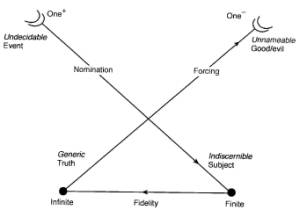
I should
point out that only now do we enter fully into the realm of philosophy, since
everything discussed so far is shared between philosophy and mathematics, and
hence between philosophy and ontology.
Speaking of
ontology, let it be said in passing that Lacan had no qualms
about calling it a disgrace -
a disgrace of sense, or
of the senses. A culinary disgrace, I would add, a family disgrace for
philosophy, not a form of good housekeeping but a disgrace for the
philosophical household. But for me 'ontology' is just another name for
mathematics - or, to be more precise,
'mathematics' is the name of ontology as a language situation. I thereby evade
the place where disgrace dwells. What we have here is a subtraction of ontology
as a whole from philosophy, which is now simply the language situation in which
truths - in the plurality of their procedures
- become pronounceable as Truth - in the singularity of its inscription. But
let's return to the gamma diagram.
It
represents the trajectory of a truth, regardless of its type. I maintain that
there are four types of truth: scientific, artistic, political, and amorous. My
diagram is philosophical in that it renders the four types of truth compossible
through a formal concept of Truth.
Notice how
the four figures of subtraction are distributed according to the register of
pure multiplicity. This also designates the latent being of these acts.
The
undecidable and the unnameable are coupled by their common presupposition of
the one: a single statement in the case of the undecidable;
On Subtraction
the
uniqueness of what evades the proper name in the case of the unnameable. Yet
the position of the one within the subtractive effect differs in each case.
Because it
is subtracted from the effect of the norm of evaluation, the undecidable statement
falls outside the compass of what can be inscribed, since what defines the
possibilities of inscription is precisely to be governed by the norm. Thus
Go'del's statement is absent from the domain of the provable because neither it
nor its negation can be admitted into it. Consequently, we could say that the
undecidable statement supplements the language situation governed by the norm.
I indicate this in the diagram by the plus sign appended to the one.
The
unnameable, on the contrary, is embedded in the intimate depths of
presentation. It bears witness to the flesh of singularity and thus provides
the point-like ground for the entire order in which terms are presented. This
radical underside of naming, this folding of the proper back upon itself, designates
that in being which undermines the principle of the one, such as it has been
established by language in the naming of the proper. This weakening of the one
of language by the point-like ground of being is indicated in the diagram by
appending the minus sign to the one.
As for the
indiscernible and the generic, they are coupled by their common presupposition
of the multiple. Indiscernibility is said of at least two terms, since it is a
difference without a concept. And the generic, as we have seen, requires an
infinite dissemination of the terms in the universe, since it provides the
schema for a subset that is subtracted from all predicative unity.
But here,
once again, the type of multiple differs in each case. The criterion for the
kind of multiple implied in the indiscernible is constituted by the places
marked out in a discerning expression. Since every effective expression in a
language situation is finite, the multiple of the indiscernible is necessarily
finite. The generic, on the contrary, requires the infinite.
Thus the
gamma diagram superimposes the logical figures of subtraction onto an
ontological distribution. There is a quadripartite distribution of the
one-more, the one-less, the finite, and the infinite. A truth circulates within
this exhaustive quadripartite structure, which accounts for the ways in which
being is given. Similarly, the trajectory of a truth is traced by the complete
logic of subtraction.
Let us now
follow this trajectory.
In order
for the process of a truth to begin, something must happen. As Mallarmé would put it, it is necessary that we be not in
a predicament where nothing takes place but the place. For the place as such
(or structure) gives us only repetition, along with the knowledge which is
known or unknown within it, a knowledge that always remains in the finitude of
its being. I call
112
Theoretical Writings
the advent,
the pure supplement, the unforeseeable and disconcerting addition: 'event'. It is,
to quote the poet once more, that which is 'sprung from the croup and the
flight'.6 A truth arises in its novelty - and every truth is a novelty - because a
hazardous supplement interrupts repetition. Indistinct, a truth begins by
surging forth.
But from
the outset, this surging forth provides the basis for the undecid-able. For the
norm of evaluation that governs the situation, or structure, cannot be applied
to the statement 'this event belongs to the situation'. Were such a statement
to be decidable, then clearly the event would already be subject to the norms
of repetition, and consequently would not be éventai. Every statement implying the naming of the
event harbours an intrinsic undecidability. And no assessment, no exhibition,
can compensate for the insufficiency of the norm. For hardly has the event
surged forth than it has already disappeared. It is nothing but the flash of a
supplementation. Its empirical character is that of an eclipse. That is why it
will always be necessary to say that it took place, that it was given in the
situation, and this unverifiable statement, subtracted from the norm of
evaluation, constitutes a supplementation vis-à-vis the realm of what language decides: it is well
and truly in this one-more that undecidability is played out.
A truth's
first step is to wager on this supplement. One decides to hold to the statement
'the event has taken place', which comes down to deciding the undecidable. But
of course, since the undecidable is subtracted from the norm of evaluation,
this decision is an axiom. It has no basis other than the presupposed vanishing
of the event. Thus every truth passes through the pure wager on what has being
only in disappearing. The axiom of truth -which always takes
the form 'this took place, which I can neither calculate nor demonstrate' - is simply the affirmative obverse of the
subtraction of the undecidable.
It is in
the wake of this subtraction that the infinite procedure of verifying the true
begins. It consists in examining within the situation the consequences of the
axiom. But this examination itself is not guided by any established law.
Nothing governs its trajectory, because the axiom that supports it has decided
independently of any appeal to the norms of evaluation. Thus it is a hazardous
trajectory, one without a concept. The successive choices that make up the
verification are devoid of any aim that would be rcpresentable in the object or
supported by a principle of objectivity.
But what is
a pure choice, a choice without a concept? Obviously, it is a choice faced with
two indiscernible terms. If there is no expression to discern two terms in a
situation, one may be certain that the choice whereby the verification
proceeds through one term rather than the other has no basis in any objective
difference between them. It is then a question of an absolutely pure
On Subtraction
113
choice,
free from any presupposition other than that of having to choose, in the
absence of any distinguishing mark in the presented terms, the one through
which the verification of the consequences of the axiom will first proceed.
This
situation has frequently been registered in philosophy, under the name 'freedom
of indifference'. This is a freedom that is not governed by any noticeable
difference, a freedom that faces up to the indiscernible. If there is no value
by which to discriminate what you have to choose, it is your freedom as such
which provides the norm, to the point where it effectively becomes
indistinguishable from chance. The indiscernible is the subtraction that
establishes a point of coincidence between chance and freedom. Descartes will
make of this coincidence God's prerogative. He even goes so far as to claim
that, given the axiom of divine freedom, the choice of 4 rather than 5 as the answer to the sum 2 + 2 is the choice between two indiscern-ibles. In
this instance, the norm of addition is that from which God is axio-matically
subtracted. It is his pure choice that will retroactively constitute the norm,
which is to say actively verify it or turn it into truth.
Putting God
aside, I will maintain that it is the indiscernible that coordinates the
subject as pure punctum in the process of verification. A subject is
that which disappears between two indiscernibles, or that which is eclipsed
through the subtraction of a difference without concept. This subject is that
throw of the dice which does not abolish chance but effectuates it as verification
of the axiom that grounds it. What was decided at the point of the undecidable
event will proceed through this term, in which the local act of a truth
is represented - without reason or marked difference,
and indiscernible from its other. The subject, fragment of chance, crosses the
distance-less gap that the subtraction of the indiscernible inscribes between
two terms. In this regard the subject of a truth is in effect genuinely
in-different: the indifferent lover.7
Clearly,
the act of the subject is essentially finite, as is the presentation of
indiscernibles in its being. Nevertheless, the verifying trajectory goes on,
investing the situation through successive indifferences. Little by little,
what takes shape behind these acts begins to delineate the contour of a subset
of the situation - or of the universe wherein the éventai axiom verifies its effects. This subset is
clearly infinite and remains beyond the reach of completion. Nevertheless, it
is possible to state that if it is completed, it will ineluctably be a generic
subset.
For how
could a series of pure choices engender a subset that could be unified by means
of a predicate? This could only be the case if the trajectory of a truth was
secretly governed by a concept or if the indiscernibles wherein the subject is
dissipated in its act were actually discerned by a superior intel-
114
Theoretical Writings
lect. This
is what Leibniz thought, for whom the impossibility of indiscern-ibles was a
consequence of God's computational intellect. But if there is no God to compute
the situation, if the indiscernibles are genuinely indiscernible, the
trajectory of truth cannot coincide in the infinite with any concept
whatsoever. And as a result, the verified terms compose — or rather, if one supposes their infinite totalization, will have composed
- a generic subset of the universe. Indiscernible
in its act or as subject, a truth is generic in its result or being. It is
subtracted from every recollection of the multiple in the one of a designation.
Thus there
are two reasons, and not just one, for maintaining that a truth is
scarcely-said.
The first
is that, since it is infinite in its being, a truth can be represented only in
the future perfect. It will have taken place as generic infinity. Its
taking-place, which is also its localized relapse into knowledge, is given in
the finite act of a subject. There is an incommensurability between the
finitude of its act and the infinity of its being. This incommensurability is
also what relates the verifying exposition of the éventai axiom to the infinite hypothesis of its
completion; or what relates the indiscernible subtraction, which founds the
subject, to the generic subtraction, wherein is anticipated the truth that the
subject is a subject of. This is the relation between the almost
nothing, the finite, and the almost everything, the infinite. Whence the fact
that every truth is scarcely-said, since what is said about it is always tied
to the local order of verification.
The second
reason is intrinsic. Since a truth is a generic subset of the universe, it does
not let itself be summarized by any predicate, it is not constructed by any
expression. This is the nub of the matter: there is no expression for truth.
Whence the fact that it is scarcely-said, since ultimately the impossibility of
constructing truth by means of an expression comes down to the fact that what we
know of truth is only knowledge - that which,
always finite, is arranged in the background of pure choices.
The fact
that a truth is scarcely-said articulates the relation between the indiscernible
and the generic, which is governed by an undecidable axiom.
Nevertheless,
the generic or subtractive power of a truth can be anticipated as such. The
generic being of a truth is never presented, but we can know, formally, that a
truth will always have taken place as a generic infinity. Whence the
possibility of a fictive disposition of the effects of its
having-taken-place. From the vantage point of the subject, it is always
possible to hypothesize a universe wherein the truth through which the subject
is constituted will have completed its generic totalization. What would the
consequences of such a hypothesis be for the universe in which truth proceeds
infinitely? Thus the axiom, which decides the undecidable on the basis of the
On Subtraction
115
event, is
followed by the hypothesis, which fictively maintains a Universe supplemented
by this generic subset whose finite, local delineations are supported by the
subject through the trial of the indiscernible.
What is it
that obstructs such a hypothesis? What limits the generic power of a truth
projected through the fiction of its completion, and hence of its being
wholly-said? I maintain that this obstacle is none other than the unnameable.
The
anticipating hypothesis as to the generic being of a truth is obviously a forcing
of the scarcely-said. This forcing enacts the fiction of an all-saying from
the vantage of an infinite and generic truth. But then there is a great
temptation to exert this forcing on the most intimate, most subtracted point of
the situation, and to try to force that which testifies to the situation's
singularity, that which does not even have a proper name, the proper of the
proper, which is anonymous but for which 'anonymous' is not even the adequate
name.
Let us say
that forcing, which represents the infinitely generic character of truth in the
future perfect, encounters its radical limit in the possibility that its power
of all-saying in truth will result in a truth ultimately giving its own name to
the unnameable.
The constraint
that the infinite, or the subtractive excess of the generic, exerts on the
weakness of the one at the point of the unnameable, may give rise to the desire
to name the unnameable, to appropriate the proper of the proper through naming.
But it is in
this very desire, which every truth puts on the agenda, that I perceive the
figure of evil as such. To force a naming of the unnameable is to deny
singularity as such; it is the moment in which, in the name of a truth's
infinitely generic character, the resistance of what is absolutely singular in
singularity, of that share of being of the proper which is subtracted from
naming, appears as an obstacle to the deployment of a truth seeking to ensure
its dominion over the situation. The imperialism of a truth - its worst desire - consists in invoking generic subtraction in order to force the
subtraction of the unnameable, so that it may vanish in the light of naming.
We will
call this a disaster. Evil is the disaster of a truth when the desire to force
the naming of the unnameable is unleashed in fiction.
It is
commonly held that evil is the negation of what is present and the denial of
what is affirmed, that it is murder and death, that it is opposed to life. I
would say instead that it is the denial of a subtraction. It is not
self-affirmation that evil affects, but rather always that which is withdrawn
and anonymous in the weakness of the one. Evil is not disrespect for the name
of the other, but rather the will to name at any price.
Moreover,
it is also commonly held that evil is mendacity, ignorance, murderous
stupidity. But, alas, evil has the process of a truth as its radical
116
Theoretical Writings
condition.
There is evil only in so far as there is an axiom of truth at the point of the
undecidable, a trajectory of truth at the point of the indiscernible, an
anticipation of the being of truth at the point of the generic, and the forcing
in truth of a naming at the point of the unnameable.
If the
forcing of the unnameable subtraction is a disaster, it is because it affects
the situation as a whole by pursuing within it singularity as such, for which
the unnameable is the emblem. In this sense, the desire in fiction to suppress
the fourth subtractive operation unleashes a capacity for destruction latent in
every truth, in the precise sense in which Mallarmé could write that 'Destruction was my Beatrice'.8
Accordingly,
the ethics of a truth consists entirely in exercising a sort of restraint with
regard to its powers. It is important that the combined effect of the
undecidable, the indiscernible, and the generic - or of the event, the subject, and truth - should acknowledge as the fundamental limit for its trajectory that
unnameable which Samuel Beckett chose as the title for one of his books.
Samuel
Beckett was certainly not unaware of the hidden ravages inflicted on the
subtraction of the proper by the desire for truth. He even saw in it the
ineluctable violence of thought, when he has his Unnamable say this: 'I only
think ... once a certain degree of terror has
been exceeded.'9 But he also knew that the ultimate guarantee for
the possibility of a peace among truths is rooted in the reserve of non-saying;
in the limit of the voice vis-à-vis
that which shows
itself; in that which is subtracted from the absolute imperative to speak the
truth. This is also what he intended when in Molloy he reminded us that
'[t]o restore silence is the role of objects'10 and when in How
It Is he congratulates himself on the fact that 'the voice being so ordered
I quote that of our total life it states only three quarters'.11
Subtracting
lies at the source of every truth. But subtraction is also what, in the guise
of the unnameable, governs and sets a limit to the subtractive trajectory.
There is only one maxim in the ethics of a truth: do not subtract the last
subtraction.
Which is
something that Mallarmé,
with whom I wish to
conclude, says with customary precision in his 'Prose (for des Esseintes)'.
There is
always the danger that a truth - however errant
and incomplete it may be - takes itself, in the words of the
poet, for an 'age of authority'. It then wants everything to be triumphantly
named in the Summer of revelation. But the heart of what is, the 'southland' (midi) of our unconsciousness of being, does not and must
not have a name. The site of the true, which is subtractively constructed — or, as the poet puts it elsewhere, the flower
that a contour of absence has separated from every garden - itself remains, in its intimate depth, subtracted from the proper name.
The sky and the map
On Subtraction
117
testify
that this land did not exist. But it does exist, and this is what wears thin
the authoritarian truth, for which only what has been named through the power of
the generic exists. This erosion must be sustained by safeguarding the proper
and the nameless. Let us conclude then by reading Mallarmé's poem, wherein everything I have said is
dazzlingly rendered:
L'ère
d'autorité se trouble Lorsque,
sans nul motif, on dit De ce midi que notre double Inconscience approfondit
Que, sol de
cent iris, son site Ils savent s'il a bien été Ne porte pas de
nom que cite L'or de la trompette d'été.
The age of
authority wears thin When, without reason, it is stated Of this southland which
our twin Unconsciousness has penetrated
That, soil
of a hundred irises, its site, They know if it was really born: It bears no
name that one could cite, Sounded by summer's golden horn.12
CHAPTER
10
Truth:
Forcing and the Unnameable1
When a philosopher
makes a claim about truth, is it not natural - 'natural' in a sense which etymology upholds through thoroughgoing
artifice - for him to do so from the bias of
his love? Doubtless, the Platonic gesture - registered, acclaimed, then reviled through the centuries - persists in discerning a connotation of
superior intensity in the wise friendship of philosophia; especially
when it is in the shelter of wisdom that we discover truth's enigma and, as a
result, at the heart of serene friendship that we encounter the tempest of
love. As Lacan demonstrated in his strange
appropriation of a real Symposium, it is through this transference (in
every sense of the word) that philosophy is able to proclaim itself 'love of
truth'.
Thus when Lacan insists that the position of the psychoanalyst
surely does not consist in loving truth, there can be no doubt that he is
maintaining the stance he ended up describing as that of an 'anti-philosophy'.
Yet in
doing so, Lacan clearly appoints himself educator
for every philosophy to come. In my view, only those who have had the courage
to work through Lacan's anti-philosophy without faltering deserve to be called
'contemporary philosophers'. There are not many of them. But it is as a
contemporary philosopher that I will here endeavour to elucidate what I declare
to be a return of truth. Let's say that I'm speaking here as a
philosopher-subject supposed to know anti-philosophy2 - and hence as a lover of truth supposed to know
what little faith can be afforded to the protestations made in the name of such
a love.
Lacan delineates his concept of the love
of truth in the seminar entitled The Reverse of Psychoanalysis, which
has recently been published in an edition I shall simply take as it is, without
entering into the controversies that invariably attend the inscription of the
living word into the dead letter.3
In this
seminar, Lacan makes the radical claim that since
truth is primordially a kind of powerlessness or weakness; if there is such a thing
as the love of truth, it can only be the love of this powerlessness, the love
of this weakness. It's worth noting that in this claim Lacan for once echoes Nietzsche, for whom truth is in a certain regard the
impotent form of
120
Theoretical Writings
power, or
the name that the powerless give to power in order to disguise it.
But Lacan immediately distances himself from the
Dionysian preacher. For Lacan,
the weakness wherein
truth dwells is not rooted in revenge or resentment. That which affects truth
with an insurmountable restriction is, obviously enough, castration. Truth is
the veil thrown over the impossibility of saying it all, of saying all of
truth. It is both what can only be half-said and what disguises this acute
powerlessness that restricts the access to saying - in an act of pretence, whereby it transforms itself into a total image
of itself. Truth is the mask of its own weakness. In which regard Lacan now echoes Heidegger, for whom truth is the
very veiling of being in its withdrawal. Except that Lacan distances himself completely from the pathos with which Heidegger
characterizes the becoming-distress of the veil and the forgetting. For
castration is structural, it is structure itself, so that for Lacan there can be no place for the primordially
uncastrated, which is what the pre-Socratic thinkers and poets ultimately are
for Heidegger.
What then,
for Lacan, is the love of truth, given this
authoritative status of structure? We must not shy away from the consequences: it
is purely and simply the love of castration.
We are so
accustomed to thinking of castration in terms of horror that we are astonished
to hear Lacan discussing it in terms of love.
Nevertheless, Lacan does not hesitate. In the seminar
dated 14 January 1970 we read:
The love of
truth is the love of that weakness whose veil we have lifted; it is the love of
that which is hidden by truth, and which is called castration.4
Thus, under
the guise of the love we bear toward it, truth affects castration with a veiling.
Castration thereby manifests itself stripped of the horror that it inspires as
a pure structural effect.
The
philosopher will reformulate the matter as follows: truth is bearable for
thought, which is to say, philosophically lovable, only in so far as one
attempts to grasp it in what drives its subtractive dimension, as
opposed to seeking its plenitude or complete saying.
So let us
try to weigh truth in the scales of its power and its powerlessness, its
process and its limit, its affirmative infinity and its essential subtraction -even if this weighing, and the concomitant desire to attain a precise
measure of truth's indispensable mathematical connection (not to mention the
demands of brevity), entails approximation.
I shall
construct the scales for this weighing of truth by means of a quadruple
disjunction:
Truth: Forcing and the Unnameable
121
1. The disjunction between
transcendence and immanence. Truth is not of the order of something which
stands above the givenness of experience; it proceeds or insists within
experience as a singular figure of immanence.
2. The disjunction between the
predicable and the non-predicable. There exists no single predicative trait
capable of subsuming and totalizing the components of a truth. This is why we
will say that a truth is nondescript or generic.
3. The disjunction between the infinite
and the finite. Conceived in its being, as something that cannot be completed,
a truth is an infinite multiplicity.
4. The disjunction between the nameable
and the unnameable. A truth's capacity for disseminating itself into judgements
within the field of knowledge is blocked by an unnameable point, whose name is
forced only at the cost of disaster.
Thus a
truth finds itself quadruply subtracted from the exposition of its being. It is
neither a supremum, visible in the glare of its self-sufficiency, nor
that which is circumscribed by a predicate of knowledge, nor that which
subsists in the familiarity of its finitude, nor that whose erudite fecundity
is blessed with boundless power.
To love
truth is not only to love castration, but to love the figures in which its
horror is drawn and quartered: immanence, the generic, the infinite, and the
unnameable.
Let us
consider them one by one.
That truth,
or at least our truth, is purely immanent was one of Freud's simplest
yet most fundamental insights. Freud was uncompromising in his defence of this
principle, especially against Jung. It would be
no exaggeration to say that one of Lacan's primary motivations was to mobilize
this Freudian insight against the scientistic and moralistic objectivism of the
Chicago school.
I will use
the word 'situation' - the most anodyne word imaginable - to designate the multiple made up of
circumstances, language, and objects, wherein some truth can be said to
operate. We will say that this operation is in the situation, and is
neither its end, nor its norm, nor its destiny. Similarly, the experience of
the analyst clearly shows that a truth works through the subject - especially through his suffering - in the situation of analysis itself. Truth
comes into being within this situation through the successive operations that
make up the analysis. Moreover, it is a mistake to think that the existence of
this truth constitutes a pre-given norm for what is observed in the analysis,
or that it is a matter of discovering or revealing the truth, as though it were
some secret entity buried, so to speak, in the deep exteriority
122
Theoretical Writings
of the
situation. The whole point is that there is no depth, and depth is just another
name - treasured by the hermeneuts - for transcendence.
Where does
a truth come from then, if its process is strictly immanent and if it is not
given as the secret depth or intimate essence of the situation? How can it
advance within the situation if it has not always already been given within it?
Lacan's genius lay in seeing that, as with Columbus's egg, the answer is
already contained in the question. If a truth cannot originate from its being
given, it must be because it has its origin in a disappearance. I call 'event'
this originary disappearance supplementing the situation for the duration of a
lightning flash; situated within it only in so far as nothing of it subsists;
and insisting in truth precisely in so far as it cannot be repeated as
presence. Obviously, the event is the philosophical analogue of (for example)
what Freud called the primal scene. But since the latter is endowed with the
force of truth only through its abolition, and has no place other than the
disappearance of the having-taken-place, it would be futile to ask, using the
realist categories proper to the situation, whether it is accurate or merely
represents a fiction. This question remains genuinely undecidable, in the
logical sense. Except that the effect of truth consists in retroactively validating
the fact that at the point of this undecidable there was the disappearance - acutely real and henceforth immanent to the
situation - not only of the undecidable, but of
the very question of the undecidable.
Such is the
first subtractive dimension of truth, whose immanence depends upon the
undecidability of what that immanence retraces.
What then
is a truth the truth of? There can be truth only of the situation wherein truth
insists, because nothing transcendent to the situation is given to us. Truth is
not a guarantor for the apprehension of something transcendent to the
situation. Since a situation, grasped in its pure being, is only ever a
particular multiple, this means that a truth is only ever a sub-multiple of
that multiple, a subset of the set named 'situation'. Such is the rigour of the
ontological requirement of immanence. Because a truth proceeds within a
situation, what it bears witness to does not in any way exceed the situation.
We could say a truth is included in that which it is the truth of.
Let me open
a cautionary parenthesis at this stage. Cautionary because I have to admit that
I am not, nor have ever been, nor will probably ever be either an analyst or an
analysand, or even a psychoanalytic patient. I am the unanalysed. Can the
unanalysed say something about analysis? You will have be the judge of that. It
seems to me from what I have said so far that, if truth is at stake in
analysis, it is not so much a truth of the subject as a truth of the analytical
situation as such; a truth which, no doubt, the analysand will henceforth have
to cope with, but which it would be one-sided to describe as belonging to him
or her alone. Analysis seems to me a situation
Truth: Forcing and the Unnameable
123
wherein the
analysand is provided with the painful opportunity for encountering a truth,
for crossing a truth along his path. He emerges from this encounter
either armed or disarmed. Perhaps this approach sheds some light on the
mysteries of what Lacan, no doubt thinking of the real as
impasse, called 'the pass'.
But we now
find ourselves precisely in the domain of the impasse. I said that a truth
comes into being at the end of its process only as a subset of the
situation-set. Yet the situation registers any number of subsets. Indeed, this
provides the broadest possible definition of knowledge: to name subsets of the
situation. The function of the language of the situation consists in gathering
together the elements of the situation according to one or other predicative
trait, thereby constituting the extensional correlate for a concept. A subset - such as those of cats or dogs in a perceptual
situation, or of hysterical or obsessive traits and symptoms in an analytical
situation - is captured through concepts of the
language on the basis of indices of recognition attributable to all the terms
or elements that fall under this concept. I call this conceptual and nominal
swarming of forms of knowledge, the encyclopedia of the situation. The
encyclopedia is what classifies subsets. But it is also the polymorphous
interweaving of forms of knowledge that language continually elicits.
Yet if a
truth is merely a subset of the situation, how does it distinguish itself from
a rubric of knowledge? This question is philosophically crucial. It is a matter
of knowing whether the price of immanence may not be purely and simply the
reduction of truth to knowledge; in other words, a decisive concession to all
the variants of positivism. More profoundly, the question is whether immanence
may not entail some sort of neoclassical regression that would forsake the
impetus given by Kant, and later retrieved by Heidegger, to the crucial
distinction between truth and knowledge, which is also the distinction between
thought and cognition. Simplifying somewhat, this neoclassical version of
immanence would basically end up claiming that once you have diagnosed an
analysand's case, which is to say, recognized him as hysterical or
obsessive or phobic; once you have established the predicative trait inscribing
him in the encyclopedia of the analytical situation, the real work has been
done. It is then only a matter of drawing consequences.
Because of
the way in which he envisaged his fidelity to Freud, Lacan categorically rejected this nosological vision of the analytical
situation. To that end, he took up the modern notion of a non-conceptual gap
between truth and forms of knowledge and projected it onto the field of
psychoanalysis. Not only did he distinguish between truth and knowledge, he
also showed that a truth is essentially unknown; that it quite literally
constitutes a hole in forms of knowledge.
124
Theoretical Writings
In doing so
- and this is in my opinion a point whose
consequences have yet to be fully grasped - Lacan declared that psychoanalysis was not a form of knowledge but a way of
thinking.
Yet despite
the claims of those who would like to effect a theological recuperation of
psychoanalysis - and they are indefatigable, rather
like someone who has figured out how to turn pig-feed into a communion wafer -and who like to indulge in delectable speculations about the
transcendence of the Big Other, Lacan himself, on
the whole, refused any compromise about the immanence of truth.
He thereby
had to force our impasse and establish that, although reducible to a depthless
subset of the situation, a truth of the situation is nonetheless heterogeneous
to all those subsets registered by forms of knowledge.
This is the
fundamental meaning of the maxim concerning 'half-saying'. That a truth cannot
be entirely said means that its all, the subset that it constitutes within the
situation, cannot be captured by means of a predicative trait that would turn
it into a subsection of the encyclopedia. The truth at stake in the analysis of
such and such a woman cannot be assimilated to the fact that she is, as they
say, a hysteric. There is no doubt that many of the components of the truth
operating in this situation possess the distinctive traits of what, in the
register of knowledge, is called hysteria. But to say so is not to do anything in
truth. For the truth in question necessarily organizes other components,
whose traits are not pertinent as far as the encyclopedic concept of hysteria
is concerned, and it is only in so far as these components subtract the set
from the predicate of hysteria that a truth, rather than a form of knowledge,
proceeds in its singularity. Thus however confident the diagnosis of hysteria
and the consequences drawn from it may be, not only do they not constitute a saying
of truth, they do not even constitute its half-saying, since the fact that they
are ascribable to knowledge entails that they completely miss the
dimension of truth.
A truth is
a subset of the situation but one whose components cannot be totalized by means
of a predicate of the language, however sophisticated that predicate. Thus a
truth is an indistinct subset; so nondescript in the way it gathers together
its components that no trait shared by the latter would allow the subset to be
identified by knowledge.
Obviously,
it is because it is included within the situation in the form of a singular
indeterminacy of its concept, and because it is subtracted from the
classificatory grasp of the language of the encyclopedia, that such a subset is
a truth of the situation as such, an immanent production of its pure multiple
being, a truth of its being qua being - as opposed to a
knowledge of this or that regional particularity of the situation.
Truth: Forcing and the Unnameable
125
As is so
often the case, mathematics bolsters Lacan's insight. At the beginning of the 1960s, the mathematician Paul Cohen showed how, for a
given set, it was possible to identify subsets of it possessing all the
characteristics outlined above. Cohen calls a subset that has been subtracted
from every determination in terms of a fixed expression of the language a generic
subset. Moreover, he uses a demonstrative procedure to prove that the
hypothesis that generic subsets exist is consistent.
Twenty
years earlier, Godel had provided a rigorous definition for the idea of a
subset named in knowledge. These are subsets whose elements validate a fixed
expression of the language. Gôdel
had called these constructible subsets. But Cohen's generic subsets are non-constructible. They are too indeterminate to
correspond to, or be totalized by, a single predicative expression.
There can
be no doubt that the opposition between constructible sets
and generic sets provides a purely immanent ontological basis for the
opposition between knowledge and truth. In this regard, Cohen's demonstration
that the existence of generic subsets is consistent amounts to a genuinely
modern proof that truths can exist and that they are irreducible to any
encyclopedic datum whatsoever. Cohen's theorem mobilizes the ontological
radicality of the matheme to consummate the modernity inaugurated by the
Kantian distinction between thought and knowledge.
That a
truth is generic rather than constructible, as Lacan brilliantly intuited in his maxim about truth's half-saying, also
implies that a truth is infinite - our third
disjunction.
This point
seems to rebut every philosophy of finitude, in spite of the way Lacan inscribed finitude at the heart of desire
through the thesis of the objet petit
a. The being that
sustains desire resides entirely in this object, which is also its cause. And
since the defining characteristic of the objet petit a is that it is always a partial object,
its finitude is constitutive.
But the
dialectic of the finite and the infinite is extremely tortuous in Lacan, and I dare say the philosopher's eye here
glimpses the limit, and hence the real, of what psychoanalysis is capable when
conceived as a form of thinking, which is indeed how Lacan envisaged it.
That a
truth is infinite constitutes an objection to the philosophical rumination on
finitude only if that truth remains immanent, and hence only in so far as it
touches on the real. If truth is transcendent, or supra-real, it can very well,
under the name 'God' or some other name - such as 'the
Other' -consign the entire destiny of the
subject to finitude.
I said that
Lacan sided with the immanence of truth.
But I added: 'on the whole'. For, strictly speaking, he observes the constraint
of immanence only within what could be called the primordial motivation of his
thought. Elsewhere, we encounter significant oscillations, arising from
Lacan's tendency to
126
Theoretical Writings
equivocate
when it comes to severing every link with the hermeneutics of finitude to which, alas,
the majority of contemporary philosophizing is ultimately reducible. Today,
this hermeneutics of finitude seems to be in the process of reinstalling a
pious discourse, a religiosity whose little God would seem to constitute the
minimum of transcendence compatible with that democratic conviviality to which
we are told there is no longer any conceivable alternative.
There is no
doubt that we owe to Lacan, and specifically to his implacable
insistence on the distinction between the logic of sense and the logic of
truth, the conceptual apparatus required to expose the abjection of pious
discourse. As for democratic conviviality, we know it was not Lacan's forte.
Moreover, that it is not even a satisfactory ideal becomes more apparent every
day when we consider those who lay claim to his legacy.
Nevertheless,
the equivocation on Lacan's part persists. It is this equivocation that leads
him to say in Or Worse...5 - to choose just one example among many - that Cantor's non-denumerable transfinite cardinals represent 'an object
which I would have to characterize as mythic'. I would counter that it is not
possible to proceed very far in drawing the consequences of the infinity of the
true without insisting that non-denumerable cardinals are real, not mythic.
To advance
beyond Lacan perhaps we must above all put our
trust in the matheme on this particular point — which is, of course, another way of remaining faithful to the master.
This entails first and foremost that we hold fast to the affirmation, by way of
mathematical proof, that every truth is infinite.
Let us
suppose that a truth were finite. As a finite subset of the situation, it is
made up of the terms at, 02, and so on up to an, where n fixes the intrinsic
dimension of this truth. In other words, it is a truth comprising n components.
It immediately follows that there exists a predicate appropriate to this
subset, which, since it is inscribed in the encyclopedia, falls under the
purview of knowledge. This is to say that a finite subset could not be generic.
It is necessarily constructible.
Consider the predicate
'identical with al, or identical with a2, ... or identical with an', which
is always available in the language of a situation. The set made up of the
terms in question - i.e. the terms a1,
a2, and so on up to an — is exactly circumscribed by this predicate. In
other words, this predicate constructs this subset; it identifies it in the
language, thereby excluding the possibility of its being generic. Consequently,
it is not a truth. QED.
The infinity
of a truth immediately implies that it cannot be completed. For the subset that
it constitutes, and which is delineated on the basis of the éventai disappearance, is composed through a succession
that inaugurates a
Truth: Forcing and the Unnameable
127
time - e.g. the highly particular time proper to
analysis. Whatever the intrinsic norm governing its extension, such a time
remains irremediably finite. And so the truth that unfolds within it does not
attain the complete composition of its infinite being. Freud's genius was to
grasp this point in the guise of the infinite dimension of analysis, which
always leaves open, like a gaping chasm, the truth that slips into the time
inaugurated by analysis.
We now seem
to find ourselves driven back to castration, as to that which truth veils,
thereby granting us permission to love it.
For if a
truth remains open onto the infinity of its being, how are we to gauge its
power? To say that truth is half-said is to say too little. The relation
between the finitude proper to the time of its composition - a time founded by the event of a disappearance - and the infinity of its being is a relation
without measure. It is better to say instead that a truth is little-said, or
even that a truth is almost not spoken. Is it then legitimate to speak of a
power of the true, a power required in order to found the concept of its
eventual powerlessness? In the seminar I quoted at the outset, Lacan plainly states that 'it seems to be among the
analysts, and among them in particular, that, invoking certain taboo words with
which their discourse is festooned, one never notices what truth - which is to say, powerlessness - is'.6 I concur. But in order to be
neither like those festooned analysts, nor simply jealous of the festooned, we
shall have to think the powerlessness of a truth, which presupposes that we
first be able to conceive its power.
I conceive
of this power - perhaps already recognized by Freud
in the category of 'working through' - in terms of the
concept of forcing, which I take directly from Cohen's mathematical
work. Forcing is the point at which a truth, although incomplete, authorizes
anticipations of knowledge concerning not what is but what will have been if
truth attains, completion.
This
anticipatory dimension requires that truth judgements be formulated in the
future perfect. Thus while almost nothing can be said about what a truth is,
when it comes to what happens on condition that that truth will have been, there
exists a forcing whereby almost everything can be stated.
As a
result, a truth operates through the retroaction of an almost nothing and the
anticipation of an almost everything.
The crucial
point, which Paul Cohen settled in the realm of ontology, i.e. of mathematics,
is the following: you certainly cannot straightforwardly name the elements of a
generic subset, since the latter is at once incomplete in its infinite
composition and subtracted from every predicate which would directly identify
it in the language. But you can maintain that if such and such an
element will have been in the supposedly complete generic subset, then
such and such a statement, rationally connectable to the element in question, is, or rather will
have been, correct. Cohen describes this method - a method
128
Theoretical Writings
constraining
the correctness of statements according to an anticipatory condition bearing
on the composition of an infinite generic subset- as that of forcing.
I say
'correct' or 'correctness' because Lacan superimposes
the opposition between the correct and the true onto the opposition between
knowledge and truth. But it is necessary to see why the statement caught up in
forcing cannot, without serious confusion, be called true. For its value is
determined only according to a condition of existence which pertains to a
generic subset, and hence according to a condition of truth.
I use the
term veridical to describe the value of a 'forced' statement. It
simultaneously indicates the gap as well as the connection with truth. Thus,
extrapolating from Cohen's matheme to what it prescribes for the philosopher,
we will say that a truth proceeds in situation, devoid of the power either to
say or to complete itself. In this sense truth is absolutely castrated, almost
not being what it is. Nevertheless, with regard to any given statement, truth
has the power to anticipate the following conditional judgement: if this or
that component will have figured in a supposedly complete truth, then the
statement in question will have been either veridical or erroneous. The power
of a truth, deployed in the dimension of the future perfect, consists in
legislating about what is veridically sayable, in anticipation of its own existence.
Obviously, what is veridically sayable is a matter of knowledge, and the
category of the veridical is a category of knowledge. Consequently, we will say
that although a truth is castrated with regard to its own immediate power, it
is all-powerful with regard to possible forms of knowledge. The bar of
castration does not fall between truth and knowledge. It separates truth from
itself, thereby releasing truth's power of hypothetical anticipation within the
encyclopedic field of knowledge. This power is that of forcing.
I maintain
that the analytical experience is built on such a basis. That which, little by
little, comes to be articulated in the course of analysis is not only that
which weaves the interminable infinity of the true into a finite, metered time,
but also - and especially with regard to the
rare interventions of the analyst - the anticipatory
marking of what it will have been possible to say veridically, in so far as
this or that sign, act, or signifier
will have been supposed
as a component of the truth. We know that this anticipatory marking depends
upon the future perfect tense of the empirical completion of analysis, beyond
which any supposition as to truth's completion becomes impossible, since the
situation has been terminated and with it the forcing of a possible
veridicality proper to the judgements about that situation. This testifies as
to how an enunciated veridicality can be called knowledge, but knowledge in
truth. As to what this knowledge truly is, this knowledge 'forced' by the
treatment, the analysand is our sole witness, operating through a retroaction that
balances the anticipation of forcing.
Truth: Forcing and the Unnameable
129
Once again,
as the unanalysed, I need to sound a note of caution here and remark that I am
not sure if it is appropriate to call the act of the analyst an interpretation.
I would prefer to call it a forcing - despite the
word's scandalously authoritarian ring. For it is always a matter of
intervening according to the suspended hypothesis of a truth taking its course
in the analytical situation.
I do not
think it too forceful to register a hint of doubt as to the value of
interpretation in many of the dead master's texts. This should not be too
surprising when one recalls that all sorts of hermcneuts, stepping into the
breach opened up by the faithful Paul Ricoeur, have tried to make the term
'interpretation' bear the burden of the putative link between psychoanalysis
and the revamped forms of pious discourse. Let me be blunt: I do not believe
analysis consists in interpretation. It is ruled by truth, not meaning. But it
certainly does not consist in discovering truth, since, truth being
generic, we know it is vain to hope that it could be uncovered. The sole
remaining hope is that analysis would consist in forcing a knowledge into truth
through the risky game of anticipation, by means of which a generic truth in
the process of coming into being delivers in fragmentary fashion a constructible knowledge.
Having
gauged the power of truth, must we say it extends to all those statements that
circulate in the situation in which it operates, without exception - even if only on condition of the wager about
its coming into being as a multiple? Does truth, in spite (and because) of its
generic nature, possess the power of naming all imaginable veridicalities?
To respond affirmatively
would be to disregard the return of castration, and of the love that binds us
to it through truth, in the terminal form of an absolute obstacle — a term which, although given in the situation,
is radically subtracted from the grip of veridical evaluation. There is a point
that is unforceable, so to speak. I call this point the unnameable, while in
the realm of psychoanalysis Lacan
called it enjoyment.
Let us
consider a situation in which a truth proceeds as the trace of a vanished
event; a situation immanently supplemented by the becoming of its own truth.
For a generic truth is the paradox of a purely internal anonymous supplement,
an immanent addition. What is the real for such a configuration?
Let us
rigorously distinguish between being and the real. This distinction is already
operative in Lacan's very first seminar, since on 30 June 1954 he claims that the three fundamental
passions - love, hate and ignorance - can be inscribed 'only in the realm of being,
and not in that of the real'.7 Thus, if the love of truth is a
passion, this love is certainly directed toward the being of truth, but it
falters upon encountering its real.
As far as
the being of truth is concerned, we have already acquired its concept: it is
that of a generic multiplicity subtracted from the constructions
130
Theoretical Writings
of
knowledge. To love truth is to love the generic as such and this is why, as in
all love, we have here something that goes astray, something that evades the
order of language, something that is maintained in the errancy of an excess
through the power of the forcings it permits.
Nevertheless,
there remains the question of the real upon which this very errancy and the
power that it founds come to falter.
In this
regard, I would say that in the realm determined by a situation and the generic
becoming of its truth, what testifies to a real is a single term or point - one and only one - where the power of truth is cut short. When it comes to this term, no
anticipatory hypothesis about the generic subset can allow judgement to be
forced. It is a genuinely unforceable term. No matter how advanced the process
of truth, this term may never be prescribed in such a way that it would be
conditioned by this truth. No matter how great the transformative resources
proper to the immanent tracing of the true, no naming is appropriate for this
term of the situation. That is why I call it unnameable. Unnameable should be
understood not in terms of the available resources of knowledge and the
encyclopedia, but in the precise sense in which it remains out of reach for the
veridical anticipations founded on truth. It is not unnameable 'in itself,
which would be meaningless, but unnameable with regard to the singular process
of a truth. The unnameable emerges only in the domain of truth.
This sheds
some light on why, in the situation of the psychoanalytic treatment, which is
precisely one of the sites wherein one supposes a truth to be at work,
enjoyment is at once what that truth deploys in terms of the real and what remains
forever subtracted from the veridical expanse of the sayable. This is because,
from the perspective of psychoanalytical truth, or the truth of the situation
of treatment, enjoyment is precisely the point of the unnameable that
constitutes a stumbling block for the forcings permitted by this truth.
It is
imperative to insist that this term is unique. There cannot be two or
more unnameables for a singular truth. The Lacanian maxim, 'there is oneness',
is here fastened to the irreducible real, to what could be called the 'grain of
the real' jamming the machinery of truth, whose power consists in being the
machinery of forcings and hence the machinery for producing finite
veridicalities from the vantage point of a truth that cannot be accomplished.
Here, the jamming effected by the One-real is opposed to the path opened up by
veridicality.
This effect
of oneness in the real, elicited by the power of truth, constitutes truth's
powerless obverse. This is signalled straight away by the peculiar difficulty
that arises when it comes to thinking this effect. How can we think that
which subtracts itself from every veridical naming? How can we
Truth: Forcing and the Unnameable
131
think in
truth that which is excluded from the powers of truth? Is to think it not also
thereby to name it? And how could we ever name the unnameable?
Lacan's
response to this paradoxical appeal is never explicitly spelled out. When it
comes to trans-phallic or secondary jouissance, one
sees Lacan resorting to the triangle of the feminine,
the infinite and the unsayable, about which the least that can be said is that
it seems to hark back to a pre-Freudian era. That feminine enjoyment ties the
infinite to the unsayable, and that mystical ecstasy provides evidence for
this, is a theme I would characterize as cultural. One feels that, even in Lacan, it has not yet been submitted to a radical test
by the ideal of the matheme.
Perhaps one
of the sources of Lacan's difficulties resides in the paradox of the
unnameable, a paradox which I will formulate as follows: if the unnameable is
unique within the domain of a truth, is it not then nameable precisely on
account of this property? For if what is not named is unique, not being named
functions as its proper name. Ultimately, wouldn't 'the unnameable' be
the proper name for the real of a situation traversed by its truth? Wouldn't
unsayable enjoyment be the name for the real of the subject, once he or she
comes to grips with his or her truth, or with a truth within the
therapeutic situation?
But then
the unnameable is named in truth; it is forced, and truth possesses a genuinely
boundless reservoir of power.
Here once
again, mathematics comes to our aid. In 1968, the logician
Furkhen proved that the uniqueness of the unnameable is no objection to its
existence. Furkhen created a mathematical situation in which the resources of
the language, along with its capacities for naming, are clearly defined, and in
which there exists one term, and one term only, which cannot receive a name,
which means that it cannot be identified by means of an expression of the
language.
Consequently,
in the register of the matheme, it is perfectly consistent to maintain that one
term and one term only in a given situation remains unforceable for a generic
truth. It is thus that, in the situation supplemented by its truth, the real of
that supplementation is attested to. No matter how powerful a truth is, no
matter how capable of veridicality it proves to be, this power comes to falter
upon a single term, which at a stroke effects the swing from all-powerfulness
to powerlessness and displaces our love of truth from its appearance, the love
of the generic, to its essence, the love of the unnameable.
Not that
the love of the generic is nothing. By itself, it is radically distinct from
the love of opinions, which is the passion of ignorance; or from the disastrous
desire for complete constructibility. But the love of the unname-
132
Theoretical Writings
able lies
beyond even the generic, and it alone allows the love of truth to be maintained
without disaster or dissolution coming to affect the veridical in its entirety.
For where truth is concerned, only by undergoing the ordeal of its
powerlessness do we discover the ethic required for assuming its power.
The
circumstances in which we find ourselves in this autumn of 1991 enjoin me to conclude, in an apparently
incongruous manner, with Vladimir Ilyich Ulyanov, also known as Lenin, whose
statues it is fashionable nowadays to tear down.
Let us note
in passing that, were a Lacanian tempted to join in the zeal of those now
toppling statues, he or she would do well to reflect on the following paragraph
from the seminar dated 20 March 1973, which begins thus:
Marx and
Lenin, Freud and Lacan are not coupled in being. It is via
the letter they found in the Other that, as beings of knowledge, they proceed
two by two, in a supposed Other.8
Thus the
would-be Lacanian toppler of Lenin's statues has to explain why Lacan identified himself as Freud's Lenin.
Let's add that,
at a time when many analysts are worried about their relation to the state,
even if only in the monumental guise of the Inland Revenue and the European
Union, they would surely do better to consider Lenin's writings than those of
the statuc-topplers - supposing such writings exist.
Lenin felt
obliged to write: 'Theory is all-powerful because it is true.' This is not
incorrect, since forcing subordinates to itself in anticipatory fashion the
expanse of the situation through a potentially infinite network of veridical
judgements. But, once again, this is only to say the half of it. It is
necessary to add: 'Theory is powerless, because it is true.' This second half
of the statement's correctness is supported by the fact that forcing finds
itself in the impasse of the unnameable. But on its own, this second half of
correctness is no more capable of staving off disaster than the first.
Thus Lenin
seems to have adopted a relation of love vis-à-vis castration
that veils the latter in that half of power which it founds. By way of
contrast, it is only too apparent that the statue-topplers seem to have adopted
the direct love of powerlessness which does nothing but pave the way for situations
devoid of truth.
Is this
oscillation inevitable? I don't think so. Under the stern guarantee of the
matheme, we can advance into that open expanse wherein the love of truth is
related to castration from the twofold perspective of power and powerlessness,
of forcing and the unnameable. All that is required of us is to
Truth: Forcing and the Unnameable
133
hold both
to the veridical and to what cannot be completed; to analysis terminable and
interminable. Or, as Samuel Beckett puts it in the final words of a book
which is not called The Unnamable for nothing: 'you must go on, I can't
go on, I will go on.'
CHAPTER
11
Kant's
Subtractive Ontology
If at first
sight it appears that Kant has no ontology, since he seems to declare the very
idea inconsistent, this is because he is above all the philosopher of relation,
of the linkages between phenomena, and this constitutive primacy of relation
forbids all access to the being of the thing as such. Are not Kant's famous
categories of experience a veritable conceptual catalogue of every conceivable
kind of relation (inherence, causality, community, limitation, totality, etc.)?
Is it not for Kant a question of showing that the ultimate basis for the bound
character of representations cannot be sought in the being of the
represented and must be superimposed upon it through the constituting synthetic
power of the transcendental subject? It might seem as if the Kantian solution
to the problem of structured representation amounted to identifying the pure
inconsistent multiple (or being qua being, in my conception of ontology) with
the phenomenality of the phenomenon, and the counting-as-one (in my vocabulary,
being qua given or being 'in situation') with relation, which is itself set out
on the basis of the structuring activity of the subject. The experience of the
phenomenal manifold would be rendered consistent through the power of
counting-as-one (i.e. the universal linkages) that the subject imposes upon
experience.
But that is
not the case. For in one of his most radical insights, Kant firmly
distinguishes between binding (Verbindung), which is synthesis of the
manifold of phenomena, and unity (Einheif), which provides the originary
basis for binding as such: 'Binding is representation of the synthetic unity of
the manifold. The representation of this unity cannot therefore arise out of
the binding. On the contrary, it is what, by adding itself to the
representation of the manifold, first makes possible the concept of the
binding.'1
Here then
it seems that, far from being resolved through the categories of relation, the
problem of how the inconsistent manifold comes to be counted-as-one must have
been decided in advance in order for relational synthesis to be possible. Kant
sees very clearly that the consistency of multiple-presentation is originary,
and that the relations whereby phenomena arise out of that
multiple-presentation are merely derivative realities of experience. The
136
Theoretical Writings
question of
the qualitative unity of experience puts relation in its place, which is
secondary. It is first necessary to ground the fact that experience presents
unified multiplicities; only then is it possible to think the origin of
phenomenal relations.
In other
words, it is necessary to understand that the source of the order in
experience (the synthetic unity of the manifold) cannot be the same as that of
the one. The place of the former is in the transcendental system of
categories. The latter is necessarily a special function, one which Kant
certainly ascribes to the understanding, but which is already presupposed in
categorial 'functioning'. Kant calls this supreme function of the
understanding - the guarantor of the general unity
of experience, and hence of 'the law of the one' -'originary apperception'. If we set aside the subjective connotation in
the notion of originary apperception, which is conceived of by Kant as the 'transcendental
unity of self-consciousness',2 and focus strictly on its
functioning, we should have no difficulty recognizing in it what I call the
counting-as-one, which Kant applies to representation in general, conceived as
a universal abstract situation. Originary apperception is the name for the fact
that nothing can enter into presentation without having been submitted a priori
to the determination of its unity: 'Synthetic unity of the manifold of intuitions,
as generated a priori, is thus the ground of the identity of
apperception itself, which precedes a priori all my determinate
thought.'3 What makes boundedness possible is not the bind as such, which,
from this point of view, in-exists, but the pure faculty of binding, which is
not reducible to effective relations since only the one can account for it; it
is the originary law for the consistency of the multiple, the capacity for
'bringing the manifold of given representations under the unity of
apperception'.4
Thus Kant
clearly conceives of the distinction between the counting-as-one as guarantor
of consistency and originary structure for all presentation, and binding, which
characterizes all representable structures, in terms of the gap between
pure originary apperception (the function of unity) and the system of
categories (the function of synthetic binding) within the transcendental
activity of the understanding.
But Kant
introduces originary apperception only as a precondition for a complete
solution to the problem of relation. It is the attempt to elucidate order,
which is for him the correlate of knowledge, that enjoins him to think the one.
What I mean is this (which has been compellingly indicated by Heidegger): what
is always problematic in Kant is not so much the critical radicality of his
conclusions, in which regard he excels in audacity, but rather the singular
narrowness of the means of access to this radicality. In truth, his problematic
does not have its origin in the question of the possibility of presentation in
general. The primary question for him is that of knowing
Kant's Subtractive Ontology
137
how a
priori synthetic judgements arc possible, by which he means those universally acknowledged
bindings which he believes to be operative in Euclidian mathematics or
Newtonian physics. Although it has its point of departure in what is probably
an erroneous analysis of the form of scientific statements, the rigour of his
procedure leads him to radical conditions and conclusions - such as those of unity and binding. But the limiting effect of the point
of departure extends into the consequences, which do not always clearly deliver
the full extent of their significance.
To approach
the 'there is oneness' in terms of the 'there is binding' entails certain
consequences for the doctrine of the one. There is in Kant a distinct trace of
the fact that the supreme function of the counting-as-one is invoked only
because an originary consistency is ultimately required in order to support the
binding activity of the categories. As a result, this 'one' will be conceived
only for the needs of binding, the concept of consistency will be limited to
what is required by the intrinsically relational nature of the phenomenal
manifold, and the fundamental structure of presentation will be subordinated to
the illusory structure of representation. This trace, which reduces the
originary presentation of the multiple-as-one to the status of necessary
condition for the conception of representable bindings, resides in the fact
that, in Kant, the one-multiple is limited to the form of the object.
Ultimately, if Kant is only able to think the one-multiple in terms of the
narrow representability of the object, it is because the movement of his
discourse subordinates the question of presentative consistency to the resolution
of the critical problem, which is conceived of as an cpistemological problem.
Kantian ontology, which Heidegger characterizes so aptly, labours beneath the
shade of its inception in the pure logic of cognition.
But the
category of the object is not pertinent when it comes to designating what
exists in so far as the latter manifests itself in situation as the counted-one
of the pure multiple. Only from the perspective of binding does the object
designate the one. The object is the aspect of the existent that is representable
according to the illusion of the bind. The word 'object' is no more than an
equivocal compromise between two entirely separate problematics: that of the
counting-as-one of the inconsistent multiple (the appearance of being), and
that of the connected, empirical character of existents. The notion of object
is an equivocation, one that corresponds to that other typically Kantian
equivocation, which ascribes both the supreme function of unity - originary apperception - and the categorial function of binding to the single term
'understanding'.
When Kant
writes that 'the transcendental unity of apperception is that unity through
which all the manifold given in an intuition is united in the concept of an
object',5 he reduces the one-multiple to the object in such a
138
Theoretical Writings
way as to
allow the same term to also designate what is bound in representation by these
bindings. Correlated with originary apperception as the unity available to it
in the manifold of presentations, the object will also be correlated with the
categories conceived as 'concepts of an object in general, by means of which
the intuition of an object is regarded as determined in respect of one
of the logical functions of judgment'.6 That what exists in
experience is also an object within it is evidence of the 'double register' in
which Kant's argument operates: at once ontological, in accordance with the one
(which is not) of being (which is multiple); and epistemological, in accordance
with the logical form of judgement. But aside from the fact that it is supposed
to provide a basis for the bind or relation - which Hume was finally right to consider a pure
fiction, devoid of being - the trouble with this equivocation
concerning the object is that it weakens the radical distinction, boldly
proposed by Kant, between the origin of the one and the origin of relation.
For Kant
holds to his conviction that the a priori conditions for the binding of
phenomena must include, under the name of object, the supreme condition of the
one as that which provides stability for what is manifested in the field of
representations. What other meaning can we give to the famous formulation: 'the
conditions of the possibility of experience in general are likewise
conditions of the possibility of the objects of experience'? given that
the word 'object' here explicitly serves as a pivot between the condition for
the consistency of presentation (referring back to the multiple as such, or the
originary structure), and the derivative condition of the link between
repre-sentable 'objects' (referring back to empirical multiplicity, or illusory
situations)?
Granted,
Kant is well aware that what is left undetermined by the object is 'the being
of the object', its objectivity, the pure 'something in general = x' that provides a basis for the being of binding
without that x itself ever being presented or bound. And we also know
that x is the pure or inconsistent multiple, and hence that the object,
in so far as it is the correlate of the apparent binding, is devoid of being.
Kant has an acute sense of the subtrac-tive nature of ontology, of the void
through which the presentative situation is conjoined to its being. By the same
token, the existent-correlate of originary apperception conceived as
non-existent operation of the counting-as-one is not, strictly speaking, the
object, but rather the form of the object in general - which is to say, that absolutely indeterminate being from which the very
fact that there is an object originates. At the most intense point in his
ontological meditation, Kant comes to conceive of the operation of the count as
the correlation of two voids.
Kant splits
both terms in the subject/object pairing. The empirical subject, which exists
'according to the determinations of our state in inner sense' and
Kant's Subtractive Ontology
139
which is
changeable, without fixity or permanence, has as its correlate represented
phenomena, which 'as representations, [have] their object, and can themselves
in turn become objects of other representations'.8 The transcendental
subject, as given in originary apperception - the supreme guarantor of objective unity (and hence of the unity of the
representation of objects), relative to which 'representations of objects is
alone possible',9 'pure, originary, unchangeable consciousness'10
- has as its correlate an object 'which cannot
itself be intuited by us'11 because it is the form of objectivity in
general, the 'transcendental object = x',12
which is distinct
from empirical objects. This object is not one among 'several' objects because
it is the general concept of consistency for all possible bound objectivity,
the principle that provides that oneness on the basis of which there are
objects available for binding. The transcendental object is 'throughout
all our knowledge one and the same = x'.13
So on the
one hand we have the subject of experience (immediate self-consciousness) with
its multiple correlates, the objects bound in representation; and on the other
we have originary apperception (pure, singular consciousness) with its
correlate, the object of objectivity, the postulated x from which bound objects
derive their unitary form.
But the
feature common both to originary apperception as transcendental proto-subject
and this x as transcendental proto-object is that, as the primitive,
invariant forms required for the possibility of representation, this subject and
this object remain absolutely un-presented: they are referred to, over and
above all possible experience, only as the void withdrawn from being, for which
all we have are names.
The subject
of originary apperception is merely a necessary 'numerical unity', an immutable
power of oneness, and is unknowable as such. Kant's entire critique of the
Cartesian cogito is based on the impossibility of maintaining the
transcendental subject's absolute power of oneness as an instance of knowledge,
as the determination of a point of the real. Originary apperception is an
exclusively logical form, an empty necessity: 'beyond this logical meaning of
the "I", we have no knowledge of the subject in itself, which as
substratum underlies this "I", as it does all thoughts'.14
As for the
transcendental object = x, Kant explicitly declares that it 'is nothing to
us - being as it is something that has to be
distinct from all our representations'.
The
subtractive radicality of Kantian ontology culminates in grounding representation
in the relation between an empty logical subject and an object that is nothing.
Moreover, I
cannot accept Heidegger's account of the differences between the first and
second editions of the Critique of Pure Reason. For Heidegger,
140
Theoretical Writings
Kant
retreated 'from the doctrine of the transcendental imagination'. According to
Heidegger's exegesis, the 'spontaneous impetus' of the first version posited
the imagination as that 'third faculty' (beside those of sensibility and
understanding) providing a basis for the regime of the one and thereby
guaranteeing the possibility of ontological knowledge. Heidegger reproaches
Kant for failing to go further in exploring this 'unknown root' of the essence
of man and for reducing the imagination to a mere operation of the
understanding. Kant, he says, 'perceived the unknown and was forced to retreat.
It was not just that the transcendental power of imagination frightened him,
but rather that in between [the two editions] pure reason as reason drew him increasingly
under its spell'.16
In my
opinion, Kant's decision not to resort to the positivity of a third faculty
(the imagination), his reduction of the problem of the one to that of a mere
operation of the understanding, testify to his critical intransigence and his
refusal to concede anything to the aesthetic prestige of the ontologies of
presence. The 'prestige of pure reason' may well be another name for this
intransigence when faced with the great temptation. For Kant, this is also
where the genuine danger lies: that of having to acknowledge, from the
perspective of the transcendental subject as well as from that of the object = x, the crucial significance of the void, thereby
illuminating - for the first time independently of
all negative theology - the paths of a subtractive ontology.
Is this to
say that Kant's enterprise is entirely successful? No, because it continues to
bear the trace of the fact that the origin of the deduction lies in the theory
of binding. Kant effectively ascribes the foundational function to the relation
between two voids. He does so, in the final analysis, because he is
attempting to ground the 'there is' of objects, the objectivity of the object,
which is the sole support for the deployment of the categorial binding of the manifold
of representations. For Kant, the object remains the sole name for the one in
representation. The synthetic unity of consciousness is required not only for
knowledge of the object, but because it 'is a condition under which every
intuition must stand in order to become an object for me. For otherwise,
in the absence of this synthesis, the manifold would not be united in
one consciousness'.17 The subordination of theory to the knowledge
of universal relations (its epistemological intent) forces the power of the
counting-as-one to admit representablc objects as its consequence and splits
the void in conformity with the general idea of the subject/object relation,
which remains the unquestioned framework for ontology as such.
Kantian
Critique hesitates on the threshold of the ultimate step, which consists in
positing that relation is not, and that this non-being of relation differs
in kind from the non-being of the one, so that it is impossible to arrange
an identitarian symmetry between the void of the counting-as-one
Kant's Subtractive Ontology
141
(the
transcendental subject) and the void as name of being (the object x). Naturally,
this gesture would also posit that the object is not the category through which
thought gains access to the being of representations. It would also accept the
dissolution of both object and relation in pure multiple presentation, without
thereby relapsing into Humean scepticism.
Nevertheless,
Kant is an extremely scrupulous and rigorous philosopher.
There is no
doubt he saw how, in wanting to ground the universality of relations, he was in
fact opening up an unthinkable abyss between the withdrawal of the
transcendental object and the absolute unity of originary apperception;
between the ontological site of binding and the function of the one. The
hesitations and retractions attested to by the major differences between the
two editions of the Critique of Pure Reason, which have a particular
bearing on the status of the transcendental subject, do not, in my opinion,
stem from hesitations over the role of imagination. They are the price to be
paid for the problematic relation between the narrowness of the premises
(examination of the form of judgments) and the extent of the consequences (the
void as point of being). It is clear that the root of this difficulty lies in
the notion of object - a topic to which Heidegger devotes a
decisive exegesis. Kant burdens himself with a notion that, pertinent though it
may be for a critical doctrine of binding, should be dissolved by the
operations of ontology.
By the same
token, faced with the abyss opened up in being by the double naming of the void
(according to the subject and according to the object), Kant will take up the
problem again but from another angle, by asking himself where and how these two
voids can in turn be counted as one. To answer these questions, an entirely
different framework will be necessary, which is to say, a situation other than
the epistemological one. What is essentially at stake in the Critique of Pure
Reason is the demonstration that both the void of the subject and the void
of the object belong to a single realm of being, which Kant will call the
supra-sensible. From this point of view, far from being the instance of
'metaphysical' regression it is sometimes regarded as, the second Critique
constitutes a necessary dialectical reworking of the ontological
impasses of the first. Its aim, in a different situation (that of voluntary
action), is to count as one that which, in the cognitive situation, remained
the enigmatic correlate of two absences.
Nevertheless,
in the register of knowledge, Kant's powerful ontological intuitions remain
tethered to a starting point restricted to the form of judgement (which, it
must be said, is the lowest degree of thinking), while in the order of
localization, they remain tied to a conception of the subject which makes of
the latter a protocol of constitution, whereas it can, at best, only be a
result.
142
Theoretical Writing
In spite of
this, we can hold on to the notion that the question of the subject is that of
identity, and hence of the one, with the proviso that the subject be
understood, not as the empty centre of a transcendental realm but rather as the
operational unity of a multiplicity of effectuations of identity. Or as the multiple
ways of being self-identical.
CHAPTER
12
Eight
Theses on the Universal
1. THOUGHT IS THE PROPER MEDIUM OF THE
UNIVERSAL
By
'thought', I mean the subject in so far as it is constituted through a process
that is transversal relative to the totality of available forms of knowledge.
Or, as Lacan puts it, the subject in so far as it
constitutes a hole in knowledge.
REMARKS:
a. That
thought is the proper medium of the universal means that nothing exists as
universal if it takes the form of the object or of objective legality. The
universal is essentially 'anobjective'. It can be experienced only through the
production (or reproduction) of a trajectory of thought, and this trajectory
constitutes (or reconstitutes) a subjective disposition.
Here are
two typical examples: the universality of a mathematical proposition can only
be experienced by inventing or effectively reproducing its proof; the situated
universality of a political statement can only be experienced through the
militant practice that effectuates it.
b. That
thought, as subject-thought, is constituted through a process means that the
universal is in no way the result of a transcendental constitution, which would
presuppose a constituting subject. On the contrary, the opening up of the
possibility of a universal is the precondition for there being a
subject-thought at the local level. The subject is invariably summoned as
thought at a specific point of that procedure through which the universal is constituted.
The universal is at once what determines its own points as subject-thoughts and
the virtual recollection of those points. Thus the central dialectic at work in
the universal is that of the local, as subject, and the global, as infinite
procedure. This dialectic is constitutive of thought as such.
Consequently,
the universality of the proposition 'the series of prime numbers goes on
forever' resides both in the way it summons us to repeat
144
Theoretical Writings
(or
rediscover) in thought a unique proof for it, but also in the global procedure
that, from the Greeks to the present day, mobilizes number theory along with
its underlying axiomatic. To put it another way, the universality of the
practical statement 'a country's illegal immigrant workers must have their
rights recognized by that country' resides in all sorts of militant
effectuations through which political subjectivity is actively constituted, but
also in the global process of a politics, in terms of what it prescribes
concerning the State and its decisions, rules and laws, c. That the process of
the universal or truth - they are one and the same - is transversal relative to all available
instances of knowledge means that the universal is always an incalculable
emergence, rather than a describable structure. By the same token, I will say
that a truth is intransitive to knowledge, and even that it is essentially
unknown. This is another way of explaining what I mean when I characterize
truth as unconscious.
I will call
particular whatever can be discerned in knowledge by means of
descriptive predicates. But I will call singular that which, although
identifiable as a procedure at work in a situation, is nevertheless subtracted
from every predicative description. Thus the cultural traits of this or that
population are particular. But that which, traversing these traits and
deactivating every registered description, universally summons a
thought-subject, is singular. Whence thesis 2:
2. EVERY UNIVERSAL IS SINGULAR, OR IS A
SINGULARITY
REMARKS:
There is no
possible universal sublation of particularity as such. It is commonly claimed
nowadays that the only genuinely universal prescription consists in respecting
particularities. In my opinion, this thesis is inconsistent. This is
demonstrated by the fact that any attempt to put it into practice invariably
runs up against particularities which the advocates of formal universality find
intolerable. The truth is that in order to maintain that respect for
particularity is a universal value, it is necessary to have first distinguished
between good particularities and bad ones. In other words, it is necessary to
have established a hierarchy in the list of descriptive predicates. It will be
claimed, for example, that a cultural or religious particularity is bad if it
does not include within itself respect for other particularities. But this is
obviously to stipulate that the formal universal already be included in the
particularity. Ultimately, the universality of respect for particularities is
Eight Theses on the Universal
145
only the
universality of universality. This definition is fatally tautological. It is
the necessary counterpart of a protocol — usually a violent
one - that wants to eradicate genuinely
particular particularities (i.e. immanent particularities) because it freezes
the predicates of the latter into self-sufficient identitarian combinations.
Thus it is
necessary to maintain that every universal presents itself not as a
regularization of the particular or of differences, but as a singularity that
is subtracted from identitarian predicates; although obviously it proceeds via
those predicates. The subtraction of particularities must be opposed to their
supposition. But if a singularity can lay claim to the universal by
subtraction, it is because the play of identitarian predicates, or the logic of
those forms of knowledge that describe particularity, precludes any possibility
of foreseeing or conceiving it.
Consequently,
a universal singularity is not of the order of being, but of the order of a
sudden emergence. Whence thesis 3:
3. EVERY UNIVERSAL ORIGINATES IN AN
EVENT,
AND THE
EVENT IS INTRANSITIVE TO THE
PARTICULARITY
OF THE SITUATION
The
correlation between universal and event is fundamental. Basically, it is clear that
the question of political universalism depends entirely on the regime of
fidelity or infidelity maintained, not to this or that doctrine, but to the
French Revolution, or the Paris commune, or October 1917, or the struggles for national liberation, or May 1968. A contrario, the negation of political universalism, the
negation of the very theme of emancipation, requires more than mere reactionary
propaganda. It requires what could be called an éventai revisionism. Thus, for example, Furet's attempt to show that
the French Revolution was entirely futile; or the innumerable attempts to
reduce May 1968 to a student stampede toward sexual
liberation. Eventai revisionism targets the connection
between universality and singularity. Nothing took place but the place,
predicative descriptions are sufficient, and whatever is universally valuable
is strictly objective. In fine, this amounts to the claim that whatever
is universally valuable resides in the mechanisms and power of capital, along
with its statist guarantees.
In that
case, the fate of the human animal is sealed by the relation between
predicative particularities and legislative generalities.
For an
event to initiate a singular procedure of universalization, and to constitute its
subject through that procedure, is contrary to the positivist coupling of
particularity and generality.
146
Theoretical Writings
In this
regard, the case of sexual difference is significant. The predicative
particularities identifying the positions 'man' and 'woman' within a given
society can be conceived in an abstract fashion. A general principle can be
posited whereby the rights, status, characteristics and hierarchies associated
with these positions should be subject to egalitarian regulation by the law.
This is all well and good, but it does not provide a ground for any sort of
universality as far as the predicative distribution of gender roles is
concerned. For this to be the case, there has to be the suddenly emerging
singularity of an encounter or declaration; one that crystallizes a subject
whose manifestation is precisely its subtractive experience of sexual
difference. Such a subject comes about through an amorous encounter in which
there occurs a disjunctive synthesis of sexuated positions. Thus the amorous
scene is the only genuine scene in which a universal singularity pertaining to
the Two of the sexes - and ultimately pertaining to
difference as such - is proclaimed. This is where an
undivided subjective experience of absolute difference takes place. We all know
that, where the interplay between the sexes is concerned, people are invariably
fascinated by love stories; and this fascination is directly proportional to
the various specific obstacles through which social formations try to thwart
love. In this instance, it is perfectly clear that the attraction exerted by
the universal lies precisely in the fact that it subtracts itself (or tries to
subtract itself) as an asocial singularity from the predicates of knowledge.
Thus it is
necessary to maintain that the universal emerges as a singularity and that all
we have to begin with is a precarious supplement whose sole strength resides in
there being no available predicate capable of subjecting it to knowledge
The
question then is: what material instance, what unclassinable effect of
presence, provides the basis for the subjectivating procedure whose global
motif is a universal?
4. A UNIVERSAL INITIALLY PRESENTS
ITSELF AS A DECISION ABOUT AN UNDECIDABLE
This point
requires careful elucidation.
I call
'encyclopedia' the general system of predicative knowledge internal to a
situation: i.e. what everyone knows about politics, sexual difference, culture,
art, technology, etc. There are certain things, statements, configurations or
discursive fragments whose valence is not decidable in terms of the
encyclopedia. Their valence is uncertain, floating, anonymous: they exist at
the margins of the encyclopedia. They comprise everything whose status
Eight Theses on the Universal
147
remains
constitutively uncertain; everything that elicits a 'maybe, maybe not';
everything whose status can be endlessly debated according to the rule of
non-decision, which is itself encyclopedic; everything about which knowledge
enjoins us not to decide. Nowadays, for instance, knowledge enjoins us not to
decide about God: it is quite acceptable to maintain that perhaps 'something'
exists, or perhaps it does not. We live in a society in which no valence can be
ascribed to God's existence; a society that lays claim to a vague spirituality.
Similarly^ knowledge enjoins us not to decide about the possible existence of
'another polities': it is talked about, but nothing comes of it. Another
example: are those workers who do not have proper papers but who are working
here, in France (or the United Kingdom, or the United States ...) part of this country? Do they belong here? Yes,
probably, since they live and work here. No, since they don't have the
necessary papers to show that they are French (or British, or American ...), or living here legally. The expression
'illegal immigrant' designates the uncertainty of valence, or the non-valence
of valence: it designates people who are living here, but don't really belong
here, and hence people who can be thrown out of the country, people who can be
exposed to the non-valence of the valence of their presence here as workers.
Basically,
an event is what decides about a zone of encyclopedic indiscern-ibility. More
precisely, there is an implicative form of the type: E → d(ε), which reads as: every real
subjectivation brought about by an event, which disappears in its appearance,
implies that e, which is undecidable within the situation, has been decided.
This was the case, for example, when illegal immigrant workers occupied the
church of St. Bernard in Paris: they publicly declared the existence and
valence of what had been without valence, thereby deciding that those who are
here belong here and enjoining people to drop the expression 'illegal
immigrant'.
I will call
s the éventai statement.
By virtue of the logical rule of detachment, we see that the abolition
of the event, whose entire being consists in disappearing, leaves behind the éventai statement s, which is implied by the event, as
something that is at once:
- a real of the situation (since it
was already there);
- but something whose valence
undergoes radical change, since it was undecidable but has been decided. It is
something that had no valence but now does.
Consequently,
I will say that the inaugural materiality for any universal singularity is the éventai statement. It fixes the present for the
subject-thought out of which the universal is woven.
148
Theoretical Writings
Such is the
case in an amorous encounter, whose subjective present is fixed in one form or
another by the statement 'I love you', even as the circumstance of the
encounter is erased. Thus an undecidable disjunctive synthesis is decided and
the inauguration of its subject is tied to the consequences of the éventai statement.
Note that
every éventai statement has a declarative
structure, regardless of whether the statement takes the form of a proposition,
a work, a configuration or an axiom. The éventai statement is implied by the event's
appearing-disappearing and declares that an undecidable has been decided or that
what was without valence now has a valence. The constituted subject follows in
the wake of this declaration, which opens up a possible space for the
universal.
Accordingly,
all that is required in order for the universal to unfold is to draw all the consequences,
within the situation, of the éventai statement.
5. THE UNIVERSAL HAS AN IMPLICATIVE
STRUCTURE
One common
objection to the idea of universality is that everything that exists or is represented
relates back to particular conditions and interpretations governed by
disparate forces or interests. Thus, for instance, some maintain it is
impossible to attain a universal grasp of difference because of the abyss
between the way the latter is grasped, depending on whether one occupies the
position of 'man' or the position of 'woman'. Still others insist that there is
no common denominator underlying what various cultural groups choose to call
'artistic activity'; or that not even a mathematical proposition is
intrinsically universal, since its validity is entirely dependent upon the
axioms that support it.
What this
hermeneutic perspectivalism overlooks is that every universal singularity is
presented as the network of consequences entailed by an éventai decision. What is universal always takes the
form ε → π, where e is the éventai statement and n is a consequence, or a
fidelity. It goes without saying that if someone refuses the decision about c,
or insists, in reactive fashion, on reducing c to its undecidable status, or
maintains that what has taken on a valence should remain without valence, then
the implicative form in no way enjoins them to accept the validity of the
consequence, ππ. Nevertheless,
even they will have to admit the universality of the form of implication as
such. In other words, even they will have to admit that if the event is
subjectivated on the basis of its statement, whatever consequences come to be
invented as a result will be necessary.
Eight Theses on the Universal
149
On this
point, Plato's apologia in the Meno remains irrefutable. If a slave
knows nothing about the éventai
foundation of geometry,
he remains incapable of validating the construction of the square of the surface
that doubles a given square. But if one provides him with the basic data and he
agrees to subjectivate it he will also subjectivate the construction under
consideration. Thus the implication that inscribes this construction in the
present inaugurated by geometry's Greek emergence is universally valid.
Someone
might object: 'You're making things too easy for yourself by invoking the
authority of mathematical inference.' But they would be wrong. Every
universalizing procedure is implicative. It verifies the consequences that
follow from the éventai
statement to which the
vanished event is indexed. If the protocol of subjectivation is initiated under
the aegis of this statement, it becomes capable of inventing and establishing a
set of universally recognizable consequences.
The
reactive denial that the event took place, as expressed in the maxim 'nothing
took place but the place', is probably the only way of undermining a universal
singularity. It refuses to recognize its consequences and cancels whatever
present is proper to the éventai
procedure.
Yet even
this refusal cannot cancel the universality of implication as such. Take the
French Revolution: if, from 1792
on, this constitutes a
radical event, as indicated by the immanent declaration which states that
revolution as such is now a political category, then it is true that the
citizen can only be constituted in accordance with the dialectic of Virtue and
Terror. This implication is both undeniable and universally transmissible - in the writings of Saint-Just, for instance.
But obviously, if one thinks there was no Revolution, then Virtue as a
subjective disposition does not exist either and all that remains is the Terror
as an outburst of insanity inviting moral condemnation. Yet even if politics disappears,
the universality of the implication that puts it into effect remains.
There is no
need to invoke a conflict of interpretations here. This is the nub of my sixth
thesis:
6. THE UNIVERSAL IS UNIVOCAL
In so far
as subjectivation occurs through the consequences of the event, there is a
univocal logic proper to the fidelity that constitutes a universal singularity.
Here we
have to go back to the éventai
statement. Recall that
the statement circulates within a situation as something undecidable. There is
agreement both about its existence and its undecidability. From an ontological
point of
150
Theoretical Writings
view, it is
one of the multiplicities of which the situation is composed. From a logical
point of view, its valence is intermediary or undecided. What occurs through
the event does not have to do with the being that is at stake in the event, nor
with the meaning of the éventai
statement. It pertains
exclusively to the fact that, whereas previously the éventai statement had been undecidable, henceforth it
will have been decided, or decided as true. Whereas previously the éventai statement had been devoid of significance, it
now possesses an exceptional valence. This is what happened with the illegal immigrant
workers, who demonstrated their existence at the St. Bernard church.
In other
words, what affects the statement, in so far as the latter is bound up in an
implicative manner with the éventai
disappearance, is of
the order of the act, rather than of being or meaning. It is precisely
the register of the act that is univocal. It just so happened that the
statement was decided, and this decision remains subtracted from all
interpretation. It relates to the yes or the no, not to the equivocal plurality
of meaning.
What we are
talking about here is a logical act, or even, as one might say echoing Rimbaud,
a logical revolt. The event decides in favour of the truth or eminent valence
of that which the previous logic had confined to the realm of the undecidable
or of non-valence. But for this to be possible, the univocal act that modifies
the valence of one of the components of the situation must gradually begin to
transform the logic of the situation in its entirety. Although the
being-multiple of the situation remains unaltered, the logic of its appearance - the system that evaluates and connects all the
multiplicities belonging to the situation - can undergo a profound transformation. It is the trajectory of this
mutation that composes the encyclopedia's universalizing diagonal.
The thesis
of the equivocity of the universal refers the universal singularity back to
those generalities whose law holds sway over particularities. It fails to grasp
the logical act that universally and univocally inaugurates a transformation
in the entire structure of appearance.
For every
universal singularity can be defined as follows: it is the act to which a
subject-thought becomes bound in such a way as to render that act capable of
initiating a procedure which effects a radical modification of the logic of the
situation, and hence of what appears in so far as it appears.
Obviously,
this modification can never be fully accomplished. For the initial univocal
act, which is always localized, inaugurates a fidelity, i.e. an invention of
consequences, that will prove to be as infinite as the situation itself. Whence
thesis 7:
Eight Theses on the Universal
151
7. EVERY UNIVERSAL SINGULARITY REMAINS INCOMPLETABLE OR OPEN
All this
thesis requires by way of commentary concerns the manner in which the subject,
the localization of a universal singularity, is bound up with the infinite, the
ontological law of being-multiple. On this particular issue, it is possible to
show that there is an essential complicity between the philosophies of finitude,
on the one hand, and relativism, or the negation of the universal and the
discrediting of the notion of truth, on the other. Let me put it in terms of a
single maxim: The latent violence, the presumptuous arrogance inherent in the
currently prevalent conception of human rights derives from the fact that these
are actually the rights of finitude and ultimately - as the insistent theme of democratic euthanasia indicates - the rights of death. By way of contrast, the éventai conception of universal singularities, as Jean-François Lyotard remarked in The Différend, requires that human rights be
thought of as the rights of the infinite.
8. UNIVERSALITY IS NOTHING OTHER THAN
THE
FAITHFUL
CONSTRUCTION OF AN INFINITE
GENERIC
MULTIPLE
What do I
mean by generic multiplicity? Quite simply, a subset of the situation that is
not determined by any of the predicates of encyclopedic knowledge; that is to
say, a multiple such that to belong to it, to be one of its elements, cannot be
the result of having an identity, of possessing any particular property. If
the universal is for everyone, this is in the precise sense that to be
inscribed within it is not a matter of possessing any particular determination.
This is the case with political gatherings, whose universality follows from
their indifference to social, national, sexual or generational origin; with the
amorous couple, which is universal because it produces an undivided truth about
the difference between sexuated positions; with scientific theory, which is universal
to the extent that it removes every trace of its provenance in its elaboration;
or with artistic configurations whose subjects are works, and in which, as Mallarmé remarked, the particularity of the author has
been abolished, so much so that in exemplary inaugural configurations, such as
the Iliad and the Odyssey, the proper name that underlies them - Homer - ultimately refers
back to nothing but the void of any and every subject.
Thus the
universal arises according to the chance of an aleatory supplement. It leaves
behind it a simple detached statement as a trace of the dis-
152
Theoretical Writings
appearance
of the event that founds it. It initiates its procedure in the univocal act through
which the valence of what was devoid of valence comes to be decided. It binds
to this act a subject-thought that will invent consequences for it. It
faithfully constructs an infinite generic multiplicity, which by its very
opening, is what Thucydides declared his written history of the' Peloponnesian
war - unlike the latter's historical
particularity - would be· κατιμα es αεί, 'something
for all time'.
CHAPTER
13
Politics
as aTruth Procedure
When, and under
what conditions, can an event be said to be political? What is the 'what
happens' in so far as it happens politically?
We will
maintain that an event is political, and that the procedure it engages exhibits
a political truth, only under certain conditions. These conditions pertain to
the material of the event, to the infinite, to its relation to the state of the
situation, and to the numericality of the procedure.
1. An event is political if its material is collective, or if the event can
only be attributed to a collective multiplicity. 'Collective' is not a
numerical concept here. We say that the event is ontologically collective to
the extent that it provides the vehicle for a virtual summoning of all.
'Collective' means immediately universalizing. The effectiveness of politics
relates to the affirmation according to which 'for every x, there is thought'.
By
'thought', I mean any truth procedure considered subjectively. 'Thought'
is the name of the subject of a truth procedure. The use of the term 'collective'
is an acknowledgement that if this thought is political, it belongs to all. It
is not simply a question of address, as it is in the case of other types of
truth. Of course, every truth is addressed to all. But in the case of politics,
the universality is intrinsic, and not simply a function of the address. In
politics, the possibility of the thought that identifies a subject is at every
moment available to all. Those that are constituted as subject of a politics
are called the militants of the procedure. But 'militant' is a category
without borders, a subjective determination without identity, or without
concept. That the political event is collective prescribes that all are the
virtual militants of the thought that proceeds on the basis of the event. In
this sense, politics is the single truth procedure that is not only generic in
its result, but also in the local composition of its subject.
Only
politics is intrinsically required to declare that the thought that it is is
the thought of all. This declaration is its constitutive prerequisite. All that
the mathematician requires, for instance, is at least one other mathe-
154
Theoretical Writing
matician to
recognize the validity of his proof. In order to assure itself of the thought
that it is, love need only assume the two. The artist ultimately needs no one.
Science, art and love are aristocratic truth procedures. Of course, they are
addressed to all and universalize their own singularity. But their regime is
not that of the collective. Politics is impossible without the statement that
people, taken indistinctly, are capable of the thought that constitutes the
post-evental political subject. This statement claims that a political thought
is topologically collective, meaning that it cannot exist otherwise than as the
thought of all.
That the
central activity of politics is the gathering is a local metonymy of its
intrinsically collective, and therefore principally universal, being. 2. The effect of the collective character of the
political event is that politics presents as such the infinite character of
situations. Politics summons or exhibits the infinity of the situation. Every
politics of emancipation rejects finitude, rejects 'being towards death'. Since
a politics includes in the situation the thought of all, it is engaged in
rendering explicit the subjective infinity of situations.
Of course,
every situation is ontologically infinite. But only politics summons this
infinity immediately, as subjective universality.
Science,
for example, is the capture of the void and the infinite by the letter. It has
no concern for the subjective infinity of situations. Art presents the sensible
in the finitude of a work, and the infinite only intervenes in it to the
extent that the artist destines the infinite to the finite. But politics treats
the infinite as such according to the principle of the same, the egalitarian
principle. This is its starting-point: the situation is open, never closed, and
the possible affects its immanent subjective infinity. We will say that the
numericality of the political procedure has the infinite as its first term;
whereas for love this first term is the one; for science the void; and for art
a finite number. The infinite comes into play in every truth procedure, but
only in politics does it take the first place. This is because only in politics
is the deliberation about the possible (and hence about the infinity of the
situation) constitutive of the process itself. 3. Lastly, what is the relation between politics and the state of the
situation, and more particularly between politics and the State, in both the
ontolo-gical and historical senses of the term?
The state
of the situation is the operation which, within the situation, codifies its
parts or sub-sets. The state is a sort of metastructure that exercises the
power of the count over all the sub-sets of the situation. Every situation has
a state. Every situation is the presentation of itself, of what composes it, of
what belongs to it. But it is also given as state of the situation, that is,
as the internal configuration of its parts or sub-sets, and
Politics asTruth Procedure
155
therefore
as re-presentation. More specifically, the state of the situation re-presents
collective situations, whilst in the collective situations themselves,
singularities are not re-presented but presented. On this point, I refer the
reader to my Being and Event, Meditation 8.1
A
fundamental datum of ontology is that the state of the situation always exceeds
the situation itself. There are always more parts than elements; i.e. the
representative multiplicity is always of a higher power than the presentative
multiplicity. This question is really that of power. The power of the State is
always superior to that of the situation. The State, and hence also the
economy, which is today the norm of the State, are characterised by a
structural effect of separation and superpower with regard to what is simply
presented in the situation.
It has been
mathematically demonstrated that this excess is not measurable. There is no
answer to the question about how much the power of the State exceeds the
individual, or how much the power of representation exceeds that of simple
presentation. The excess is errant. The simplest experience of the relation to
the State shows that one relates to it without ever being able to assign a
measure to its power. The representation of the State by power, say public
power, points on the one hand to its excess, and on the other to the
indeterminacy or errancy of this excess.
We know that
when politics exists, it immediately gives rise to a show of power by the
State. This is obviously due to the fact that politics is collective, and hence
universally concerns the parts of the situation, thereby encroaching upon the
domain from which the state of the situation draws its existence. Politics
summons the power of the State. Moreover, it is the only truth procedure to do
so directly. The usual symptom of this summoning is the fact that politics
invariably encounters repression. But repression, which is the empirical form
of the errant superpower of the State, is not the essential point.
The real
characteristic of the political event and the truth procedure that it sets off
is that a political event fixes the errancy and assigns a measure to the
superpower of the State. It fixes the power of the State. Consequently, the
political event interrupts the subjective errancy of the power of the State. It
configures the state of the situation. It gives it a figure; it configures its
power; it measures it.
Empirically,
this means that whenever there is a genuinely political event, the State
reveals itself. It reveals its excess of power, its repressive dimension. But
it also reveals a measure for this usually invisible excess. For it is
essential to the normal functioning of the State that its power remain
measureless, errant, unassignable. The political event puts an end to all this
by assigning a visible measure to the excessive power of the State.
156
Theoretical Writings
Politics
puts the State at a distance, in the distance of its measure. The resignation
that characterizes a time without politics feeds on the fact that the State is
not at a distance, because the measure of its power is errant. People are held
hostage by its unassignable errancy. Politics is the interruption of this
errancy. It exhibits a measure for state power. This is the sense in which
politics is 'freedom'. The State is in fact the measureless enslavement of the
parts of the situation, an enslavement whose secret is precisely the errancy of
superpower, its measurelessness. Freedom here consists in putting the State at
a distance through the collective establishment of a measure for its excess.
And if the excess measured, it is because the collective can measure up to it.
We will
call political prescription the post-evental establishment of a fixed
measure for the power of the State.
We can now
proceed to elaborate the numericality of the political procedure.
Why does
every truth procedure possess a numericality? Because there is a determination
of each truth's relation to the different types of multiple that singularize
it: the situation, the state of the situation, the event, and the subjective
operation. This relation is expressed by a number (including Cantorian or infinite
numbers). Thus the procedure has an abstract schema, fixed in some typical
numbers which encode the 'traversal' of the multiples that are ontologically
constitutive of this procedure.
Let us give
Lacan his due: he was the first to make a
systematic use of numericality, whether it be a question of assigning the
subject to zero as the gap between 1 and 2 (the subject is what falls between the
primordial signif-iers SI and S2), of the synthetic bearing of 3 (the Borromean knotting of the real, the symbolic
and the imaginary), or of the function of the infinite in feminine jouissance.
In the case
of politics, we said that its first term, which is linked to the collective
character of the political event, is the infinite of the situation. It is the
simple infinite, the infinite of presentation. This infinite is determined; the
value of its power is fixed.
We also
said that politics necessarily summons the state of the situation, and
therefore a second infinite. This second infinite is in excess of the first,
its power is superior, but in general we cannot know by how much. The excess is
measureless. We can therefore say that the second term of political
numericality is a second infinite, the one of State power, and that all we can
know about this infinite is that it is superior to the first, and that this
difference remains undetermined. If we call σ the fixed infinite cardinality of the situation, and ε the cardinality that measures the power of the
State, then
Politics asTruth Procedure
157
apart from
politics, we have no means of knowing anything other than: ε is superior to σ. This indeterminate superiority masks the alienating and repressive
nature of the state of the situation.
The
political event prescribes a measure for the measurelessness of the State
through the suddenly emergent materiality of a universalizable collective. It
substitutes a fixed measure for the errant ε; one that almost invariably remains superior to the power σ of simple presentation, of course, but which is
no longer endowed with the alienating and repressive powers of indeterminacy.
We will use the expression π(ε)
to symbolize the result
of the political prescription directed at the State.
The mark π designates the political function. It is
exercised in several spaces (though we shall not go into the details here)
correlated with the places of a singular politics ('places' in the sense
defined by Sylvain Lazarus).2 This function
is the trace left in the situation by the vanished political event. What
concerns us here is its principal efficacy, which consists in interrupting the
indeterminacy of state power.
The first
three terms of the numericality of the political procedure, all of which are
infinite, are ultimately the following:
1. The infinity of the situation, which is summoned as such through the
collective dimension of the political event, which is to say, through the
supposition of thought's 'for all'. We will refer to it as σ.
2. The infinity of the state of the situation, which is summoned for the
purposes of repression and alienation because it supposedly controls all the
collectives or sub-sets of the situation. It is an infinite cardinal number
that remains indeterminate, though it is always superior to the infinite power
of the situation of which it is the state. We will therefore write: ε > σ.
3. The fixing by political prescription, under an éventai and collective condition, of a measure for
state power. Through this prescription, the errancy of state power is
interrupted and it becomes possible to use militant watchwords to practise and
calculate the free distance of political thinking from the State. We write this
as π(ε), designating a determinate infinite
cardinal number.
Let us try
to clarify the fundamental operation of prescription by giving some examples.
The Bolshevik insurrection of 1917 reveals a weak
State, undermined by war, whereas tsarism was a paradigmatic instance of the
quasi-sacred indeterminacy of the State's superpower. Generally speaking,
insurrectionary forms of political thought are tied to a post-evental determination
of the power of the State as being very weak or even inferior to the power of
simple collective representation.
158
Theoretical Writings
By way of
contrast, the Maoist choice of prolonged war and the encirclement of the cities
by the countryside prescribes to the State what is still an elevated measure of
its power and carefully calculates the free distance from this power. This is
the real reason why Mao's question remains the following: how can red power
exist in China? Or, how can the weakest prevail over the strongest in the long
run? Which is to say that, for Mao, π(ε) - the
prescription concerning the power of State - remains largely superior to σ the infinity
of the situation such as it is summoned by the political procedure.
This is to
say that the first three components of numericality - the three infinites σ,
ε, π(ε) - are
affected by each singular political sequence and do not have any sort of fixed
determination, save for that of their mutual relations. More specifically,
every politics proceeds to its own post-evental prescription vis-à-vis the power of the State, so that it essentially
consists in creating the political function π in the wake of the éventai
upsurge.
When the
political procedure exists, such that it manages a prescription vis-à-vis the State, then and only then can the logic of
the same, that is, the egalitarian maxim proper to every politics of
emancipation, be set out.
For the egalitarian
maxim is effectively incompatible with the errancy of state excess. The matrix
of inequality consists precisely in the impossibility of measuring the
superpower of the state. Today, for example, it is in the name of the necessity
of the liberal economy - a necessity without measure or
concept - that all egalitarian politics are
deemed to be impossible and denounced as absurd. But what characterizes this
blind power of unfettered Capital is precisely the fact that it cannot be
either measured or fixed at any point. All we know is that it prevails
absolutely over the subjective fate of collectives, whatever they may be. Thus
in order for a politics to be able to practise an egalitarian maxim in the
sequence opened by an event, it is absolutely necessary that the state of the
situation be put at a distance through a strict determination of its power.
Non-egalitarian
consciousness is a mute consciousness, the captive of an errancy, of a power
which it cannot measure. This is what explains the arrogant and peremptory
character of non-egalitarian statements, even when they are obviously
inconsistent and abject. For the statements of contemporary reaction are
shored up entirely by the errancy of state excess, i.e. by the untrammelled
violence of capitalist anarchy. This is why liberal statements combine
certainty about power with total indecision about its consequences for
people's lives and the universal affirmation of collectives.
Egalitarian
logic can only begin when the State is configured, put at a distance, measured.
It is the errancy of the excess that impedes egalitarian logic, not the excess
itself. It is not the simple power of the state of the situation that
prohibits egalitarian politics. It is the obscurity and measurelessness
Politics asTruth Procedure
159
in which
this power is enveloped. If the political event allows for a clarification, a
fixation, an exhibition of this power, then the egalitarian maxim is at least
locally practicable.
But what is
the figure for this equality, the figure for the prescription whereby each and
every singularity is to be treated collectively and identically in political
thought? This figure is obviously the 1. To finally count
as one what is not even counted is what is at stake in every genuinely political
thought, every prescription that summons the collective as such. The 1 is the numericality of the same, and to produce
the same is that which an emancipatory political procedure is capable of. The 1 disfigures every non-egalitarian claim.
To produce the
same, to count each one universally as one, it is necessary to work locally,
in the gap opened between politics and the State, a gap whose principle
resides in the measure π(ε).
This is how a Maoist
politics was able to experiment with an agrarian revolution in the liberated
zones (those beyond the reach of the reactionary armies), or a Bolshevik
politics was able to effect a partial transfer of certain state operations into
the hands of the soviets, at least in those instances where
the latter were capable of assuming them. What is at work in such situations is
once again the political function π, applied
under the conditions of the prescriptive distance it has itself created, but
this time with the aim of producing the same, or producing the real in accordance
with an egalitarian maxim. One will therefore write: π(π(ε)) => 1 in order to designate this doubling
of the political function which works to produce equality under the conditions
of freedom of thought/ practice opened up by the fixation of state power.
We can now
complete the numericality of the political procedure. It is composed of three
infinites: that of the situation; that of the state of the situation, which is
indeterminate; and that of the prescription, which interrupts the indeterminacy
and allows for a distance to be taken vis-à-vis the
State. This numericality is completed by the 1, which is partially engendered by the political function under the
conditions of the distance from the State, which themselves derive from this
function. Here, the 1 is the figure of equality and
sameness.
The
numericality is written as follows: σ, ε, π(ε), π(π(ε)) => 1.
What
singularizes the political procedure is the fact that it proceeds from the
infinite to the 1. It makes the 1 of equality arise as the universal truth of the collective by carrying
out a prescriptive operation upon the infinity of the State; an operation
whereby it constructs its own autonomy, or distance, and is able to effectuate
its maxim within that distance.
Conversely,
let us note in passing that, as I established in Conditions? the amorous
procedure, which deploys the truth of difference or sexuation
160
Theoretical Writings
(rather than of the collective), proceeds from the 1 to the infinite through the
mediation of the two. In this sense - and I leave the reader to meditate upon this - politics is love's numerical
inverse. In other words, love begins where politics ends.
And since
the term 'democracy' is today decisive, let me conclude by providing my own
definition of it, one in which its identity with politics will be rendered
legible.
Democracy
consists in the always singular adjustment of freedom and equality. But what is
the moment of freedom in politics? It is the one wherein the State is put at a
distance, and hence the one wherein the political function π operates as the assignation of a measure to the
errant superpower of the state of the situation. And what is equality, if not
the operation whereby, in the distance thus created, the political function is applied
once again, this time so as to produce the 1? Thus, for a determinate political procedure, the political adjustment of
freedom and equality is nothing but the adjustment of the last two terms of its
numericality. It is written: [π(ε)— π(π(ε))=> 1]. It should go without saying that what we have
here is the notation of democracy. Our two examples show that this notation has
had singular names: 'soviets'
during the Bolshevik
revolution, 'liberated zones' during the Maoist process. But democracy has had
many other names in the past. It has some in the present (for example:
'gathering of the Political Organization and of the collective of illegal
immigrant workers from the hostels'4); and it will have others in
the future.
Despite its
rarity, politics - and hence democracy - has existed, exists, and will exist. And
alongside it, under its demanding condition, metapolitics, which is what a
philosophy declares, with its own effects in mind, to be worthy of the name
'polities'. Or alternately, what a thought declares to be a thought, and under
whose condition it thinks what a thought is.
SECTION III
Logics
of Appearance
CHAPTER
14
Being
and Appearance
Let's
consider the following remark, in its almost matchless banality: today logic is
a mathematical discipline, which in less than a century has attained a degree
of complexity equal to that of any other living region of this science. There
are logical theorems, especially in the theory of models, whose arduous
demonstration synthesizes methods drawn from apparently distant domains of the
discipline (from topology or transcendental algebra) and whose power and
novelty are astonishing.
But the
most astonishing thing for philosophy is the lack of astonishment elicited by
this state of affairs. As recently as Hegel, it was perfectly natural to call Logic
what is obviously a vast philosophical treatise. The first category of this
treatise is being, being qua being. Moreover, this treatise includes a long
discussion that seeks to establish that, as far as the concept of the infinite
is concerned, mathematics represents only the immediate stage of its
presentation and must be sublated by the movement of speculative dialectics. As
recently as Hegel, only this dialectics fully deserved the name of 'logic'.
That
mathematization finally won the dispute over the identity of logic is a
veritable gauntlet thrown down at the feet of philosophy, the discipline that
historically established the concept of logic and set out its forms.
The
question is therefore the following: what is the status of logic, and what is
the status of mathematics, such that the destiny of the one is to be inscribed
in the other? But this inscription itself determines a sort of torsion that
puts the very question we've just posed into question. For if there is a
discipline that requires the conduct of its discourse to be strictly logical,
this discipline is indeed mathematics. Logic seems to be one of the a priori
conditions for mathematics. How is it possible then that this condition finds
itself as though injected into what it conditions, to the point that it no
longer constitutes anything but a regional disposition?
There can
be little doubt that the mediation between logic as a philosophical
prescription and logic as a mathematical discipline has its basis in what it
has become customary to call the formal character of logic. We know
that, in the preface to the second edition of the Critique of Pure Reason, Kant
164
Theoretical Writings
attributes
to this character the fact that logic, 'from the earliest times',1
has entered the secure path of a science. It is because logic gives an
'exhaustive exposition and strict proof of the formal rules of all thought'2
that, as Kant argues, it has not needed to take either one step forward or
backwards ever since the time of Aristotle. Its success is entirely bound up
with the fact that it abstracts from every object, and consequently ignores the
great partition between the transcendental and the empirical.
One can
therefore state the following, which I think is the most widespread conviction
today: since formal logic is not tied to any figure of the empirical givenness of objects, it follows that its destiny is
mathematical, for the precise reason that mathematics is itself a formal
theoretical activity - in the sense that Carnap, for
example, distinguishes the formal sciences (i.e. logic and mathematics) from
the empirical sciences, the paradigm of which is physics.
Nevertheless,
it will be noted immediately that this solution could not belong to Kant, who
is consistently faithful to the ontological intuitions that I've already
outlined in 'Kant's Subtractive Ontology'. For Kant, mathematics, which
requires the form of temporal intuition in the genesis of arithmetical objects
and the form of spatial intuition in the genesis of geometrical objects, can in
no way be regarded as a formal discipline. This is why all mathematical
judgements, even the simplest, arc synthetic — unlike logical judgements, which remain analytic. It will also be noted
that the attribution of immutability, supposedly characteristic of logic since
its Aristotelian inception, and which, is linked by Kant to its formal
character, is doubly erroneous, both in terms of history and foresight. It is
historically inaccurate, because Kant takes no account of the complexity of the
history of logic, which from the Greeks onward precludes any assumption of the
unity and fixity Kant attributes to logic. Specifically, Kant entirely effaces
the fundamental difference in orientation between the predicative logic of
Aristotle and the propositional logic of the Stoics, a difference from which
Claude Imbert has very recently drawn important consequences. And it amounts to
a failure of foresight, because it is clear that, ever since its successful
mathe-matization, logic has never ceased to take giant steps forward - which is why it is one of the great cognitive
endeavours of the twentieth century.
It is
altogether peculiar, nonetheless, that Kant's thesis, which was intended to
emphasize both the merits of logic and its restriction to the general forms of
thinking, is exactly the same as Heidegger's, the aim of which is entirely
different, i.e. to indicate the forgetting of being, one of whose principal
effects is the formal autonomy of logic. We know that for Heidegger logic - the product of a scission between phusis and
logos - is the potentially nihilistic
sovereignty of a logos from which being has withdrawn.
Being and Appearance
165
But in order
to reach this historial determination of logic, what does Heidegger tell us
about its obvious characteristics? Very simply, that logic is 'the science of
thinking, the doctrine of the rules of thinking and the forms of what is
thought',4 from which he infers, exactly like Kant, that 'it has
taught the same thing since antiquity'.5 Formalism and immutability
seem to be linked to one another and to confirm a vision of logic that confines
it either to what lies on this side of the partition between the empirical and
the transcendental (Kant), or to the technical process of a nihilistic
enframing of the totality of beings (Heidegger).
When all's
said and done, it is difficult to accept as indisputable the claim that the
mathematization of logic is a consequence of its formal character. Either this
thesis comes up against the fact that mathematization has given a formidable
impetus to logic, which contradicts the immutability supposedly imposed on it
by its formal character; or it assumes that mathematics itself is purely
formal, which in turn demands that we ask what distinguishes it from logic.
Now, in the course of the 20th century, this 'logicist' project, which
effectively sought to reduce mathematics to logic, ran aground, beset by the
paradoxes and impasses that had dogged it ever since Frege's fundamental work.
Thus, although entirely mathematized, logic itself seems to prescribe that
mathematics as a whole cannot be reduced to it.
We are thus
led back to our question as a question. What does it mean, for thinking, that
logic can be identified today as mathematical logic? We should be astonished by
this established syntagm. We must ask: what is logic, and what is mathematics,
such that it is possible and even necessary to speak of a mathematical logic?
My abiding conviction is that it is impossible to respond to this question
without first passing through a third term, one which is present from the
outset, but whose absence is signalled by the very syntagm 'mathematical
logic'. This third term is 'ontology', the science of being qua being.
In any
case, it is this third term that allows Aristotle - the founder of what Kant and Heidegger understand by the word 'logic' - to interrogate the formal necessity of the
first principles of every discourse that lays claim to consistency. That
thinking being, being qua being, demands the determination of the axioms of
thinking in general is Aristotle's thesis in book F of the Metaphysics. As he states: 'to him who studies being qua
being belongs the inquiry into [the axioms] as well'.6 This is why
the initial declaration according to which there exists a science of the entity
qua entity finds itself as though traversed, rather than realized, by a long
process legitimating first the principle of non-contradiction ('we have now
posited that it is impossible for anything at the same time to be and not to
be"); and then the principle of the excluded middle ('of one subject we
must either affirm or deny one predicate'8). There can be no doubt
that these principles today have the status of
166
Theoretical Writings
logical laws, to the extent that the acceptance or rejection of the
second (the excluded middle) distinguishes two fundamental orientations in
contemporary logic: the classical one, which validates reasoning by reductio
ad absurdum, and the intuitionist one, which only admits constructive
proofs. Thus it is indisputable that, for us, Aristotle establishes logic as
that through which ontology must be mediated. Anyone who declares the existence
of a science of being qua being will be required to ground the formal axioms
for all transmissible discourse. So let us agree that, for Aristotle, ontology
prescribes logic.
But why is this the case? In order to understand this point, it is
necessary to investigate the second of Aristotle's key statements - after the
recognition of the existence of ontology - the one that sums up the difficulty he discerns
in the science of the entity qua entity. This is the statement that the entity
is said to be in many senses, but also πpos εν, in the
direction of (or toward) the one, or in the possible grasp of the one.
Aristotle's thesis is that ontology is not in a position to constitute itself
through an immediate and univocal grasp of its putative object. The entity as
such is only exposed to thought in the form of the one, but it remains caught
up in the equivocity of sense. It is therefore necessary to conceive ontology
not as the science of an object given or experienced in its apparent unity, but
as a construction of unity for which we have only the direction -
προβ εν, toward the one. This
direction is in turn all the more uncertain in that it starts out from an
irreducible equivocity. It follows that to hold to this direction, to engage
oneself in the construction of a unified aim for the science of being, presumes
the determination of the minimal conditions for the univocity of the discourse,
rather than of the object. What universal and univocal principles does a
consistent discourse rest upon? Consensus regarding this point is necessary, if
only in order to take up the direction of the one, and to try to reduce the
initial equivocity of being. Logic deploys itself precisely in the interval
between the equivocity of being and the constructible univocity toward which
this equivocity signals. This is what the formal character of logic must be
reduced to. Let's say, metaphorically, that logic stands in the void that, for
thought, separates the equivocal from the univocal, in so far as it is a
question of the entity qua entity. This void is connected by Aristotle to the
preposition pros, which indicates, for ontological discourse, the
direction in which this discourse might constructively breach the void between
the equivocal and the univocal.
In the end, it is to the precise extent that ontology assumes the
equivocity of sense as its starting-point that it in turn prescribes logic as
the exhibition, or making explicit, of the formal laws of consistent discourse,
or as the examination of the axioms of thinking in general.
We should immediately note that, for Aristotle, the choice of the
equivocal as the immediate determination of the entity grasped in its being
precludes
Being and Appearance
167
any ontological pretension on the part of mathematics. This is because
mathematics possesses two traits, both of which were fully recognized by
Aristotle, in particular in books Β and M of the Metaphysics. On the one hand, it
is devoted to the univocal, meaning that for Aristotle mathematical things (the
μαθηματικά)
are
eternal, incorruptible, immobile. But this univocity comes at the price of the
admission that the being of mathematical things is, as I have shown elsewhere,9
only a pseudo-being, a fiction. Mathematics is not capable of offering any
access whatsoever to the determination of the entity qua entity. Mathematics is
linked to pure logic in that it is a fictional construction of eternity; one
whose destiny is ultimately, like that of every fiction, not ontological but
aesthetic. Therefore, it immediately follows from the notion that ontology is
rooted in equivocity that logic is prescribed as the formal science of the
principles of consistent discourse, and that mathematical univocity is merely
a rigorous aesthetics. This is the Aristotelian knot that ties together
ontology, logic and mathematics.
There are several ways of untying this knot, but they are all Platonic
in one way or another. For since they stipulate that it must be possible to say
being in one sense alone, they all re-establish mathematical univocity as the
(at least provisional) paradigm for ontology. More specifically, they all
restore to mathematics the pertinence of the category of truth, which is
necessarily the mediating instance between the act of thought and the act of
being. This restoration of the theme of mathematical truth stands opposed to
Aristotle's relativistic and aesthetic stance, in which the de-ontologization
of mathematics puts the beautiful in place of the true.
We could say that whoever thinks that mathematics is of the order of
rigorous fiction - a linguistic fiction, for example - transforms
it into an aesthetic of pure thought, which is essentially Aristotelian. And
this is indeed why the opposition Plato/Aristotle has been one of the great
motifs in my recent work.
Note that the place of logic differs essentially in each of the two
options that we're faced with. What, for an Aristotelian, accounts for the
force of logic, including its force with regard to mathematics? It's the fact
that logic -which is purely formal and absolutely universal, does not presuppose any
ontological determination, and is linked to the consistency of discourse in
general — is the compulsory norm for the passage from the equivocity of being to
the unity that this equivocity signals toward. But for a Platonist these characteristics
are tantamount to weaknesses. This is because for a Platonist mathematics
thinks idealities whose ontological status is undeniable, whereas pure logic
remains empty. To sublate logic, it would be necessary for it to reach a level
of mathematization that would allow it to share with mathematics the
ontological dignity that the Platonist accords to the μαθηματικά.
168
Theoretical Writings
Whereas, for the Aristotelian, it is precisely the purely formal aspect
of logic that keeps it from falling prey to the aesthetic mirage of the μαθηματικά,
those
non-existent quasi-objects. It is the principled, linguistic and non-objective
character of logic that accounts for the discursive interest it holds for
ontology.
We could say that the Platonic configuration is an ontological promotion
of mathematics that deposes logic, whilst the Aristotelian configuration is an
ontological prescription of logic that deposes mathematics.
In this sense, the position I am about to argue for is - to speak
like Robespierre berating the factions - simultaneously ultra-Platonist and citra-Plato-
nist.
10
It is ultra-Platonist in so far as, by pushing the recognition of the
ontological dignity of mathematics to its extreme, I reaffirm that ontology is
nothing other than mathematics itself. What can rationally be said of being qua
being, of being devoid of any quality or predicate other than the sole fact of
being exposed to thought as entity, is said - or rather written
- as pure mathematics. What's more, the actual history of ontology
coincides exactly with the history of mathematics.
But our position will also be citra-Platonist, in so far as we will not
presuppose the deposition of logic. Indeed, we shall see that by asserting the
radical identity of ontology and mathematics we can identify logic otherwise
than as a formal discipline regulating the use of consistent discourse. We can
wrest logic away from its grammatical status, separate it from what is
currently referred to as the 'linguistic turn' in contemporary philosophy.
It is undeniable that this turn is essentially anti-Platonist. For the
Socrates of the Cratylus, the maxim is that we philosophers begin from
things, not from words. This could also be stated as follows: we begin from
mathematics, and not from formal logic: Let no one enter here who is not a
geometer. To reverse the linguistic turn, which ultimately serves only to
secure the tyranny of the Anglo-American philosophy of ordinary language, is
tantamount to accepting that, in mathematical thought or in mathematics as a
thought, it is the real, and not mere words, which is at stake.
For a long time, I was convinced that this sublation of Platonism
implied the deposition of formal logic, understood as the privileged point of entry
into rational languages. In doing so, I shared the characteristically French
suspicion with which Poincaré and Brunschvicg regarded what they called
logistics. It was only at the cost of a long, arduous study of the most recent
formulations of logic, and by grasping their mathematical correlations - a study
which I have only recently completed, and of which I present here only the
outline or programme - that I came to understand the following: by allowing
the insight that mathematics is the science of being qua being to
Being and Appearance
169
illuminate logic, so that logic becomes deployed as an immanent
characteristic of possible universes rather than as a syntactical norm, logic
is finally placed once more under an ontological, rather than linguistic,
prescription. And although this prescription involves taking up the
Aristotelian gesture again, it does so in terms of an entirely different
orientation.
Thus it is possible to do justice - a justice meted out by being itself, so to speak
- to the enigmatic
syntagm 'mathematical logic'. Once fully unpacked, this syntagm will now mean
the following: the plurality of logics instituted by an ontological decision.
That ontology realizes itself historically as mathematics is the opening
thesis of my book Being and Event, and I have neither the intention nor
the possibility of reiterating the arguments behind this claim here, since I
have already established its principal points in the first part of this volume.11
What is relevant for us here with regard to the question of logic is a
thesis derived from the one mentioned above, or rather, a theorem that can be
deduced from the fundamental axioms of set-theory, and therefore from the
principles of the ontology of the multiple. This theorem ordinarily takes the
following form: there is no set of all sets. This non-existence means that
thought is not capable of sustaining, without collapsing, the hypothesis that a
multiple (i.e. a being) comprises all thinkable beings. Once it is related to
the category of totality, this fundamental theorem indicates the non-existence
of being as a whole. In certain regards, and in accordance with a transposition
of the physical into the metaphysical, it decides Kant's first Antinomy of pure
reason in favour of the Antithesis: 'The world has no beginning, and no limits
in space; it is infinite as regards both time and space.'12 Of
course, it is not a matter here either of time or space, nor even of the
infinite, which, as we've said again and again, is nothing but a simple actual determination
of being in general, and is not as such problematic. Instead, let us posit the
following: it is impossible for thought to grasp as a being a multiple that
would supposedly comprise all beings. Thought falters at the very point of what
Heidegger calls 'being in its totality'. The fact that this claim is a theorem
once we have assumed that ontology is mathematics, and hence that the
properties of being qua being can be demonstrated, means that it must be
understood in the strong sense: it is an essential property of being qua
being that there cannot exist a whole of beings, once beings are thought solely
on the basis of their beingness.
A crucial consequence of this property is that every ontological
investigation is irredeemably local. In effect, there can exist no
demonstration or intuition bearing upon being qua totality of beings, or even
qua general place wherein beings arc set out. This incapacity is not only a de facto
inaccessi-
170
Theoretical Writings
bility, or
a limit that would transcend the capacities of reason. On the contrary, it is
reason itself which determines that the impossibility of the whole is an
intrinsic property of the being-multiple of the entity.
To put it
succinctly: a determination in thought of what can be rationally said about the
entity qua entity, and therefore about the pure multiple, always assumes as the
place for this determination, not the whole of being, but a particular being,
even though the scale of this being may be that of an infinity of infinites.
Being is
exposed to thought only as a local site of its own untotalizable deployment.
But this
localization of the site of an ontological cognition, which in Being and
Event I call a situation, affects being, since qua pure multiple being does
not contain in its being something that could ground the limits of the site in
which it exposes itself. The entity, qua entity, is multiple, pure multiple,
multiple without-one, or multiple of multiples. It shares this determination
with all other entities. But what is designated by 'all other entities'
doesn't exist; it has no being. Consequently, in so far as the aforementioned
determination is given, it is given in a site, or in a situation, which in
turn, thought in its being qua being, is a multiple-being. This situation is
not that of the ontological generality of being, which would be the
non-existent whole of entities that share the determination of their being as
pure multiplicity. A being can only assert its beingness in a site whose local
character cannot be inferred from this beingness as such.
We will
call that aspect of a being which is linked to the constraint of a local or
situated exposition of its being-multiple, the 'appearance' of this being.
Clearly, it is intrinsic to the being of entities to appear, in so far as being
as a whole does not exist. All being is being-there: this is the essence of
appearance. Appearance is the site, the 'there' of being-multiple when the
latter is thought in its being. Within this framework, appearance in no way
presupposes depend on space, time, or, more generally, any transcendental
field. Appearance does not depend on the presupposition of a constituting
subject. Being-multiple does not appear for a subject. Rather, it is of
the essence of being to appear, once it is admitted that, since a being cannot
be situated according to the whole, it must assert its being-multiple with
regard to a non-whole, that is, with regard to another particular being, which
determines the being of the 'there' in being-there.
Appearance
is an intrinsic determination of being. But it is immediately evident that
since the localization of being, which constitutes its appearance, implies
another particular being - its site or situation - appearance as such is what binds or re-binds a
being to its site. The essence of appearance is relation.
Being and Appearance
171
Mow, being
qua being is, for its part, absolutely unbound. This is a fundamental
characteristic of the pure multiple, such as it is thought within the framework
of a theory of sets. There are only multiplicities, nothing else. None of them,
taken on its own, is linked to any other. In a theory of sets, even functions
must be thought of as pure multiplicities, which means that they are equated
with their graph. The beingness of beings presupposes nothing save for its
immanent composition, that is, its status as a multiple of multiples. This
excludes that there may be, strictly speaking, a being of relation. Being,
thought as such, in a purely generic manner, is subtracted from any bond.
However, to
the extent that it is intrinsic to being to appear, and thus to be a singular
entity, it can only do so by affecting itself with a primordial bond relating
it to the entity that situates it. It is appearance, and not being as such,
that superimposes the world of relation upon ontological unbinding.
This
clarifies something that seems empirically obvious and that gives rise to a
kind of reversal of Platonism tout court in the wake of the combination
of ultra-Platonism and citra-Platonism. Platonism seems to say that appearance
is equivocal, mobile, fleeting, unthinkable, and that it is ideality, including
mathematical ideality, that is stable, univocal, and exposed to thought. But we
moderns can maintain the opposite. It is the immediate world, the world of
appearances, that is always given as solid, linked, consistent. This is a world
of relation and cohesion, one in which we have our habits and reference
points; a world in which being is ultimately held prisoner by being-there. And it
is being in itself, conceived as mathematicity of the pure multiple, or even as
the physics of quanta, which is anarchic, neutral, inconsistent, unbound,
indifferent to signification, having no ties with anything other than itself.
Of course,
Kant already adopted as his starting-point the notion that the phenomenal world
is always related and consistent. For him, the question that this world poses
to us is indeed already the reversal of Plato. For it is not the inconsistency
of representation that constitutes a problem, but rather its cohesion. What
needs to be explained is the fact that appearance composes a world that is
always bound and re-bound. There can be no doubt that the Critique of Pure
Reason is preoccupied with interrogating the logic of appearance.
But Kant
infers from the conditions of this logic of appearance that being in itself
remains unknowable for us, and consequently postulates the impossibility of
any rational ontology. For Kant - and this
conceptual link is neither Aristotelian nor Platonist - the logic of appearance deposes ontology.
For me, on
the contrary, ontology exists as a science, and being in itself attains to the
transparency of the thinkable in mathematics. Except that this
172
Theoretical Writings
transparency
only accords to being the senseless rationality of the pure multiple. Being qua
being is caught up in the infinite task of its knowledge, which constitutes the
historicity of mathematics. Consequently, it becomes possible to say that it is
appearance as such that requires that there be a logic, because it is logic
that establishes the 'there' of being-there as relation. The ontological base
is nothing but the tendency toward inconsistency that characterizes pure
multiplicity such as it is thought in mathematics.
This sheds
light on our initial problem. Let's say that logic is what makes appearance as
an intrinsic dimension of being into the object of a science. Whereas
mathematics is the science of being qua being. In so far as appearance, i.e.
relation, is a constraint that affects being, the science of appearance must
itself be a component of the science of being, and therefore of mathematics.
It is required that logic be mathematical logic. But in so fai as mathematics
apprehends being qua being on this side of its appearance and hence in its
fundamental unbinding, it is also necessary that mathematics not be confused
with logic in any way.
Consequently,
we will posit that within mathematics logic is the movement of thought whereby
the being of appearance - that is, what affects being in so
far as it is being-there - is grounded.
Appearance
is nothing but the logic of a situation, which is always, in its being, this
situation. Logic as a science restores the logic of appearance as the
theory of situational cohesion in general. This is why logic is not the formal
science of discourse, but the science of possible universes, thought according
to the cohesion of appearance, which is itself the intrinsic determination of
the unbinding of beings qua beings.
On this point,
we are very close to Leibniz. Logic is that which is valid for every possible
universe; it is the principle of coherence, which can be demanded for every
existent once it has appeared. But we're also far from Leibniz. For what, when
thought in its being, is not governed by any harmony or principle of reason,
but on the contrary is disseminated into an inconsistent, groundless multiple.
We must
then ask ourselves how and where, from within the domain of mathematics, we can
illuminate the mathematical status of logic as the mathematical theory of
possible universes, or the general theory of the cohesion of being-there, or
the theory of the relational consistency of appearance.
In this
regard, we cannot remain content with the formalization of logic such as has
been realized from Boole and Frege, all the way up to the sophisticated
developments of Gôdel, Tarski or Kleene. Admirable as it
may be, this formalization remains a simple aftereffect of the initial
constructions of both Aristotle, originator of the predicate calculus and the
theory of proof, and the Stoics, precursors of propositional calculus and modal
logic. This
Being and Appearance
173
logical
formalism assumes, as did the Greeks, that logic consists in constructing
formal languages; it consolidates the idea that logic is nothing but the hard
core of a generalized rational grammar. In this sense, this version of
formalism is inscribed in philosophy's linguistic turn. It believes it can do
without ontological prescription and overlooks the intrinsic identity of logic
and appearance, or being-there. Its mathematical appearance is derivative and
extrinsic, since it is nothing but a calculating literalization, an accidental
univocity. All told, in this figure of logic, mathematization is nothing but
formalization. Now the essence of mathematics is in no way formalization.
Mathematics is a thought, a thought of being qua being. Its formal transparency
is a direct consequence of the absolutely univocal character of being.
Mathematical writing is the transcription or inscription of this univocity.
In order
that logic may call itself mathematical in the full sense of the term, two
conditions must be satisfied, which the theory of formal languages is very far
from bringing together.
First
condition: Logic
must emerge from within the movement of mathematics itself, and not as the
will to establish an extrinsic linguistic framework for mathematical activity.
In giving birth to the ontological theory of sets, Cantor was not preoccupied
with general and extrinsic aims, but with problems that were intrinsic to the
topology and classification of real numbers. The mathematical character of
logic will only be elucidated if the gesture that establishes and demarcates it
effectively reproduces the fundamental theme that concerns us here: that
appearance is an intrinsic dimension of being, and therefore that logic, which
is the science of appearance, is itself called, summoned, from within the
science of being, which is to say from within mathematics.
Second
condition: Logic
must not be pegged to grammatical and linguistic analysis; its primary question
must not be that of propositions, judgements or predicates. Logic must
primarily provide a mathematical conception of the being of a universe of
relations; or tell us what a possible situation of being is, when it is thought
in its relational cohesion; or again, what being-there is, as the bound essence
of the ineluctable localization of being.
Consequently,
a contemporary theory of logic, whose singularity we've already caught more
than a glimpse of, must obey these two conditions and break with the
linguistic, formalistic, and axiomatic protocol to which all of modern logic
seems to have been confined. This theory, we repeat, is the theory of
categories, whose product is the theory of topoi - an appropriate name, since it is in effect the place of being that is at
stake.
This theory
was outlined by Eilenberg and MacLane in the 1940s,13 on the basis of the immanent requirements of
modern algebraic geometry. Our first
174
Theoretical Writings
condition
is thereby satisfied. This theory sets out, under the concept of topos, a conception of what constitutes an acceptable, or possible, universe such
that a given mathematical situation may be localized within it. The logical
dimension of this presentation of a universe is entirely immanent to the given
universe. It presents itself as a mathematically assignable characteristic of
the universe, and not as a formal and linguistic exteriority. Our second
condition is thereby satisfied.
This is
certainly not the place to enter into the technical details of what is
currently called the categorial presentation of logic, or theory of elementary topoi.
I will only retain three traits of this theory here, traits that are appropriate
to the philosophical questions that concern us.
1. The theory of topoi is
descriptive and not really axiomatic. The classical axioms of set-theory fix
the untotalizable universe of the thinking of the pure multiple. We could say
that set-theory constitutes an ontological decision. The theory of topoi defines,
on the basis of an absolutely minimal concept of relation, the conditions under
which it is acceptable to speak of a universe for thinking, and consequently to
speak of the localization of a situation of being. To borrow a Leibnizian
metaphor: set-theory is the fulminating presentation of a singular universe, in
which what there is is thought, according to its pure 'there is'. The theory of
topoi describes possible universes and their rules of possibility. It is
akin to the inspection of the possible universes which for Leibniz are
contained in God's understanding. This is why it is not a mathematics of being,
but a mathematical logic.
2. In a topos, the purely
logical operators are not presented as linguistic forms. They are constituents
of the universe, and in no way formally distinct from the other constituents. A
category, i.e. a topos, is defined on the basis of an altogether general
and elementary notion: a relation oriented from an object a toward an
object b, a relation which is called an arrow, or morphism. In a topos,
negation, conjunction, disjunction, implication, quantifiers (universal
and existential), are nothing but arrows, whose definitions can be provided.
Truth is nothing but an arrow of the topos, the truth-arrow. And logic
is nothing but a particular power of localization immanent to such and such a
possible universe.
3. The theory of topoi provides
a foundation for the plurality of possible logics. This point is of crucial
importance. If, in effect, the local appearance of being is intransitive to
its being, there is no reason why logic -which is the
thinking of appearance - should be one. The relational form
of appearance, which is the manifestation of the 'there' of being-there, is
itself multiple. The theory of topoi permits us to fully comprehend, on
Being and Appearance
175
the basis
of the mathematicity of possible universes, where and how logical variability - which is also the contingent variability of
appearance - is marked with respect to the strict
and necessary univocity of multiple-being. For example, there can be classical topoi
which intrinsically validate the law of the excluded middle, or the
equivalence between double negation and affirmation; but there can also be
non-classical ones, which do not validate these two principles.
For these
reasons, as well as for many others which can only be illuminated by the
laborious mathematical construction of the concept of topos, we can
assert that this theory really is mathematical logic as such. Which is to say
that within ontology the theory of topoi is the science of appearance;
the science of what it means for every truth of being to be irremediably local.
For all that,
the theory of topoi culminates in magnificent theorems on the local and
the global. It develops a sort of geometry of truth, giving a fully rational
sense to the concept of local truth. In it we can read - in the transparency of the theorem, so to speak - that the science of appearance is also the science of being qua being,
in this inflection inflicted by the place that destines a truth to being.
Aristotle's
desire, that logic be prescribed by ontology, is thereby fulfilled. Not,
however, on the basis of the equivocity of being, but, on the contrary, on the
basis of its univocity. This is what leads philosophy, conditioned by
mathematics, to rethink being according to what I regard as its contemporary
programme: to understand how it is possible for a situation of being to be at
once a pure multiplicity on the edge of inconsistency, and the solid and
intrinsic binding of its appearance.
It is only
then that we know why, when a truth shows itself, when being seems to displace
its configuration under our very eyes, it is always despite appearance, in a
local collapse of the consistency of appearance, and therefore in a temporary
cancellation of all logic. For what comes to the surface at that point,
displacing or revoking the logic of the place, is being itself, in its
redoubtable and creative inconsistency, that is, in its void, which is the
place-lessness of every place.
This is
what I call an event. For thought, the event is to be located at the internal joint
that binds mathematics and mathematical logic. The event arises when the logic
of appearance is no longer capable of localizing the multiple-being it harbours
within itself. We are then, as Mallarmé would
say, in the environs of the vagueness wherein all reality comes to be
dissolved. But we also find ourselves where there's a chance that - as far as possible from the fusion of a place
with the beyond, that is, from the advent of another logical place - a constellation, cold and brilliant, will
arise.
CHAPTER
15
NotesToward
aThinking of Appearance
I. The
philosophical starting point we've chosen involves showing the logical
inconsistency of any concept of an absolute totality or reference, perhaps in
the sense that Heidegger spoke of 'being in its totality'. The demonstrable
thesis is that this concept is inconsistent, that is to say, it gives rise to a
formal contradiction. I wish to argue that this concept of totality cannot be
appropriated by thought.
It could be
objected that the inconsistent character of a concept does not preclude its
existence. This is an identifiable philosophical thesis, the 'chaotic' thesis.
Here we shall try to engage thought in a different path. Clearly, this implies
an element of decision.
When one
makes this choice - a 'rationalist' choice in the
broadest sense of the term - one assumes the philosophical axiom
according to which the 'there is' is intrinsically thinkable. One thereby
assumes a variant of the dictum from Plato's Parmenides: 'It is the same
to think and to be'. It is impossible to ascribe to being traits of
inconsistency which would render a thinking of being untenable. One implicitly
maintains a co-belonging of being and thought.
Ultimately,
that there is no Whole is a consequence of the idea that everything is
intrinsically thinkable. Now the absolute totality cannot be thought. This is
the Platonist orientation in its absolute generality. The exposure to the
thinkable is what Plato calls an Idea. The statement 'For everything that is,
there is an idea' could serve as the axiom for our enterprise. This does not
mean that the idea is actual.
Let me open
a historical parenthesis: for Plato, is there an idea of all that there is?
This question is broached in the preliminary discussion of the Parmenides, when
it is argued that besides the idea of the good or the beautiful there is the
idea of hair or mud. This is why Plato will declare himself a Parmenidean,
whence the 'parricide' of the Sophist. As he declares in Book VI of the Republic:
'What is absolutely, is absolutely knowable.' This is a decision of thought
beyond which it is difficult to ascend. Chaos is set aside, not as an objective
composition, in the sense in which all meaning is denied
178
Theoretical Writings
to the
universe, but rather in the sense that one would acknowledge that it is
possible for something to be, whilst remaining totally inappropriate to
thought.
This could
be expressed in the following terms: if the universe is conceived as the
totality of beings, there is no universe. One can also understand by universe a
situation considered as a local réfèrent, since there is no total réfèrent. It seems this is what Lucretius believed. This position follows from the
intuition that there is no whole.
When one
possesses a thinking of the multiple and the void of the sort that we find in
atomism, one assumes that there is no totality. This is what separates the
Epicureans from the Stoics, for whom the totality as such essentially exists.
On this basis, I maintain that the history of philosophy has no unity, being
originally split into two orientations. Consequently, the usage of the notion
of metaphysics is inconsistent.
II. The mainspring of the logical
demonstration of the inconsistency of the absolute totality is Russell's
paradox. It is necessary to recall the logical context of this paradox. Our
starting-point is to be located in the conceptual confidence of Frege, for whom
once a concept is given it makes sense to speak of all the objects that fall
under this concept. This is what is referred to as the extension of the
concept. Extension is not an empirical given.
Frege
demands that the consideration of totality be a consistent intellectual
operation. Here we must distinguish between the consistent and the
repre-sentable. The totality of blue objects is consistent in the register of
pure thought, but it is not representable. In a certain sense, there is
something Platonic in all this. The concept becomes the correlate of the
totality of the objects it covers. This is what Plato calls 'participation' (in
the idea).
This
position constitutes an extensional Platonism. Extension takes place in
the medium of total recollection. Contradiction is introduced via the empty
set. It is this extensional Platonism that is undermined by Russell's paradox,
which constructs a concept that does not have extension in the aforementioned
sense. A certain kind of confidence in the concept is thereby undermined. This
development is related to the Kantian tradition of critique, which introduces a
limit in the use of the concept. One cannot put one's trust in the concept when
it comes to the existence of its extension. This issue is intimately connected
to the relationship between language and reality. In Frege, who distinguishes
sense from reference, every concept has a reference. This means that language
refers either to reality per se or to a
particular reality. One can then legitimately speak of the reality designated
by language. What we have then is a referential concept of language. Russell's
paradox tells us that it is not true that one can argue that language always
refers to a
NotesToward aThinking of Appearance
179
reality. In
other words, it is not true that language prescribes an existence for thought.
This last point is crucial.
At this
point we find ourselves subject to two requirements: (a) there is no totality;
(b) there is no extensional Platonism.
A
parenthesis: we are confronted here by the notorious problem of what it means
to speak of fictitious entities. By and large, for the empiricist it comes down
to the empty set, while for the rest it is not necessary for the unicorn to
exist in order for us to be able to speak of it. In Anglo-American philosophy
this question has given rise to numerous speculative subtleties. In our view,
one cannot maintain that every well-defined concept has a consistent extension.
It is possible to maintain that a well-defined predicate can 'inconsist' for
thought.
III. How were all of these matters
actually dealt with? What direction was followed? We can identify three paths:
1. The first argues that Russell's
paradox proves one must pay attention to existence. This position is shared by
the ensemble of constructivist and intuitionist orientations. It precludes
demonstrations of existence by reductio ad absurdum. One must always be
able to exhibit at least one case. This is a drastic orientation, since, among
other things, it refuses the principle of the excluded middle. Its great
representative is Brouwer, working at the beginning of the 20th century. It can
also be encountered in the development of computer science. Arguably, it draws
the ultimate consequences of the various critiques of the ontological argument
for the existence of God. Incidentally, it should be noted that God has proved
an extraordinary field for the exercise of rational thought, much like speculations
concerning angels. In effect, both God and angels are existences that cannot be
experiences - outside of mysticism. The essence of
rational theology is the same as that of mathematics, which works with idealities.
In logic, this translates into the problem of the relation that a concept bears
to its reference. In other words, theology prepares the ground for logic.
2. The hierarchical path, whose great
representative is Russell. This is the path that Russell adopts in the Principia
Mathematical. The underlying principle is that whenever one attributes a
property to a given object, the property must always be considered as
pertaining to a different level than that of the object to which it is applied.
Predication is only possible from top to bottom; this is what is referred to as
the 'theory of types'. One thereby eschews any circularity. This is also a
Platonic universe, but one that has been rendered completely hierarchical.
Within it, every concept
180
Theoretical Writings
is
originarily associated with a number. The result is extraordinarily difficult
to manipulate. Consequently, it will be necessary to introduce simplifying
axioms (axioms of reducibility). This theory has recently re-emerged, on account
of its appropriateness to the theory of categories. 3. The most operational orientation: to limit every exercise of predication
to a presupposed existence. Here one begins by availing oneself of some
existent. One will speak of all the x's having property P, provided they
are already placed within a set. A separation has been effected. The great name
that graces this operation is that of Zermelo. This is an extensional
Platonism, but a situated one. All the same, it means that existence always precedes
the separating activity of the concept. One will have to avail oneself of an
existence, since it no longer suffices merely to avail oneself of a concept.
Thus there will be initial declarations of existence, and hence existential
axioms. The difficulty will concern these axioms. Zer-melo's path pulls the
question of existence onto the side of decision. It will be necessary to
declare at least one existence, for example that of the empty set, or that of
the infinite set. This is a complex point, since one moves from 'affirming the
whole' to 'affirming something'. Characteristically, this entails 'affirming
the nothing'. Existence will therefore be 'punctuated', as the object of a
local division rather than as a placement within the Whole. Once this is done,
predicative separation enters the frame.
In order to
argue that everything which exists possesses an idea, it is necessary to
maintain that something exists. This existence is not empirical, it is a
decision of thought. Therefore, an initial non-empirical existence is required.
This requirement is more Cartesian than Platonist. For Descartes there is an
absolutely initial point of existence. In my view, Zermelo's axiom is a Cartesian
rectification of Platonism. The cogito is a pure point of existence, the first
figure of an existence without qualities. For Descartes, 'I am' each time I
think in or about this point. This point of existence is beset by a constitutive
instability; it is a vanishing 'I am'.
We encounter here the staging of modern rationality, for which the point of
existence bears the name of 'subject'.
The
conclusion to be drawn is that the only being we shall admit is a situated one.
Every assertion of existence must be referred to a situation - x belongs to S. No existence is allowed which does not presuppose another,
except for the one decided axiomatically. This is the consequence of the fact
that there is no Whole.
There will
be two ways of saying x: (1) in itself, as a
pure, mathematically assignable multiplicity, and (2) in so far as it exists, in terms of its belonging
NotesToward aThinking of Appearance
181
to a
situation. Ontologically, x is said as a pure multiplicity that leaves
the question of its existence undecided. When x is said mathematically,
the possible and the real become indiscernible. It is from this standpoint that
mathematics is an ontology. But otherwise, in so far as it exists, x is
situated, it exists in a situation (or in several). This status is not
prescribed by x itself. This is why the belonging of x to the
situation is called its appearance.
Appearance
is what is thinkable about x in so far as it belongs to S. The
appearance of x is distinct from its being: x is also thinkable
as a pure multiple. Appearance is x situated in S; x in
situation; x in the place where it happens to be.
This is a
distinctly non-Aristotelian thesis. For Aristotle,
every physical being has a natural place. There are situations which are
particularly adequate for a being x to belong to. For example, the place
of heavy things will be down below. This means that the place is involved in
the being of x. There is an affinity between being and the situation;
this is the problem of 'elective affinities'. We will posit that there is no
natural place. Consequently, the site of a being is not inferred from its
constitutive properties, even if every being is situated.
Appearance
is really distinct from being. Being in situation is not transitive to its
multiple composition. We bid farewell to the idea of nature: appearance is not
natural. For Aristotle, what is not natural is violent. Consider, for instance,
the difference he outlines between the falling stone and the thrown stone. In
our view, on the contrary, there is something violent about appearance.
We are
thereby introduced to an elementary set-up for thought:
1. There are only multiples.
2. Every element is a being.
3. Every being is situated.
4. Appearance is distinct from being.
How does
the difference between being and appearance offer itself to thought? What is it
to think a being in its appearance? Let us say we have x in situation,
and we propose to interrogate ourselves about the difference between x and
y. This question forces itself upon us because there needs to be a
principle of differentiation within the situation. Thinking in situation must
therefore be a thinking of relation in the broadest sense of the term. We know
the ontological difference between the two, because x and y are multiples which are the same if and only
if they possess the same elements (axiom of extensionality). This does not in
any way bring the situation into play. It
182
Theoretical Writings
is an
ontological criterion of differentiation, which is independent of the question
of knowing how x and y appear. It
says nothing about differentiation within a situation, i.e. about appearance.
If we consider appearance to be thinkable (because everything is thinkable, as
the Parmenides instructs us), we are obliged to suppose that there
exists a different relation which is thinkable within appearance.
We need a
theory of difference according to appearance, over and above the fact that this
difference may be phenomenologically obvious. This is what we will call the transcendental:
the entire apparatus which must be presupposed in order to be able to think
difference within appearance. Obviously, these differences within appearance
will differ from the differences within being. What is at stake in the
transcendental is the difference between the differences in being and the differences
in appearance. As in Kant, there will also be a connection between the two,
except that for us the thing in itself is perfectly thinkable. There are indeed
a noumenon and a phenomenon, but the noumenon is knowable.
Our concern
will be the exposition of the transcendental. This exposition will be carried
out by moving back and forth between the condition and the conditioned. At
first, we will proceed in an abstract fashion. The fact that appearance differs
from being does not mean that there is no being of appearance. What thought
thinks in appearance is obviously the being of appearance, and includes the
difference between being and appearance. This difficulty can also be
encountered in Kant's exposition of the transcendental. The thinking of the being
of appearance will therefore need to be distinguished from the thinking of a
particular apparent. The aim is to enable a thinking of difference, and more
generally of relation. This thinking will obviously be a thinking in situation.
Let's
formally suppose that we are in a situation S. The question before us is that
of the difference between x and y in so far as they appear in this situation. What do we require in order
to ask this question?
As a
general rule, there is no reason to suppose that the same laws of
differentiation apply both to being and appearance. Our working hypothesis is
that these laws are not the same, since we wish to give the greatest scope to
the notion of situation.
In being
there are no degrees of identity (again, according to the axiom of
extensionality): it is either the same or not the same; thus, the difference is
classical and conforms to the law of excluded middle. Appearance is not obliged
to respect this law. Phenomenologically speaking, we know that it is not. What
can be predicated about appearance? Degrees, surely. If there is no Whole,
being in situation is a singular allocation. The situation introduces
difference within difference. The ontological regulation is bivalent. This is
NotesToward aThinking of Appearance
183
not the
case in appearance. The identity/difference logic can vary from one situation
to another. Different transcendental configurations, i.e. effectively different
regimes of difference, will be permitted. All this cannot be reduced to the
One.
This multiplicity
of transcendentals presupposes a multiplicity of measures. An operator of plus
or minus will be necessary. The formal concept will be that of a structure
of order. This concept gives rise to the idea of the plus or the minus, of
an availability of the plus or minus for formaliza-tion. Basically, the
transcendental of a situation S will be an
ordered set, a figure of order.
The essence
of alterity is anti-symmetry, which indicates that the two places of the relation
are not equivalent. The axiom of anti-symmetry is a placement of differences.
The places are not interchangeable. The relation of order organizes conditions
of non-exchangeability. Saying that the transcendental is a relation of order
means that it is a multiple endowed with a structure of order. Order is not a
structure of the situation. Within the situation, there is an ordered set; the
situation is not itself ordered.
The
situation is not the transcendental. The situation does not appear in the
situation, since no set is an element of itself (the axiom of foundation). The
situation is not given, it does not appear, but the transcendental is an
element of the situation and it appears. The inapparent structuring of S would entail that S is ordered. If the transcendental
appears, it is because it falls under the law of the transcendental; the
identity and difference of the transcendental are themselves regulated by the
transcendental. In other words, the transcendental regulates itself. This is the
classical objection to any appearance of the transcendental: how can something
both appear and legislate over itself? The transcendental can appear, 'more or
less'. There is an experience of the transcendental itself. The transcendental
is not the situation itself, it is an element of the situation, and it appears.
The structure of order is an operator of plus or minus. There is also a
principle of minimality that comes down to not appearing. Something that is can
not appear. Thus there is the existence of a minimum, which corresponds to
non-appearance. This determines what two beings have in common from the
standpoint of appearance (we encounter here the operator of conjunction of
appearance).
We also
need an operator of synthesis, which can respond to the question: what is a
global appearance? This is what we will call the envelope.
To
undertake the exposition of the transcendental is to forward the hypothesis
that every situation of appearance obeys a structure which in turn obeys this
imperative.
Everything
we are about to say can be placed under the heading 'exposition
184
Theoretical Writings
of the
transcendental', that is, under the aegis of what reveals the legislative
character of appearance.
In the
Kantian tradition, this involves the exposition of a number of categories.1
In our own case these categories will be logico-ontological. In the Kantian
tradition, transcendental is understood in terms of the subjective constitution
of experience. We will instead expose the laws of appearance, respecting the
principle that it is beings as such that appear (against the Kantian
distinction between noumena and phenomena). In this regard, our conception is
more Hegelian than Kantian. For Hegel, it is of the essence of being to
manifest itself. This comes down to saying that it is of the being of
appearance to manifest itself, that appearance is a dimension of being itself,
a consequence of its localization, of the fact that there is no Whole. We must
distinguish being-in-itself from being-there. Thinking the transcendental
means thinking being as being-there, together with the operations that make it
possible. The most important general objective is that of trying to think what
happens to beings as such once they have had to appear. Beings are marked by
appearance. In saying this, we still remain within an ontological discourse. It
is indeed being which is at stake, including what happens to it in so far as it
has to appear. This can also be formulated as follows: What happens to beings
when there is no All? This is the question of the femininity of being in
Lacan's sense, the question of the being that is not-all. Where in beings is
their own appearance registered? If we abstract from totality, this is a
Hegelian question. What happens to being is indeed something like a synthesis;
it is true to say that some kind of unification is at work.
Consequently,
this is a logical project in the strong sense of the term. There is an
essential connection between appearance and logic: logic is the principle of
order of appearance, its legislation (linguistic legality is only one of its
aspects). In any case, this goes back to Kant.
In the Critique
of Pure Reason, Kant calls the exposition of the transcendental the
'transcendental logic'. This is actually the title of the entirety of the
second part, the first consisting in an 'aesthetic'. The second part of the Critique
covers the analytic and the dialectic. Duality is here more important than
triplicity. This means that the exposition of the categories and antinomies is
carried out under the 'umbrella' of transcendental logic. The latter is already
introduced by Kant in the Introduction to the second part. The essential point
is that Kant introduces transcendental logic by opposing it to general logic.
He speaks of the 'idea of a transcendental logic'.2
What does
the opposition between general logic and transcendental logic mean? General
logic is indifferent to the question of the origin - whether empirical or a priori - of knowledge. It
comprises the principle of identity,
Notes Toward aThinking of Appearance
185
the
principle of non-contradiction and formal syllogism. But it does not register
the trajectory of knowing. It relates to the formal result, independently of
the process.
Transcendental
logic interrogates the source of knowledge. It is concerned with the
possibility of instances of a priori knowledge, of that knowledge which is
capable of relating to any object whatsoever. It is a question of concepts the
origin of which are neither empirical nor aesthetic (and therefore not a
question of space and time). It is really a question of the thinking of
objects, or, as Kant puts it, of the 'science of the pure understanding and of
the rational knowledge of a priori objects'.3 Only the laws of
reason and the understanding are at stake.
We must
retain two things from Kant's procedure. First, transcendental logic does
indeed deal with the 'there is' as such, and is effectively concerned with the
relation to objects. It is not a pure linguistic syntax; it is preoccupied with
the relation that reason and the understanding have to objects. Second, there
is no cognitive origin of any sort here, nor any empirical origin. This is why
the object becomes any object whatsoever. Transcendental logic is a theory of
concepts that relate a priori to any objects whatsoever; therefore, it is not
indifferent to the source of knowledge, but to the particularity of the object.
This is precisely the object = x. What is sought is the objectivity of
the object.
For us, the
transcendental is indeed what concerns the 'there is' in general. We will treat
the object as a pure mark of objectivity. We too are dealing with the object = x. We will provide a protocol of identification for
the object, but there will be no identity of the object, since this would
belong to the register of effective or empirical givenness. The fundamental
difference with regard to the Kantian orientation is that we do not accept the
distinction between general and transcendental logic. It is the logic of
objectivity as such that authorizes any logic whatsoever. For me, every logic
is a logic of appearance; there is no other logic. Since every logic is real,
there is no logic besides that of the appearance of beings as such, the logic
of the real. This logic does not differ in any respect from a formal logic. We
will fuse together what Kant holds apart. First, the distinction between
phenomenon and noumcnon (the in-itself, i.e. mathematics itself, is easier to
know than appearance). Then the distinction between general and transcendental
logic (as in Husserl's title: Formal and transcendental logic). Formal
logic is a diagrammatic approach to transcendental logic: a particular section
of transcendental logic.
Kant's
guiding clue is the following: at the beginning of the 'transcendental
analytic', in the first section, we find the 'analytic of concepts'. In the
first chapter we encounter the argument under the heading 'On the clue to
186
Theoretical Writings
the
discovery of all the pure concepts of the understanding.'4 This is
where we find the exposition of the transcendental.
A
parenthesis: Kant's fundamental conviction is that this exposition of the
transcendental can be completed. The transcendental can be exhaustively
expounded as a list comprising the pure concepts of the understanding. This
conviction is sometimes stated as follows: the new metaphysics - the non-dogmatic, critical metaphysics - can be successfully realized. Kant is the
Aristotle of the transcendental. He begins and ends, like Aristotle, with
general logic. It is a closed project.
We can
therefore ask ourselves what the leading clue may be. It is almost immediately
apparent that this leading clue is general logic. The truth is that it is the
completion of the Aristotelian project that allows for the completion of the
Kantian one (the table of judgements inherited from general logic). The leading
clue which allows for the completion of the new critical metaphysics is
Aristotle's logic. For Kant, the latter has not accomplished any progress ever
since its creation.
We cannot
endorse such an approach. First of all, general logic is subsumed by
transcendental logic. Consequently, it cannot be used as a guide in the
examination of the latter. Furthermore, even if this could be done, we would
not be able to accept Kant's thesis about the static nature of logic, since for
us logic has its own historicity. This means that our leading clue will not be
provided by a theory of judgement. We must find another path.
A second
remark is in order. We no longer possess the certainty regarding the closed or
complete character of this exposition, which in Kant is linked to the idea that
logic is complete. We are obliged to admit that our exposition is necessarily
incomplete, but without being able to define this incompleteness. This
proposition belongs to the exposition of the transcendental. It relates back to
the essential incompleteness of mathematics. We cannot exclude possible
mathematical reversals or transformations. Kant traces his exposition of the
transcendental from a logic which he believes to be complete, and can therefore
hope to complete his own endeavour. This is not the case for us, because we
labour within the framework of an open mathematics.
What then
will be our leading clue? We will agree to call it 'phenomenolo-gicaP. It will
consist of a minimal phenomenology of appearance, an abstract phenomenology of
localization. Since there is no logical source, there is a phenomenological
one. This means that we will need to introduce some descriptive principles
valid for every situation.
1. The existence of a formalism of the
plus and the minus.
2. A principle of minimality (this
gives meaning to the not-all, and consequently to negation itself).
NotesToward aThinking of Appearance
187
3 A principle of elementary connection (how it can be said that two things
are there at the same time).
4. A synthetic principle (how a
'bundle' of appearance, a being-together-there, can be thought globally).
This is a
minimal phenomenological matrix from which we will draw all of the possible
variants of logic. Ontology (mathematics) will be our indispensable resource.
In other words, we will propose an 'ontologization' of the phenomenological.
The exposition of the transcendental means a thinking of the transcendental in
the ambit of the ontologization of phenomenological access. These are the
guidelines in accordance with which we will realize the general programme of a
thinking of appearance.
CHAPTER
16
TheTranscendental
A. THE INEXISTENCE OF THE WHOLE
If one
posits the existence of a being of the Whole, it follows, from the fact that
any being thought in its being is pure multiplicity, that the Whole is a
multiple. A multiple of what? A multiple of all that there is. Or since 'what
there is' is as such multiple, a multiple of all multiples.
If this
multiple of all multiples does not count itself in its composition, it is not
the Whole. For one would then possess the 'true' Whole only by adding to the
given multiple-composition this identifiable supplementary multiple which is
the recollection of all the 'other' multiples.
The Whole
therefore enters into its own multiple composition. Or: the Whole presents
itself, as one of the elements that constitute it as multiple.
We will
agree to call reflexive a multiple (a being) which has the property of
presenting itself in its own multiple composition. Engaging in an altogether
classical consideration, we have just said that if the being of the Whole is
presupposed, it must be presupposed as reflexive. Or that the concept of
Universe entails, with regard to its being, the predicate of reflex -ivity.
If there is
a being of the Whole, or if (it amounts to the same) the concept of
Universe is consistent, one must admit that it is consistent to attribute to
certain beings the property of reflexivity, since at least one of them
possesses it, namely the Whole (which is). Moreover, we know that it is
consistent not to attribute it to certain beings. Thus, since the set of
the five pears in the fruit-bowl before me is not itself a pear, it cannot
count itself in its composition. Thus there certainly are non-reflexive
multiples.
If we now
return to the Whole (to the multiple of all multiples), we see that it is
logically possible, once we suppose that it is (or that the concept of Universe
consists), to divide it into two parts: on the one hand, all the reflexive
beings (there is at least one amongst them - the Whole itself -which, as we have seen, enters into
the composition of the Whole), and on the other, all the non-reflexive beings
(of which there are undoubtedly a great number). It is therefore consistent to
take into consideration the
190
Theoretical Writings
multiple
defined by the phrase 'all the non-reflexivc multiples'. Or the phrase: 'all
the beings that are absent from their own multiple-composition'.
It is clear
that this multiple is not itself in doubt, since it is a part of the Whole,
whose being has already been presupposed. Therefore it is presented by the
Whole, which is the multiple of all beings.
Thus we
know that within the Whole there is the multiple of all the
non-reflexive multiples. Let us name this multiple the Chimera. Is the
Chimera reflexive or non-reflexive? The question is pertinent, since
'reflexive' or 'non-reflexive' is, as we have already said, a partition of the
Whole into two. This is a partition without remainder. Given a being, either it
presents itself (it figures within its own multiple-composition), or it does
not.
Now, if the
Chimera is reflexive, it is because it presents itself. It is within its own
multiple composition. But what is the Chimera? It is the multiple of all
non-reflexive beings. If the Chimera is amongst these multiples, it is because
it is not reflexive. But we have just presumed that it is: inconsistency.
Therefore, the Chimera is not reflexive. However, it is by definition the
multiple of all non-reflexive multiples. If it is not reflexive, it is within
this 'all', this whole, and therefore, it presents itself. It is reflexive.
Inconsistency, once again.
Since the
Chimera can be neither reflexive nor non-reflexive, and since this partition
admits of no remainder, we must conclude that the Chimera is not. But the being
of the Chimera followed necessarily from the being which was ascribed to the
Whole. Therefore, the Whole has no being - which proves
statement 1.
We have
just reached a conclusion by means of proof. Is this really necessary? Would
it not be simpler to consider the inexistence of the
Whole as a matter of evidence? It seems that the supposition of the existence
of the Whole relates back to those outdated ancient conceptions of the cosmos
that envisaged it as the beautiful and finite totality of the world. This is
indeed how Koyré understood it, when he entitled his
studies on the Galilean 'epistemological break': From the Closed World to
the Infinite Universe.1 The argument concerning the 'disclosure'
of the Whole is then rooted in the Euclidean infinity of space and in the
isotropic neutrality of what inhabits it.
However,
there are serious objections to this purely axiomatic treatment of
detotalization.
First of
all, it is being as such that we are here declaring cannot constitute a whole,
not the world, or nature, or the physical universe. It is indeed a question of
establishing that every consideration of being-in-totality is inconsistent.
The question of the limits of the visible universe is but a secondary aspect of
the ontological question of the Whole.
TheTranscendental
191
Moreover,
even if one only considers the world, it quickly becomes obvious that
contemporary cosmology falls on the side of its finitude (or its closure)
rather than of its radical detotalization. This cosmology even reestablishes, with
the theory of the Big Bang, the well-known metaphysical path going from the
initial One (in this case, the infinitely dense 'point' of matter and its
explosion) to the multiple-Whole (in this case, the galactic clusters and their
composition).
The infinite
discussed by Koyré is still too undifferentiated to
acquire, with respect to the question of the Whole, the value of an
irreversible break. Today we know, especially after Cantor, that the infinite
can indeed be local, that it can characterize a singular being, and that it is
not only - as is Newton's space - the property that marks the global place of
every thing.
In the end,
the question of the Whole, since it is essentially logical or ontological,
cannot be decided in terms of physical or phenomenological evidence. It calls
for an argument, the very one that mathematicians discovered at the beginning
of the twentieth century, and which we have reformulated here.
B.
DERIVATION OF THE THINKING OF A BEING ON THE BASIS OF THAT OF ANOTHER BEING
A multiple-being
can only be thought to the extent that its composition - i.e. the elements belonging to it - is determined.
The multiple that has no elements thus finds itself immediately determined. It
is the Void. All other multiple-beings are only 'mediately' determined, by
considering the beings from which their elements derive. Therefore, the fact
that multiple-beings can be thought implies that at least one being is
determined in thought 'prior to them'.
As a
general rule, the being of a multiple-being is thought on the basis of an
operation that indicates how its elements derive from another being, whose
determination is already effective. The axioms of the theory of multiples (or
rational ontology) aim in great part at regulating these operations. Let us mention
here at least two classical operations. We will say that given a
being-multiple, it is consistent to think the being of another being, the
elements of which are the elements of the elements of the first (this is the
operation of immanent dissemination). And we will say that given a being, the
possibility of thinking the other being whose elements are the parts of the
first is guaranteed (this is the operation of 'extraction of parts', or of representation).
Ultimately,
it is clear that every thinkable being is drawn from operations first applied
to the void alone. A being will be the more complex the longer
192
Theoretical
Writings
the
operational chain that, on the basis of the void, leads to its determination.
The degree of complexity is technically measurable: this is the theory
of 'ontological rank'.
If there
was a being of the Whole, doubtless we could separate within it any multiple by
taking into account the properties that singularize this or that multiple.
Moreover, there would be a universal 'place' of beings, on the basis of which
both the existence of what is and the relations between beings would be
arranged. In particular, the predicative separation would uniformly determine
multiplicities by identification and differentiation within the Whole.
But, as we
have just seen, there is no Whole. Therefore, there is no uniform procedure of
identification and differentiation of beings. Thinking about any being is
always a local question, in as much as it is derived from singular beings and
is not inscribed in any multiple whose referential value would be absolutely
general.
Let us
consider this from a slightly different angle. From the inexistence of the Whole it follows that every
multiple-being enters into the composition of other beings, without this plural
(the others) ever being able to fold back upon a singular (the Other). For if
all beings were elements of a single Other, the Whole would be. But since the
concept of Universe 'inconsists', as vast as the multiple in which a singular
being is inscribed may be, there exist others, not enveloped in the first
multiple, in which this being is also inscribed.
In the end,
there is no possible uniformity covering the derivations of the intelligibility
of beings, nor a place of the Other in which all of them could be situated.
The
identifications and relations of beings are always local. The site of these
identifications and relations is what we call a world.
In the
context of the operations of thought whereby the being of a being is guaranteed
in terms of that of another being, one calls 'world' (for these operations) a
multiple-being such that, if a being belongs to it, every being whose being is
assured on the basis of the first - in accordance
with the aforementioned operations - belongs to it
equally.
Thus, a
world is a multiple-being closed for certain derivations of being.
C. A
BEING IS THINKABLE ONLY IN AS MUCH AS IT BELONGS TO A WORLD
The
possibility of thinking the being of a being follows from two things: one other
being (at least), the being of which is guaranteed; and one operation (at
least) which legitimates thought passing from this other being to the one
TheTranscendental
193
whose being
of which needs to be guaranteed. But the operation presumes that the space in
which it is exercised, that is, the (implicit) being-multiple within which the
operational passage takes place, is itself presentable. In other words, one can
indeed say that the being of a being is always guaranteed in a local manner,
in terms of the being of another being. Ultimately, this is the case because
there is no Whole. But what precisely is the place of the local, if there is no
Whole? This place is surely the site where operation operates. We are
guaranteed one point in this place: the other being (or beings) on the basis of
which the operation (or operations) give access to the being of the 'new'
being. And the being thus guaranteed in its being names another point within
the place. 'Between' these two points there is the operational passage, on the
basis of the place as such.
Ultimately,
what indicates the place is the operation. But what localizes an operation?
Obviously, it is a world (for this operation). There where 'it' operates
without existing, 'there' is the place where the being attains its thinkable
being - its consistency. Thus, a being is
exposed to the thinkable only in so far as - invisibly, in the guise of an operation that localizes it - it names, within a world, a new point. It is
thus that a being appears in a world.
We can now
think what the situation of a being is:
We call
'situation of being', for a singular being, the world in which it inscribes a
local procedure of access to its being on the basis of other beings.
It is clear
that, as long as it is, a being is situated by or appears in a world.
If we speak
of a situation of being for a being, it is because it would be
ambiguous, and ultimately mistaken, to speak too quickly about the world of
a being, or about its being-in-the-world. In effect it goes without saying
that a being, abstractly determined as pure multiplicity, can appear in
different worlds. It would be absurd to think that there is an intrinsic link
between such and such a being and such and such a world. The 'worldlification'
of a (formal) being, which is its being-there or its appearance, is ultimately
a logical operation: the access to a guarantee of its being. This operation is
capable of appearing in numerous ways, and to carry along with it, as the bases
for the derivations of being that it effects, entirely distinct worlds. Not
only is there a plurality of worlds, but the 'same' being - ontologically the 'same' - generally
co-belongs to different worlds.
In
particular, man is the animal that appears in a great number of worlds. Empirically
speaking, this animal is simply the being which, amongst all those whose being
we acknowledge, appears most multiply. The human animal is the being of the
thousand logics. We shall see, much later in our exposition, that, since it is
capable of entering into the composition of a subject of truth, the human
animal can even contribute to the appearance of a (generic) being for such and
such a world. That is, it is capable of including
194
Theoretical Writing
itself in the
ascent of appearance (the plurality of worlds, logical construction) towards
being (the pure multiple, universality), and it can do this vis-avis a
virtually unlimited number of worlds.
This
capacity notwithstanding, the human animal cannot hope for a worldly
proliferation as exhaustive as that of its principal competitor: the void.
Since the void is the only immediate being, it follows that it figures in every
world. In its absence, in effect, no operation has a starting point in being;
no operation can operate without the void. Without the void there is no world,
if by 'world' we understand the closed place of an operation. Conversely, where
there is operation - that is, where there is world - the void can be registered.
Ultimately,
man is the animal that desires the worldly ubiquity of the void. It is - as a logical power - the voided animal. This is the fugitive One of its infinite
appearances.
The
difficulty of this theme (the worldly multiplicity of a unity of being) derives
from the following point: when a being is thought in its pure form of being,
unsituated outside of intrinsic ontology (mathematics), one takes no
consideration of the possibility that it has of belonging to different
situations (to different worlds). The identity of a multiple is considered only
from the narrow vantage point of its multiple composition. Of course, and as
we've already remarked, this composition is itself only 'mediately' thought - save in the case of the pure multiple. It is
validated, in the consistency of its being, only by being derived from
multiple-beings whose being is guaranteed. And the derivations are in turn
regulated by axioms. But the possibility for a being to be situated in
heterogeneous worlds is not reducible to the mediate or derived character of
every assertion regarding its being.
Let us
consider, for example, some singular human animals - let's say Ariadne and Bluebeard. The world-fable in which they are
given, in Perrault's tale, is well known: a lord kidnaps and murders a number
of women. The last of them, doubtless because her relationship to the situation
is different, discovers the truth and (depending on the variant) flees or gets
Bluebeard killed. In short, she interrupts the series of feminine destinies.
This woman, who is also the Other-woman of the series, is anonymous in
Perrault's tale (only her sister is accorded the grace of a proper name, 'Anna,
my sister Anna...'.). In Bartok's brief and dense opera, Bluebeard's Castle,
her name is Judith, while it is Ariadne in Maeterlinck's piece, Ariadne
and Bluebeard, adapted by Paul Dukas into a magnificent yet almost unknown
opera.
It would be
a mistake to be surprised by our adopting as an example the logic of appearance
of the opera by Maeterlinck-Dukas. The opera is essentially about the visibility
of deliverance, about the fact that it is not enough
TheTranscendental
195
for freedom
to be (in this case under the name and acts of Ariadne), but that freedom must
also appear, in particular to those who are deprived of it. Such is the case for
the five wives of Bluebeard, who do not want to be freed. It is the case even
though Ariadne frees them de facto (but not subjectively) and,
from the beginning of the fable, sings this astonishing maxim: 'First, one must
disobey: it's the first duty when the order is menacing and refuses to explain
itself.'
In a
brilliant and sympathetic commentary on Ariadne and Bluebeard, Olivier Messiaen, who was the respectful student of Paul Dukas,
highlights one of the heroine's replies: 'My poor, poor sisters! Why then do
you want to be freed, if you so adore your darkness?' Messiaen then compares
this call directed at the submitted women to St John's famous declaration: 'The
light shines in the darkness and the darkness has not understood.'2
What is at stake, from one end to the other of this musical fable, is the
relation between true-being (Ariadne) and its appearance (Bluebeard's castle,
the other women). How does the light make itself present, in a world
transcendentally regulated by the powers of darkness? We can follow the
intellectualized sensorial component of this problem throughout the second act,
which, in the orchestral score and the soaring vocals of Ariadne, is a terrible
ascent toward light, and is something like the manifestation of a
becoming-manifest of being, an effervescent localization of being-free in the
palace of servitude.
But let us
begin with some simple remarks. First of all, the proper names 'Ariadne' and
'Bluebeard' convey the capacity for appearing in narrative, musical or scenic
situations that are altogether discontinuous: Ariadne before knowing Bluebeard,
the encounter, Ariadne leaving the castle, Bluebeard the murderer, Bluebeard as
child, Ariadne freeing the captives, Bluebeard and Ariadne in the sexual arena,
etc. This capacity is in no way regulated by the set of genealogical
constructions required in order to fix the réfèrent of these proper names within the real. Of
course, the vicissitudes that affect the two characters from one world to
another presuppose that, under the proper names, a genealogical invariance authorizes the thought of the same. But this
'same' does not appear; it is strictly reduced to the names. Appearance is
always the transit of a world; and the world in turn logically regulates what
shows itself within it as being-there. Similarly, the set of whole natural
numbers N, once the procedure of succession that authorizes its concept is
given, does not by itself indicate that it can be either the transcendent
infinite place of finite calculations, or a discrete sub-set of the continuum,
or the reservoir of signs for the numbering of this book's pages, or what
allows one to know which candidate holds the majority in an election, or
something else altogether. Ontologically, these are indeed the 'same' whole
numbers, which simply means that, if I reconstruct their concept on the basis
of rational
196
Theoretical Writing
ontology, I
will obtain the same ontological assertions in every case. But this
constructive invariance no longer obtains in the potative
univocity of signs, when the numbers appear in properly incomparable
situations.
It is
therefore guaranteed that the possibility of thinking a being grasped in the
efficacy of its appearance includes something other than the ontological or
mathematical construction of its multiple-identity. But what?
The answer
is: a logic, whereby every being finds itself arranged and constrained as soon
as it appears locally, and its being is thus affirmed as being-there.
In effect,
what does it mean for a singular being to be there, once its being - which is a pure mathematical multiplicity - does not prescribe anything about this 'there'
to which it is consigned? It necessarily means the following:
(a) That it
differs from itself. Being-there is not the same as being qua being. It is not
the same, because the thought of the being qua being does not envelop the
thought of the being-there.
(b) That it
differs from other beings from the same world. Being-there is indeed this being
that (ontologically) is not an other, and its inscription with others in this
world cannot abolish this differentiation. On the one hand, the differentiated
identity of a being cannot account on its own for the appearance of this being
in a world. But on the other hand, the identity of a world can no more account
on its own for the differentiated being of what appears.
The key to
the think of appearance is to be able to determine at one and the same time,
where singular beings are concerned, the self-difference which imposes that
being-there should not equal being qua being, and the difference to others
which imposes that being-there, or the law of the world that is shared by these
others, should not abolish being qua being.
If
appearance is a logic, it is because it is nothing but the coding, world by
world, of these differences.
The logic
of the tale thus comes down to explicating in which sense, in situation after
situation - love, sex, death, the vain preaching
of freedom -Ariadne is something other than 'Ariadne',
Bluebeard something other than 'Bluebeard'; but also how Ariadne is something
other than Bluebeard's other wives, even though she is also one of them, and
Bluebeard something other than a maniac, even though he is traversed by his
repetitive choice, etc. The tale can only attain consistency to the extent that
this logic is effective, so that we know that Ariadne is 'herself, and differs
from Sélysette, Ygraine, Mélisande, Bellangère and Alladine (in the opera, these
are the other women in the series, who are not dead and who refuse to be freed
by Ariadne) - but
TheTranscendental
197
also that
she differs from herself once she has been affected by the world of the tale.
The same can be said of 197, to the extent that when it is numbering
a page or a certain quantity of voters it is indeed this mathematically constructible number, but also isn't, no more than it is 198, which nevertheless, standing right next to it,
shares its fate, which is to appear on the pages of this book.
Since a
being, having been rendered worldly, both is and is not what it is, and since
it differs from those beings that, in an identical manner, are of its world, it
follows that differences (and identities) in appearance are a question of more
or less. The logic of appearance necessarily regulates degrees of difference,
of a being with respect to itself and of the same with respect to others. These
degrees bear witness to the way in which a multiple-being is marked by its
coming-into-situation in a world. The consistency of this coming is guaranteed
by the fact that the connections of identities and differences are logically
regulated. Appearance, for any given world, is never chaotic.
For its
part, ontological identity does not entail any difference with itself, nor any
degree of difference with regard to another. A pure multiple is entirely
identified by its immanent composition, so that it is senseless to say that it
is 'more or less' identical to itself. And if it differs from an other, even if
only by a single element among an infinity of others, it differs absolutely.
This is to
say that the ontological determination of beings and the logic of being-there
(of being in situation, or of appearing-in-a-world) are profoundly distinct.
This is what we shall have to establish in the remainder of our argument.
D.
APPEARANCE AND THE TRANSCENDENTAL
We shall
call 'appearance' that which, of a being as such (a mathematical multiple), is
caught in a situated relational network (a world), such that one can say that this
being is more or less different from another being belonging to the same
situation (to the same world). We shall call 'transcendental' the operational
set which allows us to give meaning to the 'more or less' of identities and
differences in a determinate world.
We posit
that the logic of appearance is a transcendental algebra for the evaluation of
the identities and differences that constitute the worldly 'place' of the
being-there of a being.
The
necessity of this algebra follows from everything that we have discussed up to
now. Unless we suppose that appearance is chaotic, a supposition immediately
disqualified by the incontestable existence of a thinking of
198
Theoretical Writings
beings,
there must be a logic for appearance, capable of linking in the world
evaluations of identity no longer supported by the rigid extensional identity
of pure multiples (that is, by the being-in-itself of beings). We know immediately
that every world pronounces upon degrees of identity and difference without
there being any reason to believe that these degrees, in so far as they are
intelligible, depend on any 'subject' whatsoever, or even on the existence of
the human animal. We know, from a sure source, that such and such a world
preceded the existence of our species, and that, as in 'our' worlds, it
stipulated identities and differences and had the power to deploy the appearance
of innumerable beings. This is what Quentin Meillasoux calls
'the fossil argument': the irrefutable materialist argument that interrupts the
idealist (and empiricist) apparatus of 'consciousness' and the 'object'. The
world of the dinosaurs existed, it deployed the infinite multiplicity of the
being-there of beings millions of years before there could be any question of a
consciousness or a subject, whether empirical or transcendental. To deny this
point is to indulge in a recklessly idealist axiomatic. We can be certain that
there is no need of a consciousness in order to testify that beings are obliged
to appear - to be there - under the logic of a world. Although appearance is irreducible to pure
being (which is accessible to thought through mathematics alone), it is
nonetheless what is imposed upon beings to guarantee their being once it is
acknowledged that the Whole is impossible: beings must always manifest
themselves locally, and there can be no possibility of subsuming the
innumerable worlds of this manifestation. The logic of a world is what
regulates this necessity, by affecting a being with a variable degree of
identity (and therefore of difference) relative to the other beings of the same
world.
This
necessitates that there be a scale of these degrees in the situation - the transcendental of the situation - and that a being can only exist in a world in
so far as it is indexed to this transcendental.
From the
outset, this indexing concerns the double difference to which we have already
referred. First of all, in a given world, what is the degree of identity
between a being and this or that other being in the same world? Furthermore,
what happens, in this world, to the identity between a being (étant) and its own being (être)? The transcendental organization of a world
provides the protocol of response to these questions. Thus, the transcendental
organization fixes the moving singularity of the being-there of a being in a
determinate world.
If, for
example, I ask in what sense Ariadne is similar to Bluebeard's other victims, I
must be able to respond by an evaluative nuance - she is reflexively what the others are blindly - which is available in the organization of the story, or in its language,
or (in the Maeterlinck-Dukas version) in the music,
TheTranscendental
199
considered
as the transcendental of the (aesthetic) situation in question. Inversely, the
other women (Sélysette,
Ygraine, Mélisande, Bellangère and Alladine) form a series; they can be
substituted, the one for the other, in their relationship to Bluebeard: they
are transcendentally identical, which is what marks their 'choral' treatment in
the opera, their very weak musical identification. By the same token, I
immediately know how to evaluate Bluebeard in love with Ariadne in terms of
his lag with respect to himself (he finds it impossible to treat Ariadne like
the other women, and thus stands outside what is implied by the referential
being of the name 'Bluebeard'). Within the opera, there is something of a
cipher for this lag, an extravagant element: for the duration of the last act,
Bluebeard remains on the stage, but does not sing a single note or speak a
single word. This is truly the limit value (exactly minimal, in fact) of an
operatic transcendental: Bluebeard is absent from himself.
Similarly,
I know that between the number 199 and the number 200, if indexed as pages of a book, there is of course
a difference which is in a sense absolute; but I also know that, seen 'as
pages', they are very close, that they are perhaps numbering variants of the
same theme - say a dull repetition - so that it makes sense, in the world instituted
by the reading of the book, to say (this being the transcendental evaluation
proper to this book) that the numbers 199 and 200 are almost identical. This time we are dealing
with the maximal value of what a transcendental can impose, in terms of
identity, upon the appearance of numbers.
Thus the
value of the identities and differences of a being to itself and of a being to
others, varies transcendentally between an almost nil identity and a total
identity, between absolute difference and in-difference.
It is
therefore clear in what sense we call transcendental that which allows a
local (or intra-worldly) evaluation of identities and differences.
To grasp
the singularity of this use of the word 'transcendental', it is probably
necessary to remark that, as in Kant, it concerns a question of possibility;
but we also need to note that we are dealing with local dispositions and not
with a universal theory of differences. To put it very simply: there are many
transcendentals; the intra-worldly regulation of difference is itself
differentiated. This is one of the main reasons why it is impossible here to
argue for a unified 'centre' of transcendental organization such as the Kantian
Subject.
Historically,
the first great example of what one could call a transcendental inquiry ('How
is difference possible?') was proposed by Plato in the Sophist. Let us
take, he suggests, two crucial Ideas (supreme genera or kinds) -movement and rest, for example. What does it mean to say that these two
Ideas are not identical? Since what makes the intelligibility of movement and
200
Theoretical Writings
rest
possible is precisely their Idea, it is entirely impossible to respond to the
question about their ideal difference by way of the supposed acknowledgement
of an empirical difference (the evidence that a body in movement is not at
rest). One possible solution consists in relying upon a third great Idea,
inherited from Parmenides, one that seems to touch upon the problem of
difference. This is the Idea of the Same, which bolsters the operation of the
identification of beings, ideas included (any being is the same as itself).
Couldn't we say that movement and rest are different because the Same does not
subsume them simultaneously? It is at this point that Plato makes a remarkable
decision - a truly transcendental decision. He
decides that difference cannot be thought as the simple absence of identity.
It is from this decision onwards, and in the face of its ineluctable
consequences (the existence of non-being), that Plato breaks with Parmenides:
contrary to what is argued by the Eleatic philosopher, the law of being makes
it impossible for Plato to think difference solely with the aid of Idea of the
Same. There must be a proper Idea of difference, an Idea that is not reducible
to the negation of the Idea of the Same. Plato names this Idea 'the Other'. On
the basis of this Idea, saying that movement is other than rest brings into
play an underlying affirmation within thought (that of the existence of
the Other, and ultimately that of the existence of non-being) instead of merely
signifying that movement is not identical to rest.
The
Platonic transcendental configuration is constituted by the triplet of being,
the Same, and the Other, supreme genera or kinds that allow access to the
thought of identity and difference in any configuration of thought. It is clear
that the transcendental, whether the word itself is used or not, always comes
down to the registering of a positivity of difference, to the refusal to posit
difference as nothing but the negation of identity. This is what Plato declares
by 'doubling' the Same with the existence of the Other.
What Plato,
Kant and my own proposal have in common is the acknowledgement that the rational
comprehension of differences in being-there (i.e., of intra-worldly
differences) is not deducible from the ontological identity of the beings in
question. This is because ontological identity says nothing about the
localization of beings. Plato says: simply in order to think the difference
between movement and rest, I cannot be satisfied with a Parmeni-dean
interpretation that refers every entity to its identity with itself. I cannot
limit myself to the path of the Same, the truth of which is nevertheless beyond
dispute. I will therefore introduce a diagonal operator: the Other. Kant says:
the thing-in-itself cannot account either for the diversity of phenomena or for
the unity of the phenomenal world. I will therefore introduce a singular
operator, the transcendental subject, which binds experience in its objects.
And Badiou says: the mathematical theory of the pure multiple
TheTranscendental
201
doubtlessly
exhausts the question of the being of a being, save for the fact that its
appearance - logically localized by its relations
to other beings - is not ontologically deducible. It
is therefore necessary to construct special logical machinery to account for
the intra-worldly cohesion of appearance.
I have
decided to put my trust in this lineage by retrieving the old word
'transcendental' in such a way as to purge it of its constituting and
subjective tenor.
E. IT
MUST BE POSSIBLE TO THINK IN A WORLD WHAT DOES NOT APPEAR WITHIN IT
There are a
number of ways that this point could be argued. The most immediate would be to
assume that it is impossible to think the non-appearance of a being in a given
world and to conclude that it is necessary that every being be thinkable as
appearing within it. But this would entail said world localising every being. Consequently,
this would reinstate the Universe or the Whole, the impossibility of which we
have already stated.
We can also
argue on the basis of the thought of being-there as necessarily including the
possibility of a 'not-being-there', without which it would be identical to the
thought of being qua being. For this possibility to be trans-cendentally
effective, it must be possible for a zero degree of appearance to be exposed.
In other words, the consistency of appearance requires there to be a
transcendental marking, or a logical mark, of non-appearance. The possibility
of thinking non-appearance rests on this marking, which is the intra-worldly
index of the not-there of a being.
Finally, we
can say that the evaluation of the degree of identity or difference between
two beings would be ineffective if these degrees were themselves not situated
on the basis of their minimum. That two beings arc strongly identical in a
determinate world makes sense to the extent that the transcendental measure of
this identity is 'large'. But 'large' in turn has no meaning unless referred to
'less large' and finally to 'nil', which by designating zero-identity also
allows a thinking of absolute difference. Ultimately, then, the necessity of a
minimal degree of identity derives from the fact that worlds are never
Parmenidean (unlike being as such, or the ontological situation, i.e.,
mathematics): they admit of absolute differences, which are thinkable within
appearance only in so far as non-appearance is also thinkable.
These three
arguments permit the conclusion that there exists, for every world, a
transcendental measure of the not-appearing-in-this-world, which is evidently a
minimum (a sort of zero) in the order of the evaluations of appearance.
202
Theoretical Writings
Let us not
forget, however, that, strictly speaking, a transcendental measure always
pertains to the identity or difference of two beings in a determinate world.
When we speak of an 'evaluation of appearance', as we have been doing from the
start, this is only for the sake of expediency. For what is measured or
evaluated for the transcendental organization of a world is in fact the degree
of intensity of the difference of appearance between two beings in this world,
and not an intensity of appearance considered 'in itself.
In so far
as it regards the transcendental, the thinking of the non-apparent comes down
to saying that the identity between an ontologically determinate being and
every being that really appears in a world is minimal (in other words, nil for
what is internal to this world). Since it is identical to nothing that appears
within a world, or (which amounts to the same) absolutely-different from
everything that appears within it, it can be said of this being that it does
not appear within a given world. It is not there. This means that to the extent
that its being is attested, and therefore localized, it is somewhere else, not
there (it is in another world).
If this
book has 256 pages - an uncertain thing at the moment of my writing - 321 does not appear within it, because none of the numbers that collect this
paginated substance - 1 to 256, for example - can be said to be, even in a weak
sense, identical to 321, with regard to this book as world.
This
consideration is not an arithmetical (ontological) one. We have already noted
that, after all, two arithmetically differentiated pages - 164 and 165, for example - can, on account of their sterile and repetitive aspect, be considered as
transcendentally 'very identical' in terms of the world of the book. So that
this argument, here on page 202,
is 'almost' identical
to the one proposed on page 199.
This means that under
certain relations, and in terms of the book-world in progress, the truth of the
statement '202 equals 199' has some strong arguments in its favour. This is because the
transcendental causes the emergence of intra-worldly traits, whereas prior to
its functioning there are absolute ontological differences. This is all the
more so in that it plays - whence the intelligibility of the
localization of beings - upon degrees of identity: my two
arguments are 'close', pages 164 and 165 'repeat', etc.
But as
concerns page 321, it is not of the book in the
following sense: no page is capable of being, whether in a strong or weak manner,
identical to page 321. In other words, supposing that one
wants to force page 321 to be co-thinkable in and for the
world that is this book, one can at most say that the transcendental measure of
the identity of '321' and of every page of this book-world
is nil (minimal). One will conclude that the number 321 does not appear in this world.
The subtle
point I am trying to make is that it is always through an evaluation of
minimal identity that I make pronouncements about the non-
TheTranscendental
203
apparent.
It makes no sense to transform the judgement 'such and such a being is not
there' into an ontological judgement. There is no being of not-being-there.
What I can say of such a being, with respect to its localization -with respect to its ontological situation - is that its identity with such and such a being of this situation or
this world is minimal, that is, nil according to the transcendental of this
world. Appearance, which is the local or worldly attestation of a being, is
logical through and through, and therefore relational. It follows that the
non-apparent is a case of a nil degree of relation, and never a non-being pure
and simple.
If I force
the supposition of a very beautiful woman - Ava Gardner, let's say - to participate in
the world of the cloistered (or dead?) wives of Bluebeard, it is on the basis
of the eventual nullity of her identity to the series of spouses (her identity
to Sélysette, Ygraine,
Mélisande, Bellangèrc and Alladine has the minimum as its measure), but also of the zero
degree of her identity to the other-woman of the series (Ariadne), that I will
conclude that she does not appear within it - not on the grounds of some putative ontological absurdity affecting her
marriage to Bluebeard. An absurdity, moreover, that would have been contravened
had she come to play the role of Ariadne in Maeterlinck's opera, in which case
it would have indeed been necessary -in accordance with
the transcendental of the theatre-world - to pronounce
oneself, via her acting, upon the degree of identity between 'her' and Ariadne,
and therefore upon her apparent-interiority to the scenic version of the tale.
This problem was already posed by Maeterlinck's mistress, Georgette Leblanc, of whom we can legitimately ask if (and to what
extent) she is identical to Ariadne, since she claimed to be her model and even
her genuine creator; this is particularly the case when Ariadne acknowledges
(in an admirable aria penned by Dukas) that most women do not want to be
freed. This identity is all the more strongly affirmed in that Georgette Leblanc, a singer, created the role of Ariadne after
having been refused that of Mélisande
in Debussy's opera,
something that wounded her greatly. Yes, it makes sense to say that the degree
of identity between (the fictional) Ariadne and (the real) Georgette Leblanc is very high.
This is how
the question of a non-nil degree of identity between Georgette Leblanc and Ava Gardner could have arisen, or been
there in a worldly connection logically instituted between writing, love,
music, theatre and cinema. If this is not the case, it is because, in every
attested world, the transcendental identity of Ava Gardner and Bluebeard's
women takes the minimal value that it is possible to prescribe.
It also
follows from this that there is an absolute difference between the matador Miguel Dominguin (Ava Gardner's notorious lover) and Bluebeard.
At least this is the case in every attested world, including The Barefoot
204
Theoretical
Writings
Confessa, Mankiewicz's very beautiful film, where the entire question
is that of knowing whether Ava Gardner's beauty can pass unscathed from the
matador to the prince. The film's transcendental response is 'no'. She dies. As
we will see, to die simply means to cease appearing, in a determinate world.2
F. THE
CONJUNCTION OF TWO APPARENTS
IN A
WORLD
One of the
crucial aspects of the consistency of a world is that what sustains the
co-appearance of two beings within it should be immediately legible. What does this
legibility mean? Basically, that the intensity of the appearance of the part
'common' to the two beings — common in terms of appearance -allows itself to be evaluated. What is implied, in other words, is the
evaluation of what these two beings have in common in so far as they are here,
in this world.
Broadly
speaking, the phenomenological or allegorical inquiry - taken here as a subjective guide and not as truth - immediately discerns three cases.
Case 1. Two beings are there, in the world, according to
a necessary connection of their appearance. Thus, for example, a being which is
the identifying part of another. Beholding the red leafage of virgin ivy upon a
wall in autumn, I could say that it is arguably constitutive, in this autumnal
world, of the being-there of the 'virgin ivy'. This virgin ivy in itself
nonetheless coordinates many other things, including non-apparent ones, such as
its deep and tortuous roots. In this case, the transcendental measure of what
there is in common between the being-there of the 'virgin ivy' and the
being-there 'red-leafage-unfurled' is identical to the logical value of the
appearance of the 'red-leafage-unfurled', because it is the latter that
identifies the former within appearance. The operation of the 'common' is in
fact a sort of inclusive acknowledgement. A being, in so far as it is there,
carries within it the apparent identity of another, which deploys it in the
world as its part, but whose identifying intensity it in turn realizes.
Case 2. Two beings, in the logically structured
movement of their appearance, entertain a relation to a third, which is the
most evident (the 'largest') of that to which they have a common reference,
from the moment that they co-appear in this world. Thus this country house in
the autumn evening and the blood-red leafage of the virgin ivy have 'in common'
the gravel band, visible near the roof as the ponderous matter of architecture,
The
Transcendental
205
but also as
the hollow base for the plant that creeps upon it. One will then say that the
wall of the façade is what maximally conjoins the
general appearance of the virgin ivy to the appearance - tiles and stones - of the house.
In case 1, one of the two apparents in the autumn world (the red leafage) was the common
part of its co-appearance with the virgin ivy. In the present case, neither of
the two apparents, the house or the ivy, have this
function. A third term, which represents the stability of the world, maximally
underlies the other two, and it is the stony wall of the façade. Case 3. Two beings are situated in a single world without, however, the 'common'
of their appearance itself being identifiable within appearance. Or again: the
intensity of appearance of what the being-there of the two beings have in
common is nil ('nil' obviously meaning that it is indexed to the minimal value - the zero - of the
transcendental). Such is the case with the red leafage there before me, in the
setting light of day, and - behind me, suddenly, on the path - the furious racket of a motorcycle skidding on
the gravel. It is not that the autumnal world is dislocated, or split in two.
It is simply the case that in this world, and in accordance with the logic that
assures its consistency, what the apparent 'red leafage' and the apparent
'rumbling of the motorcycle' have in common does not itself appear. This means
that the common here takes the value of minimal appearance, and that since its
worldly value is that of 'unappearing', the transcendental measure of the
intensity of appearance of the common part is in this case zero.
The three
cases, allegorically grasped according to the perspective of a consciousness,
can be objectified, independently of any idealist symbolism, in the following
way: either the conjunction of two beings-there (or the common maximal part of
their appearance) is measured by the intensity of appearance of one of them; or
it is measured by the intensity of appearance of a third being-there; or,
finally, its measure is nil. In the first case, we will say that the worldly
conjunction of two beings is inclusive (because the appearance of the one
carries with it that of the other). In the second case, that the two beings
have an intercalary worldly conjunction. In the third case, that the two beings
are disjoined.
Inclusion,
intercalation and disjunction are the three modes of conjunction, understood as
the logical operation of appearance. The link that we have just established
with the transcendental measure of the intensities of appearance is now clear.
The wall of the façade
appears as borne - in its appearance -both by the visible totality of the house and by the virgin ivy, which
masks, sections and reveals it. The measure of the wall's intensity of
appearance is
206
Theoretical Writing
therefore
certainly comparable to that of the house and the ivy. Comparable in the sense that the differential relation
between intensities is itself measured in the transcendental. In fact, we can
say that the intensity of appearance of the stone wall in the autumnal world is
'less than or equal to' that of the house, and to that of the virgin ivy. And
it is the 'greatest' visible surface to be in this common relation to the two
other beings.
Thus, in
abstract terms, we have the following situation. Take two beings that are there
in a world. Each of them has a value of appearance indexed by the
transcendental of the same world; this transcendental is an ordering structure.
The conjunction of these two beings - or the maximal
common part of their being-there - is itself measured
in the transcendental by the greatest value that is inferior, or equal, to both
measurements of initial intensity.
Of course,
it can be the case that this 'greatest value' is in fact nil (case 3). This means that no part common to the
being-there of the two beings is itself there. The conjunction 'unappears': the
two beings are disjoined.
The closer
the measure of the intensity of appearance of the common part is to the
respective values of appearance of the two 'apparents', the more the conjunction of the two beings is
there in the world. The intercalary value in this instance is strong.
Nevertheless, this value cannot exceed that of the two initial beings, that is,
it cannot exceed the weaker of the two initial measurements of intensity. If
it reaches the weaker measurement, we have case 1, or the inclusive case. The conjunction is 'borne' by one of the two
beings.
In its
detail, the question of conjunction is slightly more complicated, because, as
we've already remarked, the transcendental values do not directly measure
intensities of appearance 'in themselves', but rather differences (or
identities). When we speak of the value of appearance of a being, we are really
designating a sort of synthetic sublation of the values of transcendental
identity between this being in this world, on the one hand, and all the other
beings appearing in the same world, on the other. I will not posit directly
that the intensity of appearance of Mélisande (one
of Bluebeard's wives) is 'very weak' in the opera by Maeterlinck-Dukas. Rather,
I will say, on the one hand, that her difference of appearance with respect to
Ariadne is very large (in fact, Ariadne sings constantly, while Mélisande almost not at all); on the other, that her
difference of appearance with respect to the other wives (Ygraine, Alladine,
etc.) is very weak, leading to the 'indistinction', in
this opera-world, of her appearance. The conjunction that I will define relates
to this differential network. I will thus be able to ask what the measure of
the conjunction between two differences is. It is this procedure that draws out
the logical 'common' of appearance.
Take, for
example, the (very high) transcendental measure of the difference between Mélisande and Ariadne, and the very weak one between Mélisande
The Transcendental
207
and
Alladine. It is guaranteed that the conjunction, which places the term 'Mélisande' within a double difference, will be
very close to the weaker of the two (the one between Mélisande and Alladine). Ultimately, this means that the order
of magnitude of the appearance of Mélisande in
this world is such that, taken according to her co-appearance with Ariadne, it
is barely modified. On the contrary, the transcendental measure of Ariadne's
appearance is so enveloping that taken according to its conjunction with any
one of the other women it is drastically reduced. What enjoys power has little
in common with what appears weakly: weakness can only offer its weakness to the
'common'.
These
conjunctive paths of the transcendental cohesion of worlds can be taken in
terms of identity as well. If, for example, we say that pages 199 and 202 of this
book-world are almost identical (since they repeat the same argument), whereas
pages 202 and 205 are identical only in a very weak sense (there is a brutal caesura in
the argument), the conjunction of the two transcendental measures of identity (199/202 and 202/205) will
certainly lead to the appearance of the lowest value. In the end, this means
that pages 264 and 268 are also identical in a very weak sense.
This
suggests that the logical stability of a world deploys conjoined identifying
(or differential) networks, the conjunctions themselves being deployed from the
minimal value (disjunction) up to maximal values (inclusion), passing through
the whole spectrum - which depends on the singularity of
the transcendental order - of intermediate values
(intercalation).
G. THE
REGIONAL STABILITY OF WORLDS: THE
ENVELOPE
Let us take
up again, in line with our vulgar phenomenological procedure, the example of
disjunction (that is, the conjunction equal to the minimum of appearance). At
the moment when I'm lost in the contemplation of the wall inundated by the
autumnal red of the virgin ivy, behind me, on the gravel of the path, there's a
motorcycle taking off, whose noise, whilst being there in the world, is
associated to my vision only by the nil value of appearance. Or again: in this
world, the being-there noise of the motorcycle has 'nothing to do' with the
being-there 'unfurled-red' of the ivy on the wall.
Notice that
I said it's a question of the nil value of a conjunction, and not of a
dislocation of the world. The world deploys the 'inappearance' in a world of a One
of the two beings-there, and not the appearance of a being (the motorcycle) in
a world other than the one which is already there. It is now time to
substantiate this point.
208
Theoretical Writings
In truth,
the orientation of the space in question - fixed by the path
leading to the façade,
the trees bordering it,
and the house as what this path moves towards - envelops both the red of the ivy and my gaze (or body), the entire
invisible aspect of the world behind me (which nevertheless leads towards it),
and finally also the noise of the motorcycle taking off. So that if I turn
around, it's not because I imagine there is, between the world and the
incongruous noise that disjoins itself from the red of autumn, a sort of abyss
interposed between two worlds. No, I simply situate my attention, polarized
hitherto by the virgin ivy, in a wider correlation, which includes the house,
the path, the fundamental silence of the countryside, the crunch of the gravel,
the motorcycle ...
Moreover,
it is in the very movement whereby this correlation is extended that I situate
the nil value of conjunction between the noise of the motorcycle and the
brilliance of the ivy upon the wall. This conjunction is nil, but only within
an infinite fragment of this world that dominates the two terms, as well as
many others: this corner of the country in autumn, with its house, path, hills
and sky, which the disjunction between the motor and the pure red is powerless
to separate from the clouds. Ultimately, the value of appearance of the
fragment of world set out by the sky and its clouds, the path and the house, is
superior to that of all the disjunctive ingredients - ivy, house, motorcycle, gravel. This is why the synthesis of these
ingredients, as operated by the being-there of the corner of the world in which
the nil conjunction is indicated, forbids this nullity from being tantamount to
a scission of the world, that is, a decomposition of the world's logic.
This entire
arrangement can do without my gaze, without my consciousness, without my
shifting attention which notes the density of the earth under the liquidity of
the sky. The regional stability of the world comes down to this: if you take a
random fragment of a given world, the beings that are there in this fragment
possess - both with respect to themselves and
relative to one other - differential degrees of appearance
which are indexed to the transcendental order of this world. The fact that
nothing which appears within this fragment, including its disjunctions (i.e.
those conjunctions whose value is nil), can break the unity of the world means
that the logic of the world guarantees the existence of a synthetic value
subsuming all the degrees of appearance of the beings that co-appear in this
fragment.
Consequently,
we call 'envelope' of a part of the world, that being whose differential value
of appearance is the synthetic value appropriate to that part.
The
systematic existence of the envelope presupposes that, given any collection of
degrees (which measure the intensity of appearance of beings in a part of the
world), the transcendental order entails a degree superior or equal to all the
degrees in the collection (it subsumes them all); the envelope
TheTranscendental
209
is the
smallest degree to enjoy this property (it 'grips', as closely as possible, the
collection of degrees assigned to the different beings-there of the part under
consideration).
Such is the
case for the elementary experience that has served as our guide. When I turn
around in order to acknowledge that the noise of the world is indeed 'of this
world', that its site of appearance is 'here' - notwithstanding the fact that it bears no relation to the virgin ivy on
the wall - I am not obliged to summon the
entire planet, or the sky all the way to the horizon, or even the curve of the
hills on the edge of evening. It suffices that I integrate the dominant of a
worldly fragment capable of absorbing the motor/ivy disjunction within the
logical consistency of appearance. This fragment - the avenue, some trees, the façade ... - possesses
a value of appearance sufficient to guarantee the co-appearance of the
disjoined terms within the same world. Of this fragment, we will say that its
value is that of the envelope of those beings - strictly speaking, of the degree of appearance of these beings -which constitute its completeness as being-there. This envelope indeed
relates to the smallest value of appearance capable of dominating the values of
the beings under consideration (the house, the gravel of the path, the red of the
ivy, the noise of the motorcycle taking off, the shade of the trees, etc.).
In the
final scene of the opera that has served as our guide, Ariadne, having cut the
ropes that bind Bluebeard - who lies defeated and dumb -prepares to go 'over there, where they still await me'. She asks the
other wives if they wish to leave with her. They all refuse: Sélysette and Mélisande,
after hesitating; Ygraine, without even turning her head; Bellangère, curtly; Alladine, sobbing. They prefer to
perpetuate their servitude to the man. Ariadne then invokes the very opening of
the world. She sings these magnificent lines:
The moon
and the stars brighten all the paths. The forest and the sea call
us from
afar and daybreak perches on the vaults of the azure, showing us a world awash
with hope.
It's truly
the power of the envelope that is here put to work, confronting the feeble
values of conservatism, in the castle that opens onto the unlimited night. The
music swells, the voice of Ariadne glides on the treble, and all the other
protagonists - the defeated Bluebeard, his five
wives, the villagers - are signified in a decisive and
close-knit fashion by this lyrical transport that is addressed to them
collectively. This is what guarantees the artistic consistency of the finale, even
though no conflict is resolved in it, no drama unravelled, no destiny sealed.
Ariadne's visitation of Bluebeard's castle will
210
Theoretical
Writings
have simply
served to establish, in the magnificence of song, that beyond every figure and every
destiny, beyond things that persevere in their appearance, there is what
envelops them and turns them, for all time, into a bound moment of artistic
semblance, a fascinating operatic fragment.
H. THE
CONJUNCTION BETWEEN A BEING-THERE AND A REGION OF ITS WORLD
When,
distracted by the incongruous noise of the motorcycle taking off on the gravel
from my contemplation of the wall awash with the red of the ivy, I turn, and
the global unity of the fragment of this world reconstitutes itself, enveloping
its disparate ingredients, I'm really dealing with the conjunction between the
unexpected noise and the fragmentary totality - the house, the autumn evening — to which the
noise seemed, at first, altogether alien. The phenomenological question is
simple: what is the value (measured in terms of intensity of appearance) of the
conjunction? This is not, as before, the conjunction between the noise of the
motorcycle and a singular 'apparent' (the red unfurled on the wall); rather, it
is the conjunction of this noise and the global 'apparent', the envelope that
is already there, i.e. this fragment of autumnal world. The answer is that the
value of the conjunction depends on the value that measures the conjunction
between the noise and all the enveloped 'apparents' considered
one by one. Let's suppose, for example, that already in the autumn evening, one
regularly hears - interrupted, but always recommencing
- the whirring of a chainsaw, coming from the
forest that blankets the hills. Now, the sudden noise of the motorcycle, whose
conjunction with the ivy is measured by the transcendental degree zero, will
entertain with this periodic hum a conjunction which might be weak but which is
not nil. Moreover, this noise will doubtless be conjoined, in my immediate
memory, to a value which in this instance is distinctly higher: to a previous
passage of the motorcycle - not skidding, but fast and almost
immediately forgotten - which the present noise revives, in
accordance with a pairing that the new unity of this fragment of world must
envelop.
Now the
envelope designates the value of appearance of a region of the world as being
superior to all the degrees of appearance it contains; as superior, in
particular, to all the conjunctions it contains. Were we to ask ourselves about
the value, as being-there, of the conjunction between the noise of the skidding
motorcycle and the fragment of autumn set out before the house, we would have
to consider, in any case, all the singular conjunctions (the wall and the ivy,
the motorcycle and the chainsaw, the second and first passage of the motorcycle...) and posit that the new envelope is the one
The
Transcendental
211
appropriate
to all of them. Consequently, the envelope will have to be superior to the
minimum (to zero), superior to the value of the conjunction of the noise and
the ivy, since the value of the other conjunctions (the motorcycle and
chainsaw, for example) is not nil, and the envelope dominates all the local
conjunctions.
Conceptually
speaking, we will simply declare that the value of the conjunction between an
'apparent' and an envelope is equal to the value of the envelope of all the
local conjunctions between this apparent and all the 'apparents' of the envelope in question, considered one by
one.
The density
of this formulation doubtless calls for another example. In our opera-world,
what is the value of conjunction between Bluebeard and that which envelops the
series of the five wives (Sélysette,
Ygraine, Mélisande, Bellangère and Alladine)? Obviously, it depends on the
value of the relation between Bluebeard and each of his wives. The opera's
thesis is that this relation is almost invariable, regardless of the wife under
consideration (this is, after all, why the five wives are hardly discernible).
Consequently, since the value of the conjunction between Bluebeard and the
serial envelope of this region of the world ('the wives of Bluebeard') is the
envelope of the conjunction between Bluebeard and each of them, this value in
turn will not differ greatly from the average value of these conjunctions:
since they are close to one another, the one which dominates them in the
'closest' way -and which is the highest amongst
them (the opera suggests that it is the link Bluebeard/Alladine) - is in turn close to all the others.
If we now
take into account the fragment of world that comprises the five wives and
Ariadne, the situation becomes more complex. What the opera effectively
maintains, even in its musical score, is that there's no common measure between
the Bluebeard/Ariadne conjunction and the five others. We can't even say that
this conjunction is 'stronger' than the others. Were that to be the case, the
conjunction between Bluebeard and the envelope of the series of six wives would
turn out to be equal to the highest of the local conjunctions, the conjunction
with Ariadne. But in actual fact, within the differential network of the
opera-world, Ariadne and the other wives are not ordered; they are
incomparable. At this point it's necessary to look for a term that would
dominate the five very close conjunctions (Bluebeard/Sélysette, Blue-beard/Mélisande, etc.) as well as the incomparable conjunction
Bluebeard/ Ariadne. The final impetus of the opera shows that this dominant
term is femininity as such, the unstable dialectical admixture of servitude and
freedom. It is this admixture, materialized by Ariadne's departure as well as
by the abiding of the others, that envelops all the singular conjunctions
between Bluebeard and his wives, and finally, through the encompassing power of
the orchestra, functions as the envelope for the entire opera.
212 Theoretical Writings
I.
DEPENDENCE: THE MEASURE OF THE LINK BETWEEN TWO BEINGS IN A WORLD
The system
of operations comprising the minimum, the conjunction and the envelope is phenomenologically
complete. This principle of completeness comes down to the supposition that
every logical relation within appearance (i.e. every mode of consistency of
being-there) can be derived from the three fundamental operations.
Vulgar
phenomenology, which here serves as our expository principle -much as Aristotle's logic served Kant in the Critique of Pure Reason - makes much of relations of causality or
dependence of the following type: if such and such an 'apparent' is in a world
with a strong degree of existence, then such and such another 'apparent'
equally insists within it. Or, alternatively: if such and such a being-there
manifests itself, it prohibits such and such another being-there from insisting
in the world. And finally, if Socrates is a man, he is mortal. Thus, as far as
colour is concerned, the chromatic power of the virgin ivy upon the wall
weakens the chalky manifestation of the wall of the façade. Or again, the intensity of Ariadne's presence
imposes, by way of contrast, a certain monotony in the song of Bluebeard's five
wives.
Can the
support for this type of connection - physical
causality or, in formal logic, implication - be exhibited on the basis of the three operations that constitute
transcendental algebra? The answer is yes.
We will now
introduce a derivative transcendental operation, dependence, which will
serve as the support for causal connections in appearance, as well as for the
famous implication of formal logic. The 'dependence' of an 'apparent' A with
regard to another 'apparent' B is the 'apparent' of the greatest intensity that
can be conjoined to the first whilst remaining beneath the intensity of the
second. Dependence is thus the envelope of those beings-there whose conjunction
with the first being, (A), remains lesser in value than their conjunction with
the second, (B). The stronger B's dependence with regard to A, the greater
the envelope. This means that there are beings whose degree of appearance is
very high in the world under consideration, but whose conjunction with A
remains inferior to B.
Let's
consider once again the red virgin ivy upon the wall and the house in the
setting sun. It's clear, for instance, that the wall of the façade, conjoined to the ivy that covers it, produces
an intensity which remains inferior to that of the house as a whole.
Consequently, this wall will enter into the dependence of the house with
regard to the virgin ivy. But we can also consider the gilded inclination of
the tiles beneath the ivy: its conjunction with the ivy is not nil, and remains
included in (and therefore inferior to) the intensity of the appearance of the
house as a whole. The dependence of the house with
TheTranscendental
213
regard to
the ivy will envelop these two terms (the wall, the roof) and many others. It
is thus that even the far-away whirring of the chainsaw will be part of it. For
as we've said, the conjunction of the chainsaw with the red of the ivy was
equal to the minimum, and the minimum, as the measure of the inap-parent, is
surely inferior to the value of appearance of the house as such.
In effect,
for a reason that can only be fully illuminated under the stark light of
formalization, the dependence of the being-there 'house' with regard to the
being-there 'red virgin ivy' will be the envelope of the entire autumnal world.
Is the word
'dependence' pertinent here? Definitely. For if a being -'strongly' depends on A - i.e. the
transcendental measure of its dependence is high - it is because one is able to conjoin 'almost' the entire world to A whilst
nevertheless remaining beneath the value of appearance of B. In brief, if
something general enough holds for A, then it holds a fortiori for B, since B
is considerably more enveloping than A. Thus what holds (in the global terms of
appearance) for the virgin ivy - one can see it
from afar, it glimmers with the reflections of the evening, etc. - holds at once for the house, whose dependence
with regard to the ivy is very high (maximal, in fact). 'Dependence' means that
the predicative or descriptive situation of A holds almost entirely for B, once
the transcendental value of dependence is high.
It is
possible to anticipate some obvious properties of dependence in the light of
the foregoing discussion. Specifically, the property whereby the dependence of
a degree of intensity with relation to itself is maximal; since the predicative
situation of being A is absolutely its own, the value of this
'tautological' dependence must necessarily be maximal. A formal exposition will
deduce this property, and some others, from the sole concept of dependence.
Besides
dependence, another crucial derivation concerns negation. Of course, we have
already introduced a measure of the inapparent as such:
the minimum. But are we in a position to derive, on the basis of our three
operations, the means to think, within a world, the negation of a being-there
of this world? This question warrants a complete discussion in its own right.
J. THE
REVERSE OF AN APPARENT IN THE WORLD
We shall
show that, given a degree of appearance of a being, we can define the reverse
of this degree, and therefore the support for logical negation (or for negation
in appearance) as a simple consequence of our three fundamental
operations.
214
Theoretical Writings
First of
all, what is a degree of appearance which is 'external' to another given
degree? It is a degree whose conjunction with the given degree is equal to zero
(to the minimum). In our example, this is the case with the degree of
appearance of the motorcycle noise with respect to that of the red of the
virgin ivy.
Now, what
is the region of the world external to a given 'apparent'? It is the region
that assembles all those 'apparents'
whose degree of
appearance is external to the degree of appearance of the initial being-there.
Thus, with regard to the red upon the autumnal wall, this region would include
the disparate collection of degrees of noise belonging to the skidding
motorcycle, but also the trees upon the hill behind me, the periodic whirring
of the chainsaw, perhaps even the whiteness of the gravel, or the vanishing
form of a cloud, and so on. But doubtless this is not the case for the stony
wall, too implicated by the ivy, or for the roof-tiles struck with the rays of
the setting sun: these data are not 'without relation' to the colour of the
ivy, their conjunction with it does not amount to nil.
Finally,
once we're given the heterogeneous set of beings that are there, in the world - but which in terms of their appearance have
nothing in common with the scarlet ivy - what is it that synthesizes
their degrees of appearance and dominates all their measures in the closest
possible way? The envelope of the set. In other words, that being whose degree
of appearance is superior or equal to those of all the beings that are
phenomenologically foreign to the initial being (in this case, the virgin ivy).
This envelope will prescribe with precision the reverse of the virgin ivy, in
the world 'an autumn evening in the country'.
We shall
call 'reverse' of the degree of appearance of a being-there in a world, the
envelope of that region of the world comprising all the beings-there whose
conjunction with the first has a value of zero (the minimum).
Given an
'apparent' in the world (the gravel, the trees, the cloud, the whirring of the
chainsaw...), its conjunction with the scarlet ivy
is always transcendentally measurable. We always know whether its value is or
is not the minimum, a minimum whose existence is required by every transcendental
order. Finally, given all the beings whose conjunction with the ivy is nil, the
existence of the envelope of this singular region is guaranteed by the
principle of the regional stability of worlds. Now, this envelope is by definition
the reverse of the scarlet ivy. Therefore it's clear that the existence of the
reverse of a being is really a logical consequence of the three fundamental
parameters of being-there: minimality, conjunction and the envelope.
It's
remarkable that what will serve to sustain negation in the order of appearance
is the first consequence of the transcendental operations, and in no sense
represents an initial parameter. Negation, in the extended and
TheTranscendental
215
'positive'
form of the existence of the reverse of a being, is a result. We can say that
once the being of being-there - i.e., appearance
as constrained by the logic of a world - is at stake, the
reverse of a being exists, in the sense that there exists a degree of
appearance 'contrary' to its own.
Once again,
it's worth following this derivation closely.
Take the
character of Ariadne, at the very end of Bluebeard and Ariadne, when she
leaves by herself - the other wives having refused to be
freed from the tie of love and slavery that binds them to Bluebeard. At this
point in the opera, what is the reverse of Ariadne? Bluebeard, more fascinated
than ever by the splendid freedom of the one he was not able to enslave,
maintains a silence about which it can be argued that it is internal to the
explosion of feminine song, so that the value of the conjunction
Bluebeard/Ariadne is certainly not nil. The conjunction of the surrounding
villagers - who have captured then subsequently
freed Bluebeard, who no longer obey anyone but Ariadne, and who tell her:
'Lady, truly, you are too beautiful, it's not possible... ' - is certainly not equal to zero either. The Midwife is like an exotic
part of Ariadne herself, her body without concept. In fact, at the very moment
of the extreme declaration of freedom, when Ariadne sings 'See, the door is
open and the country is blue', those who subjectively have nothing in common
with Ariadne, who make up her exterior, her absolutely heterogeneous feminine
'ground', are Bluebeard's women, who can only think the relationship to man in
the categories of conservation and identity. They thereby manifest their
radical foreignness vis-à-vis
the imperative to which
Ariadne subjects the new feminine world - the world that
opens up, contemporaneous with Freud, at the beginning of the century (the
opera dates from 1906). Bluebeard's women manifest this
foreignness through their refusal, their silence or their anxiety.
Consequently, it is musically evident that the reverse of Ariadne's triumphal
song, with which the men (the villagers and Bluebeard) paradoxically identify,
is to be sought in the five wives: Ygraine, Mélisande, Bellangère, Sélysette and Alladine. And since the envelope of the
group of the five wives is already given - as we've noted - by the degree of existence of Alladine, which
is very slightly superior to the degree of the four others, we can conclude the
following: in the world of the opera's finale, the reverse of Ariadne is
Alladine.
The proof
is provided in the staging of this preferential negation. I quote from the very
end of the libretto:
ARIADNE:
Will I go alone, Alladine?
[At the
sound of these words, Alladine runs to Ariadne, throws herself in her arms,
and, wracked by convulsive sobs, holds her tightly and feverishly for a long
while.
216
Theoretical Writings
Ariadne
embraces her in turn and disentangles herself gently, still in tears. Stay too, Alladine ... Goodbye, be happy ...
She
moves away, followed by the Midwife. - The wives look at each other, then look at Bluebeard, who is slowly
raising his head. - A silence ensues.
THE END
We can see that
the opera-world attains its silent border, or the explosion just before
silence, when the solitude of this woman, Ariadne, separates itself in tears
from its feminine reverse.
Dukas, who
wrote a strange and vaguely sarcastic note about his own opera, which was
published in 1936 after his death, was perfectly well
aware that the group of Bluebeard's five wives constituted the negative of
Ariadne. As he wrote, Ariadne's relationship to these wives is 'clear if one is
willing to reflect that it rests on a radical opposition, and that the
whole subject is based on Ariadne's confusion of her own desire for freedom in
love with the scant need for it felt by her companions, born slaves of the
desire of their opulent torturer'. And, as he adds, referring to the final
scene we have just quoted: 'It is there that the absolute opposition between
Ariadne and her companions will become pathetic, through the collapse of the
freedom that she had dreamed for them all.'
Dukas will
declare that Alladine synthesizes this feminine reverse of Ariadne, this
absolute and latent negation, in a manner adequate to the effects of the art of
music: indeed, he writes that Alladine, at the moment of separation, is 'the
most touching'.
K. THERE
EXISTS A MAXIMAL DEGREE OF APPEARANCE IN A WORLD
This is a
consequence that combines the (axiomatic) existence of a minimum, which is
responsible for measuring the non-appearance of a being in a world, and the
(derived) existence of the reverse of any given transcendental degree. What,
in effect, can measure the degree of appearance which is the reverse of the
minimal degree? What is the value of the reverse of the unapparent? Well, its
value is that of the 'apparent' as such, the indubitable 'apparent'; in short,
the apparent whose being-there in the world is absolutely attested to. Such a
degree is necessarily maximal. This is because there cannot be a degree of
appearance superior to the one that validates appearance as such.
TheTranscendental
217
The
transcendental maximum is attributed to the being that is absolutely there.
For
example, the number 633 'inappears' with regard to the
pagination of this book. Its transcendental value in the world 'pages of this
book' is nil. If we look for the reverse of this measure, we shall first find
all of those pages which themselves are in the book, and whose conjunction with
633 is consequently and necessarily nil (they
cannot discuss the same thing, contradict it, return to it, etc.)., because it
is not of the book. But what envelops all the numbers of the book's pages? It
is the 'number of pages' of the book, which is really the number affecting the
last page. Let's say that it's 256. We can then
clearly see that the reverse of the minimum of appearance, affecting the number
633 as 'zero-in-terms-of-the-book', is none other
than 256, the maximum number of pages of the
book. In fact, 256 is the 'number of the book' in the
sense that every number less than or equal to 256 marks a page. It is the transcendental maximum of pagination and the
reverse of the minimum, which instead indexes every number that is not of the
book (in fact, every number greater than 256).
The
existence of a maximum (here deduced as the reverse of a minimum) is a worldly
principle of stability. Appearance is not infinitely amendable; there is no
infinite ascension towards the light of being-there. The maximum of appearance
distributes, unto the beings indexed to it, the calm and equitable certainty
of their worldliness.
This is
also because there is no Universe, only worlds. In each and every world, the
immanent existence of a maximal value for the transcendental degrees signals
that this world is never the world. The power of localization
held by the being of a world is determinate: if a being appears in this world,
this appearance possesses an absolute degree; this degree marks, for a given
world, the being of being-there.
L. WHAT
IS THE REVERSE OF A MAXIMAL DEGREE OF APPEARANCE?
There is no
doubt that this point is better clarified by formal exposition than by the
artifices of phenomenology. The limitations of phenomenology notwithstanding,
it is interesting to enter the problem by way of the following remark: the
conjunction between the maximum - the existence of
which we have just established - and any
transcendental degree is equal to the latter. That the reverse of the maximum
is the minimum is but a consequence of this remark.
Take the
world 'end of an autumn afternoon in the country'. The degree of
218
Theoretical Writings
maximal appearance measures appearance as such, i.e. the
entire world to the extent that it allows for a measurement of appearance. We
can say that the maximum degree fixes the 'there' of being-there in its
immovable certainty. In short, it is the measure of the autumnal envelopment of
the entire scene, its absolute appearance, without the cut provided by any kind
of witness. What the poets seek to name as the 'atmospheric' quality of the
landscape, or the painters as general tonality, here subsumes the singular
chromatic gradations and the repetition of lights and shades.
It's obvious that what this enveloping generality has
in common with a singular being-there of the world is precisely that this being
is there, with the intensity proper to its appearance. Thus the red of
the ivy, which the setting sun strikes horizontally, is an intense figure of
the world. But this intensity, when related to the entire autumnal scene that
includes it and conjoined to this total resource of appearance, is simply
identified, repeated, restored to itself. As a result, it's true that the
conjunction of a singular intensity of appearance and of maximal intensity
simply returns the initial intensity. Conjoined to the autumn, the ivy is its
red, which was already there as 'ivy-in-autumn'.
Likewise, in the finale of the opera, we know that the
femininity-song that rises from Ariadne, in the successive waves of music - after
the sad 'be happy' that she bequeaths to the voluntary servitude of the other
wives - is the supreme measure of artistic appearance in this opera-world. Which
is to say that, once related back to this element that envelops all the
dramatic and aesthetic components of the spectacle, once conjoined to its
transcendence which carries the ecstatic and grave timbre of the orchestra, the
wives, Ariadne and Bluebeard are simply the captive repetition of their own
there-identity, the scattered material for a global supremacy which has been
declared at last.
Consequently, the equation ('The conjunction of the
maximum and a degree is equal to this degree') is phenomenologically
unimpeachable. But if this is indeed the case, the fact that the reverse of the
supreme measure - of the maximum transcendental degree - is also
the inapparent is itself a matter of course. For this reverse, by
definition, must have nothing in common with that of which it is the reverse;
its conjunction with the maximum must be nil. But this conjunction, as we have
just seen, is nothing but the reverse itself. It is therefore for the reverse
that the degree of appearance in the world is nil; it is the reverse that
'unappears' in this world.
How could anything at all within the opera not bear
any relation to the ecstatic finale, when precisely all the ingredients of the
work - themes, voices, meaning, characters - relate
to it and insist within it with their latent identity? Only what has never
appeared in this opera can have a conjunction
TheTranscendental
219
with its finale equal to zero. Therefore, the only
transcendental degree capable of figuring the reverse of the skies opened up in
this final moment by Dukas' orchestra is indeed the minimal degree.
It is thereby guaranteed that, in any transcendental
whatsoever, the reverse of the maximum is the minimum.
CHAPTER
17
Hegel
and the Whole
A. HEGEL
AND THE QUESTION OF THE WHOLE
Hegel is
without doubt the philosopher who has gone farthest in the interior-ization of
Totality into every movement of thought, even the smallest. One could argue
that whereas we locate the starting point of a transcendental theory of worlds
in the statement 'There is no Whole', Hegel guarantees the inception of the
dialectical odyssey by positing that 'There is nothing but the Whole.' It is of
the greatest interest to examine the consequences of an axiom so radically
opposed to the inaugural axiom of our own work on the logics of appearing. But
this interest cannot reside in a simple extrinsic comparison, or in a
comparison of results. What is decisive here is following the movement of the
Hegelian idea, that is, to accompany it at the very moment in which it
explicitly prescribes the method of thinking.
In our
case, the inexistence of the Whole fragments the
exposition of thought by means of concepts which, however tightly linked, all
lead back to the fact that situations, or worlds, are disjoined, or to the
assertion that the only truth is a local one. As we shall see, this culminates
in the complex question of the plurality of eternal truths. For Hegel, totality
as self-realization is the unity of the True. The True is 'self-becoming' and
must be thought 'not only as substance, but also and at the same time as
subject'.1 Which is to say that the True gathers its immanent
determinations - the stages of its total unfolding - in what Hegel calls the absolute idea. If the difficulty,
for us, is that of not slipping into relativism (since there are truths), the
difficulty for Hegel, since truth is the Whole, is that of not slipping either
into the (subjective) mysticism of the One or into the (objective) dogmatism
of Substance. Regarding the first, whose principal advocate is Schelling, he
will say that the one 'who wants to find himself beyond and immediately within
the absolute, has no other knowledge before himself than that of the empty
negative, the abstract infinite'.2 Of the second, whose principal
advocate is Spinoza, he will say that it remains 'an extrinsic thought'. Of
course, Spinoza's 'true and simple insight' - that 'determinacy is negation' - 'grounds the
absolute unity of substance'.3 Spinoza saw perfectly
222
Theoretical Writing
that every
thought must presuppose the Whole as containing within itself, by
self-negation, all determinations. But he masked the subjective absoluteness
of the Whole, which alone guarantees integral immanence: 'its substance does not
itself contain the absolute form, and the knowing of this substance is not an
immanent knowing'.4
Ultimately,
the Hegelian challenge can be summed up in three principles:
- The only truth is that of the Whole.
- The Whole is a self-unfolding, and
not an absolute-unity external to the subject.
- The Whole is the immanent arrival of
its own concept.
This means
that the thought of the Whole is the effectuation of the Whole itself.
Therefore, what exhibits the Whole within thought is nothing other than the path
of thinking, that is to say its method. Hegel is the methodical thinker of the
Whole. It is indeed with regard to this point that he brings his immense
metaphysico-ontological book, the Science of Logic to a close:
The method
is the pure concept that relates itself only to itself; it is therefore the simple
self-relation that is being. But now it is also fulfilled being, the
concept that comprehends itself, being as the concrete and also
absolutely intensive totality. In conclusion there remains only this to
be said about this Idea, that in it, first, the science of logic has
grasped its own concept. In the sphere of being, the beginning of its content,
its concept appears as a knowing in a subjective reflection external to
that content. But in the Idea of absolute cognition the concept has become the
Idea's own content. The Idea is itself the pure concept that has itself for
subject matter and which, in running itself as subject matter through the
totality of its determinations, develops itself into the whole of its reality,
into the system of Science, and concludes by apprehending this process of
comprehending itself, thereby superseding its standing as content and subject
matter and cognizing the concept of Science.'
This text
calls for three remarks.
(a) Against
the idea (which I uphold) of a philosophy perennially conditioned by external
truths (mathematical, poetic, political, etc.), Hegel brings the idea of an
unconditionally autonomous speculation to its culmination: 'the pure concept
that is in relation only to itself articulates at once, in its simple (and
empty) form, the initial category, that of being. To place philosophy under the
immanent authority of the Whole is also
Hegel and the Whole
223
to render possible
and necessary its self-founding, since it must be the exposition of the Whole,
identical to the Whole as exposition (of itself).
(b)
However, the movement of this self-founding goes from (apparent) exteriority
to (true) interiority. The beginning, because it is not yet the Whole, seems
foreign to the concept: 'In [...]
being [...] its concept appears as a knowing [...] external to that content.' But through
successive subsump-tions, thinking appropriates the movement of the Whole as
constituting its own being, its own identity: 'in the Idea of absolute
cognition the concept has become the Idea's own content'. The absolute idea is
'itself the pure concept that has itself for subject matter and which [runs]
itself [...] through the totality of its determinations
[...] into the system of Science'.
Moreover, it is not only the exposition of this system, it is its completed
reflection and ends up 'cognizing the concept of Science'.
Here one
can see that the axiom of the Whole leads to a figure of thought as the
saturation of conceptual determinations - from the exterior
toward the interior, from exposition toward reflection, from form toward
content — as one comes to possess, in Hegel's
vocabulary, 'fulfilled being' (das erfullte Sein) and the 'concept comprehending itself. This is
absolutely opposed to the axiomatic and egalitarian consequences of the absence
of the Whole. For us it is impossible to order worlds hierarchically, or to
saturate the dissemination of multiple-beings. For Hegel, the Whole is also a
norm; it provides the measure of where thought finds itself; it configures
Science as system.
Of course,
we share with Hegel a conviction about the identity of being and thought. But
for us this identity is a local occurrence, and not a totalized result. We
also share with Hegel the conviction of a universality of the True. But for us
this universality is guaranteed by the singularity of truth-events, and not by
the fact that the Whole is the history of its immanent reflection.
(c) Hegel's
inaugural word is 'being as concrete totality' (konkrete Totalitdt). The
axiom of the Whole comes down to distributing thought between purely abstract
universality and the 'intensive-pure-and-simple' which characterizes the
concrete; between the Whole as form and the Whole as internalized content. The
upshot of the theorem of the non-Whole is an
entirely different distribution of thought, according to a threefold register:
the thinking of the multiple (mathematical ontology), the thinking of
appearance (logic of worlds); and true-thinking (post-evental procedures).
Of course,
triplicity is also a major Hegelian theme. But for Hegel it is the triple of
the Whole: the immediate, or the-thing-according-to-its-being; mediation, or
thc-thing-according-to-its-essence; the surmounting
224
Theoretical Writing
of
mediation, or the-thing-according-to-its-concept. Or the beginning (the Whole
as the pure edge of thought); patience (the negative labour of
internalization); and the result (the Whole in and for itself).
The triple of
the non-Whole, which we propose, goes as follows: indifferent multiplicities,
or ontological unbinding; worlds of appearance, or the logical link; procedures
of truth, or subjective eternity.
Hegel
remarks that the thoroughgoing cognition of the triple of the Whole makes four:
this is because the Whole itself, as the immediacy-of-the-result, is still
beyond its dialectical construction. Similarly, in order for truths (3) to supplement the worlds (2) of which the pure multiple is being (1), we need a vanishing cause, which is the exact opposite of the Whole: an
abolished flash, which we call the event, and which counts as 4.
B.
BEING-THERE AND THE LOGIC OF THE WORLD
Hegel
thinks with altogether unique incisiveness the correlation between the local
externalization of being (being-there) on the one hand, and the logic of
determination as the coherent figure of the situation of being on the other.
This is one of the first dialectical moments of the Science of Logic', one
of those moments that fix the very style of thinking.
First of
all, what is being-there? It is that being which is determined by its coupling
with what it is not. Just as, for us, multiple-being separates itself from its
pure being once it is assigned to a world, for Hegel, being-there 'is not
simple being, but being-there'. He then establishes a gap between pure being
('simple being') and being-there, a gap that comes down to the fact that being
is determined by what within it, it is not, and therefore by non-being:
'According to its becoming, being-there is in general being with non-being, but
in such a way that this non-being is assumed in its simple unity with being;
being-there is being determined in general.'6 We can pursue this
parallel further. For us, once it is posited - not only in the mathematical rigidity of its multiple-being, but also in
and through its worldly localisation - being is given
simultaneously as that which is other than itself and other than others. Whence
the necessity of a logic that could integrate and confer consistency upon these
differentiations. For Hegel too, the immanent emergence of determination - that is, of the specified negation of a
being-there -means that being-there becomes
being-other. With regard to this point, Hegel's text is quite remarkable:
[N]on-being
is not negative determinate being in general, but another, and more
specifically - seeing that being is differentiated
from it - at the same
Hegel and
the Whole
225
time a relation
to its negative determinate being, a being-for-other. Hence being-in-itself
is, first, a negative relation to the negative determinate being, it has the
otherness outside it and is opposed to it; in so far as something is in
itself it is withdrawn from otherness and being-for-othcr. But secondly it
has also present in it non-being itself, for it is itself the non-being of
being-for-other. But being-for-other is, first, a negation of the simple
relation of being to itself which, in the first instance, is supposed to be
determinate being and something; in so far as something is in another or is for
another, it lacks a being of its own. But secondly, it is not negative
determinate being as pure nothing; it is negative determinate being which
points to being-in-itself as to its own being which is reflected into itself,
just as, conversely, being in itself points to being-for-other.'
Of course,
the assertion that being-there is essentially 'being-for-other' requires a
logical set-up that will lead - via the exemplary
dialectic between being-for-another-thing and being-in-itself - toward the concept of reality. Reality is in
effect the moment of the unity of being-in-itself and of being-other, or the
moment in which determined being possesses in itself the ontological support
of every difference from the other; what Hegel calls being-for-another-thing.
And for us too, the 'real' being is the one which, locally appearing (within a
world), is at the same time its own multiple-identity -the identity defined by rational ontology - and the various degrees of its difference from other beings in the same
world. Thus we agree with Hegel that the moment of the reality of a being is
that in which being, locally effectuated as being-there, is identity with
itself and with others as well as difference from itself and from others.
Hegel's formula is superb, declaring that 'Being-there as reality, is the
differentiation of itself into being-in-itself and being-for-other.'8
The title
of Hegel's book alone suffices to prove that ultimately what regulates all
this is a logic - the logic of the actuality of being.
This is accompanied by the affirmation according to which, on the basis of
this being-there, 'determinacy will no longer detach itself from being', for - this is the decisive point - 'the true that now finds itself as ground is
this unity of non-being with being'.9 And in effect, as far as we're
concerned, what is exposed to thought in the (transcendental) logic of the
appearance of beings is a regulated play of multiple-being 'in itself and of
its variable differentiation. Logic, qua consistency of appearance, organizes
the aleatory unity - under the law of the world - of the mathematical capture of a being and the
local evaluation of its relations with itself as well as others.
If our
speculative agreement with Hegel is so manifest here, it is obviously because
for him being-there remains a category that is still very far from
226
Theoretical Writings
being
saturated, and very far from attaining the internalization of the Whole. As is
so often the case, we will admire in Hegel the power of local dialectics, the
precision of the logical fragments in which he articulates some fundamental
concepts (in this instance, being-there and being-for-another).
Note that
we could also have anchored our comparison in the dialectic of the phenomenon,
rather than in that of being-there. Unlike us, in effect, Hegel does not
identify being-there (the initial determination of being) with appearance
(which for him is a determination of essence). Nonetheless, the logical
constraint that leads from being-there to reality is practically the same as
the one that leads from appearance to 'the essential relation'. Just as we
posit that the logical legislation of appearance is the constitution of the
singularity of a world, Hegel posits that:
1. Essence appears, and becomes real
appearance.
2. Law is essential appearance.
The idea is
a profound one, and it has inspired us. We must understand, at the same time,
that appearance, albeit contingent with regard to the multiple composition of beings,
is absolutely real; and that the essence of this real is purely logical.
However,
unlike Hegel, we do not posit the existence of a 'kingdom of laws', and even
less that 'the existent world in and for itself is the totality of existence;
there is nothing else outside of it'.10 For us, it is of the essence
of the world not to be the totality of existence, and to endure, outside of
itself, the existence of an infinity of other worlds.
C. HEGEL
CANNOT ACCEPT A MINIMAL DETERMINA TION
For Hegel,
there can be neither a minimal (or null) determination of the identity between
two beings, nor an absolute difference between two beings. On this point
Hegel's doctrine is thus the exact opposite of our own, which instead deploys
the absolute intra-worldly difference between two beings from the 'null'
measure of their identity. This opposition between dialectical logic and the
logic of worlds is illuminating because it is constructive, as is every
opposition (Gegematz") for Hegel. For him, in effect, opposition is
nothing less than 'the unity of identity and diversity'.11
The
question of a minimum of identity between two beings, or between a being and
itself, cannot have a meaning for a thought that assumes the being of Whole,
for if there is a Whole there is no non-apparent as such. A being
Hegel and the Whole
227
can fail to
appear in a given world, but it is inconceivable that it would not appear in
the Whole. This is why Hegel always insists on the immanence and proximity of
the absolute in any given being. This means that the being-there of every being
consists in having to appear as a moment of the Whole. For Hegel, appearance is
never measurable by zero.
Of course,
there can be variable intensities. But beneath this variation of appearance
there is always a fixed determination that affirms the thing as such in
accordance with the Whole.
Consider
this passage, at once sharp and subtle, which is preoccupied with the concept
of magnitude:
A magnitude
is usually defined as that which can be increased or diminished. But
to increase means to make the magnitude more, to decrease, to make the
magnitude less. In this there lies a difference of magnitude as
such from itself and magnitude would thus be that of which the magnitude can be
altered. The definition thus proves itself to be inept in so far as the same
term is used in it which was to have been defined. ... In that imperfect expression, however, one cannot fail to recognize the
main point involved, namely the indifference of the change, so that the
change's own more and less, its indifference to itself, lies in
its very concept.12
The
difficulty here derives directly from the inexistence of a minimal degree, which would permit the
determination of what possesses an effective magnitude. Hegel is then bound to
posit that the essence of change in magnitude is Magnitude as the element 'in
itself of change. Or that far from taking root in the localized prescription of
a minimum, the degrees of intensity (the more and the less) constitute the
surface of change, considered as the immanent power of the Whole within each
thing. In my own work, I subordinate appearance as such to the transcendental
measure of the identities between a being and all the other beings that
are-there within a determined world. Hegel instead subordinates this measure
(the more/less, Mehr Minder) to the absoluteness of the Whole, which
governs the change within each thing and elevates it to the level of concept.
In my own
doctrine, the degree of appearance of a being finds its real in minimality (the
zero), which alone authorizes the consideration of its magnitude. For Hegel,
on the contrary, the degree has its real in the (qualitative) change that avers
the existence of the Whole, consequently there is no conceivable minimum of
identity.
Now, that
there exists in every world an absolute difference between beings (in the sense
of a null measure of the intra-worldly identity of these beings or of a minimal
degree of identity of their being-there) is yet another
228
Theoretical Writings
thing that
Hegel is not going to allow. He calls this thesis (which he considers to be
false) 'the proposition of diversity'. It declares that 'Two things are not
perfectly equal.' In his eyes the essence of this thesis is to produce its own
'dissolution and nullity'. Here is Hegel's refutation:
This
involves the dissolution and nullity of the proposition of diversity. Two
things are not perfectly equal; so they are at once equal and unequal; equal,
simply because they are things, or just two, without further qualification - for each is a thing and a one, no less than the
other - but they are unequal ex
hypothesi. We are therefore presented with this determination, that both
moments, equality and inequality, are different in One and the same thing, or
that the difference, while falling asunder, is at the same time one and the
same relation. This has therefore passed over into opposition. ' '
We
encounter here the classical dialectical movement whereby Hegel sublates
identity in and by difference itself. From the inequality between two things we
derive the immanent equality for which this inequality exists. For example,
things only exhibit their difference in so far as each is One by
differentiating itself from the other, and therefore - from this vantage point -is the same as the
other.
This is
precisely what the minimality clause, as the first moment of the phenomenology
of being-there, renders impossible for us. Of course, we do not adopt, any more
than Hegel, 'the proposition of diversity'. It is possible that in a given world
two beings may appear to be absolutely equal. Neither do we proceed to a
sublation of the One of the two beings; we do not exhibit anything as 'One and
the same thing'; it might be the case be that in a given world two beings will
appear as being absolutely unequal. There can be Two-without-One (I am
convinced that this is the great problem of amorous truths).
All of this
follows from the fact that, for us, the clause of the non-being of the Whole
irreparably disjoins the logic of being-there (degrees of identity, theory of
relations) from the ontology of the pure multiple (the mathematics of sets).
Whereas Hegel's aim, as prescribed by the axiom of the Whole, is to attest, for
any given category (in this instance, the equality of beings), its unified onto-logical
character.
D. THE
APPEARANCE OF NEC A TION
Hegel
confronts with his customary impetuousness the centuries-old problem whose
obscurity we have already underlined: what becomes, not of the
Hegel and the Whole
229
negation of
being, but of the negation of being-there? How can negation appear? What is
negation, not in the guise of Nothingness, but in that of a non-being within a
world, and in accordance with the logic of this world? In Hegel's post-Kantian
vocabulary, the most radical form of this question will be the following: what
becomes of the phenomenal character of the negation of a phenomenon?
For Hegel,
the phenomenon is 'essence in its existence', that is, to adopt his vocabulary,
a being-determined-in-its-being (a pure multiplicity) in so far as it is there,
in a world. Consequently, the negation of a phenomenon thus conceived will
constitute an essential negation of existence. In effect, it's easy to see how
Hegel will make the fact that essence is at once internal to the phenomenon but
also alien to it (because the phenomenon is essence, but only in so far as the
essence exists) 'labour' within the phenomenon itself. We will therefore be
able to observe the inessential aspect of phenomenality (existence as pure
external diversity) enter into contradiction with the essence whose phenomenon
is existence, the immanent unity of this diversity. Thus, the negation of the
phenomenon will be its subsisting-as-one within existential diversity.
This is what Hegel calls the law of the phenomenon.
The solution
of the problem is therefore the following: the negation of the phenomenon is to
be found in the fact that every phenomenon has a law. One can clearly see here
that (as is the case with our own concept of the reverse) negation itself
remains a positive and intra-worldly given.
Here is how
Hegel articulates the negative passage from phenomenal diversity to the unity
of law:
The
phenomenon is at first existence as negative self-mediation, so that the
existent is mediated with itself through its own non-subsistence, through
an other, and, again, through the non-subsistence of this other. In this
is contained first, the mere illusory being and the vanishing of both,
the unessential phenomenon; secondly, also their permanence or law;
for each of the two exists in this sublating of the other;
and their positedness as their negativity is at the same time the identical,
positive positedness of both. This permanent subsistence which the
phenomenon has in law, is therefore, conformable to its determination, opposed,
in the first place, to the immediacy of being which existence
has.14
It's
obvious that the phenomenon, as the non-subsisting of essence, is nothing but
'the being and the vanishing', the appearing and the disappearing. But it
nonetheless supports the permanence of the essence of which it is existence, as
its internal other. This proper negation of phenomenal non-subsisting by the
permanence of the essence within it is the law. Not simply
230
Theoretical Writings
essence,
but the essence that has become the law of the phenomenon, and thereby the
positivity of appearing-disappearing.
Thus the
sun-drenched vine in the autumn evening is the pure phenomenon for the
essential 'autumn' that it harbours within it, the autumn as the compulsory
chemistry of the leaves. Its appearing-red is certainly the inessential aspect
of this vegetable chemistry, but it also attests to its permanence as the
invariable negation of its own fugacity. Finally, the autumn law of plants, the
chemistry that rules that at a given temperature a given pigmentation of the
leafage is necessary, is the immanent negation, on the wall of the house, of
the phenomenon 'red of the vine'. It is the invisible invariable of the
fugacity of the visible. As Hegel says, 'the realm of laws is the stable image
of the phenomenal world'.15
What we
must concede to Hegel can be summarized in two points;
1. The negation of a phenomenon cannot
be its annihilation. This negation must itself be phenomenal; it must be a
negation of the phenomenon. It must touch upon what is apparent in
appearance, upon the existence of appearance, and not be carried out as a
simple suppression of its being.
In the
positivity of the law of the phenomenon, Hegel perceives intra-worldly
negation. Obviously, I'm proposing an entirely different concept, that of the
reverse of a being-there. Or, more precisely: the reverse of a transcendental
degree of appearance. But Hegel and I agree upon the affirmative reality of
'negation', once one decides to operate according to a logic of appearance.
There is a being-there of the reverse, just like there is a being-there of law.
Law and reverse are by no means related to Nothingness.
2. Phenomenal negation is not
classical. In particular, the negation of negation is not equivalent to affirmation.
For Hegel, law is the negation of the phenomenon, but the negation of the law
in no way brings back the phenomenon. In the Science of Logic, this
second negation in fact opens onto the concept of actuality.
Similarly, if
Alladine is the reverse of Ariadne, the reverse of Alladine is not Ariadne.
Rather, as we've suggested, it is the feminine-song grasped in its own accord.
The
similarities, however, stop there. For in Hegel, the negation of the phenomenon
is invariably the effectuation of the contradiction that constitutes the
phenomenon's immediacy. If law comes about as the negation of the phenomenon,
if, as Hegel says, 'the phenomenon finds its contrary in the law, which is its
negative unity',16 it is ultimately because the phenomenon contains
the contradiction of essence and existence. The law is the unity of
Hegel and the Whole
231
essence
returning through negation in the dispersion of its own existence. For Hegel,
there is an appearance of negation, because appearance, or existence, is
internally its other, essence. Or: negation is here, since the 'here' is
already negation.
We cannot
be satisfied with this axiomatic solution, which places the negative at the
very origin of appearance. As I've said, negation for us is not primitive but
derivative. 'Reverse' is a concept constructed on the basis of three
fundamental transcendental operations: the minimum, the conjunction and the
envelope.
It follows
that the existence of the reverse of a degree of appearance has nothing to do
with an immanent dialectic between being and being-there, or between essence
and existence. That Alladine is the reverse of Ariadne relates to the logic of
this singular world which is the opera Ariadne and Bluebeard, and could
not be directly drawn from Ariadne's being-in-itself. More generally, the
reverse of an apparent is a singular worldly exteriority whose envelope is
determined, and which cannot be drawn from the consideration of the
being-there taken in terms of its pure multiple being. In other words, the
reverse is indeed a logical category (and is therefore relative to the
worldliness of beings); it is not an ontological category (which would be
linked to the intrinsic multiple composition of beings, or, if you will, to the
mathematical world).
Great as
its conceptual beauty may be, we cannot accept the declaration that opens the
section of the Science of Logic entitled 'The World of Appearance and
the World-in-Itself :
The
existent world tranquilly raises itself to the realm of laws; the null content
of its varied being-there has its subsistence in an other; its subsistence
is therefore its dissolution. But in this other the phenomenal also coincides with
itself; thus the phenomenon in its changing is also an enduring, and its
positedness is law.17
No, the
phenomenal world does not 'raise itself up' to any realm whatsoever. Its
Varied being-there' has no separate subsistence that would represent its
negative effectuation. Existence only results from the contingent logic of a
world that nothing sublates, and in which, in the guise of the reverse,
negation appears as pure exteriority.
From the
red of the vine set upon the wall, one will never draw - even as its law - the autumnal shadow on the hills,
which envelops the transcendental reverse of this vine.
CHAPTER
18
Language,Thought,
Poetry1
In the
world today there are a staggering number of truly remarkable poets. This is
particularly true here in Brazil. But - at least in
Europe - who is aware of these poets? Who
reads them? Who learns them by heart?
Poetry,
alas, grows more and more distant. What commonly goes by the name of 'culture'
forgets the poem. This is because poetry does not easily suffer the demand for
clarity, the passive audience, the simple message. The poem is an intransigent
exercise. It is devoid of mediation and hostile to the media. The poem resists
the democracy of polls and television - and is always
already defeated.
The poem
does not consist in communication. The poem has nothing to communicate. It is only
a saying, a declaration that draws authority from itself alone. Let us listen
to Rimbaud:
Ah ! la poudre des saules qu'une aile secoue!
Les rosés des roseaux dès longtemps dévorées!
Ah! The pollen of willows which a wing shakes! The
roses of the reeds, long since eaten away!2
Who speaks?
What world is being named here? What elicits this abrupt entry into the
partition of an exclamation? Nothing in these words is communicable; nothing
is destined in advance. No opinion will ever coalesce around the idea that
reeds bear roses, or that a poetic wing rises from language to disperse the
willows' pollen.
The
singularity of what is declared in a poem does not enter into any of the
possible figures of interest.
The action
of the poem can never be general, nor can it constitute the conviviality of a
public. The poem presents itself as a thing of language, encountered - each and every time - as an event. Mallarmé
says of the poem that
'made, existing, it takes place all alone'.3 This 'all alone' of the
poem
234
Theoretical Writings
constitutes
an authoritarian uprising within language. This is why the poem neither
communicates nor enters into general circulation. The poem is a purity folded
in upon itself. The poem awaits us without anxiety. It is a closed manifestation.
It is like a fan that our simple gaze unfolds. The poem says:
Sache, par un subtil mensonge Garder mon aile dans ta main.
Learn,
through a subtle stratagem
How to
guard my fragile wing in your hand.4
It is
always a 'subtle lie' that binds us to the encounter of the poem. As soon as
we've encountered and unfolded it, we act as if it had been destined for us all
along. And it is thus, guarded by this wing that we clutch in our hand, that we
regain our trust in the native innocence of words.
Folded and
reserved, the modern poem harbours a central silence. This pure silence
interrupts the ambient cacophony. The poem injects silence into the texture of
language. And, from there, it moves towards an unprecedented affirmation. This
silence is an operation. In this sense, the poem says the opposite of what
Wittgenstein says about silence. It says: 'This thing that cannot be spoken of
in the language of consensus; I create silence in order to say it. I isolate
this speech from the world. And when it is spoken again, it will always be for
the first time.'
This is why
the poem, in its very words, requires an operation of silence. We can say the
following of poetry:
Du doigt que,
sans le vieux santal Ni le vieux livre, elle balance Sur le plumage
instrumental Musicienne du silence.
Which,
without the old, worn missal Or sandalwood, she balances On the plumage
instrumental Musician of silences.5
The music
of silence: a reserved and refolded word, the poem is what Mallarmé called 'restrained action'. He already opposed
it to this other use of language, which governs us today: the language of
communication and reality, the confused language of images; a mediated language
which is the
Language, Thought, Poetry
235
province of
the media; the language Mallarmé
described as that of universal
reportage.
Yes, the
poem is first of all this unique fragment of speech subtracted from universal
reporting. The poem is a halting point. It makes language halt within itself.
Against the obscenity of 'all seeing' and 'all saying' - of showing, sounding out and commenting everything - the poem is the guardian of the decency of speech. Or of what Jacques Lacan called the ethics of'well-saying'.
In this
sense, the poem is language's delicacy towards itself; it is a delicate touch
of the resources of language. But as Mallarmé had
already remarked, our era is in every respect a stranger to delicacy. I quote:
'they behave with little delicacy, disgorging, in loud revelry, the vast
expanse of human incomprehension'.6
Thus we can
say that the poem is language itself, in its solitary exposition as an
exception to the noise that has usurped the place of comprehension.
What are we
to say then of what the poem thinks? The poem is the musician of its own
silence. It is the delicate guardian of language. But what is its destiny for
thought? Does a thought of the poem exist, a poem-thought?
I say a
'thought' and not a 'knowledge'. Why?
The word
'knowledge' must be reserved for what relates to an object, the object of
knowledge. There is knowledge when the real enters experience in the form of an
object.
But - and this point is crucial - the poem does not aim at, presuppose or describe an object. The poem has
no relation to objectivity. Consider the following verses:
Comme sur quelque
vergue bas Plongeante avec la caravelle Ecumait toujours en ébats Un
oiseau d'annonce nouvelle
Qui criait
monotonement Sans que la barre ne varie Un inutile gisement Nuit,
désespoir et pierrerie Par son chant reflété jusqu'au
Sourire du pâle Vasco.
As upon some yardarm low Plunging with
the caravel A bird announcing tidings new Gaily skimmed the foaming swell
236
Theoretical Writings
And though
the tiller never varied Forever wailed in piercing tones Of a motherlode deep
buried Night, despair and precious stones
Reflected
by its song unto
The smile
of some forsaken Vasco.7
What these
verses seem to recount is certainly not the objectivity of Vasco da Gama's
discovery of new territories. And the messenger, the desiring bird, does not
(and will never) take the figure of an object the experience of which could be
shared.
The poem
contains no anecdotes, no referential object. From beginning to end, it
declares its own universe.
Not only
does the poem not have an object, but a sizeable part of its operation aims
precisely at denying the object; at making it so that thought no longer relates
to the object. The poem wants thought to declare what there is through the deposition
of every supposed object. This is the heart of the poetic experience
conceived as an experience of thought: to gain access to an ontological
affirmation that does not set itself out as the apprehension of an object.
In general,
the poem attains this result by means of two contrary operations, which I will
call 'subtraction' and 'dissemination'.
Subtraction
organizes the poem around a direct concern with the retreat of the object: the
poem is a negative machinery, which utters being, or the idea, at the very
point where the object has vanished.
Mallarmé's
logic is subtractive.
At the point where objective reality (the setting sun) disappears, the poem
brings forth what Mallarmé
calls the 'pure
notion'. This is a kind of pure, disobjectified and disenchanted thinking of
the object. A thinking that is now separate from any givenness of the
object. The emblem of this notion is often the star, the constellation, which
resides 'on some vacant and superior surface', which is 'cold from forgetting
and obsolescence'.8
The poem's
operation aims at passing from an objective commotion, the solar certainty
('firebrand of glory, bloody mist, gold, spume!'9), to an
inscription that gives us nothing, since it is inhuman and pure,
'scintillations of the one-and-six',10 and bears the marks of a
mathematical figure, 'a Constellation numbering the successive astral shock of
a total count in the making'.11
Such is the
subtractive operation of the poem, which forces the object to undergo the
ordeal of its lack.
Language, Thought, Poetry
237
Dissemination,
for its part, aims to dissolve the object through an infinite metaphorical
distribution. Which means that no sooner is it mentioned than the object
migrates elsewhere within meaning; it disobjectifies itself by becoming
something other than it is. The object loses its objectivity, not through the
effect of a lack, but through that of an excess: an excessive equivalence to
other objects.
This time,
the poem loses the object in the pure multiple.
Rimbaud
excels in dissemination. He sees 'very clearly a mosque instead of a factory'.12
Life itself, like the subject, is other and multiple; for instance, 'this
gentleman does not know what he is doing: he is an angel'.13 And
this family is 'a pack of dogs'.14
Above all,
the desire of the poem is a kind of migration among disparate phenomena. The
poem, far from founding (fonder) objectivity, seeks literally to melt
(fondre) it down.
Mais fondre
où fond ce nuage sans guide
- Oh,
favorisé de ce qui est frais! Expirer en ces violettes humides Dont les
aurores chargent ces forêts?
But to dissolve where that melting cloud is melting
- Oh! favoured by what is fresh! To
expire in those damp violets Whose awakening fills these woods?15
Thus the
object is seized and abolished in the poetic hunger of its subtraction, and in
the poetic thirst of its dissemination. As Mallarmé will say:
Ma faim qui
d'aucun fruit ici ne se régale Trouve en leur
docte manque une saveur égale.
Oh no fruits here does my hunger feast
But finds
in their learned lack the self-same taste.16
The fruit, subtracted,
nevertheless appeases hunger, which is here the expression of an objectless
subject.
And
Rimbaud, concluding the 'Comedy of Thirst', will spread this thirst over the
whole of nature:
Les pigeons qui tremblent dans la prairie Le gibier, qui court
et qui voit la nuit,
238
Theoretical Writings
Les bêtes des eaux, la bête asservie, Les derniers papillons! ... ont soif aussi.
The pigeons which flutter in the meadow, The
game which runs and sees in the dark, The water animals, the animal enslaved,
The last butterflies ! ... also are thirsty.17
Rimbaud
here turns thirst into the dispersion of every subject, as well as every
object.
The poem
introduces the following question into the domain of language: what is an
experience without an object? What is a pure affirmation that constitutes a
universe whose right to being, and even probability, nothing guarantees?
The thought
of the poem only begins after the complete disobjectification of presence.
That is why
we can say that, far from being a form of knowledge, the poem is the exemplary
instance of a thought obtained in the retreat and subtraction from everything
that sustains the faculty of knowledge.
No doubt
this is why the poem has always disconcerted philosophy. You are all
familiar with the proceedings instituted by Plato against painting and poetry.
Yet if we follow closely the argument of Book X of the Republic, we
notice a subjective complication, a certain awkwardness in the midst of this
violent gesture that excludes the poets from the City.
Plato
manifestly oscillates between a will to repress poetic seduction and a
constant temptation to return to the poem.
The stakes
of this confrontation with poetry seem immense. Plato does not hesitate to write
that 'we were entirely right in our organization of the city, and especially, I
think, in the matter of poetry'.18 What an astounding pronouncement!
The fate of politics tied to the fate of the poem! The poem is here accorded an
almost limitless power.
Further on,
all sorts of signs point to the temptation. Plato recognizes it is only 'by
force', βία, that one can separate oneself from
the poem. He admits that the defenders of poetry may 'speak in its favour
without poetic meter'.19 He thereby calls prose to the rescue of
poetry.
These
oscillations justify the statement that, for philosophy, poetry is the precise
equivalent of a symptom.
Like all
symptoms, this symptom insists. It is here that we touch upon the secret of
Plato's text. It could be thought that as the founder of philosophy, Plato invents
the conflict between the philosopher and the poet. Yet this is not what he
says. On the contrary, he evokes a more ancient, even imme-
Language,Thought, Poetry
239
morial,
conflict: 'παλαιά
τιζ διαφορά φιλοσοφία
τε και
ποιηετικη': 'there is from old a quarrel between
philosophy and poetry'.20
What does
this antiquity of the conflict refer to? Often, the reply is that philosophy
desires truth; that the poem is an imitation, a semblance, which distances truth.
But I think this is a feeble idea. For true poetry is not imitation. The
thought of the poem is not a mimesis.
The thesis
of imitation - of the illusory and internal
character of the mimetic - is not, in my view, the most
fruitful avenue for us. What imitation can we perceive in Rimbaud's mysterious
declaration:
Ο saisons, à châteaux! Quelle âme est sans défauts?
Ο seasons, O towers! What soul is
blameless?21
The poem
possesses no imitative rule. The poem is separate from the object. We could
even say that it is the naming without imitation par excellence. Mallarmé goes so far as to say, in the poem itself, that
it is nature which is unable to imitate the poem. It is thus that the Faun,
asking himself if the wind and water bear the trace of his sensual memory, ends
up abandoning this search, remarking that the power of wind and water is
inferior to that of his sole flute:
Suffoquant de chaleur le matin frais s'il lutte Ne murmure point d'eau que
ne verse ma flûte Au bosquet arrosé d'accords; et le seul vent
Hors des deux tuyaux prompt à s'exhaler avant Qu'il disperse le son dans
une pluie aride, C'est à l'horizon pas remué d'une ride Le
visible et serein souffle artificiel De l'inspiration, qui regagne le ciel.
Of stifling
heat that suffocates the morning
Save from
my flute, no waters murmuring
In harmony
flow out into the groves;
And the
only wind on the horizon no ripple moves
Exhaled
from my twin pipes and swift to drain
The melody
in arid drifts of rain
Is the
visible, serene and fictive
air
Of
inspiration rising as if in prayer.22
240
Theoretical Writings
Far from
the poem being an imitation, it is rather the deployment of objects in reality
that fails to equal the poem.
In fact, Plato's principal argument is that the poem ruins
discursiveness (διάνοια in Greek).
What is philosophically opposed to the poem is not philosophy itself
directly, but dianoia, the discursive thinking that connects and argues;
a thinking whose paradigm is mathematical.
Plato points out that the remedies that have been found against the poem
are 'measure, number, weight'. In the background of this conflict, we find
these two extremes of language: the poem, which aims at object-less presence,
and mathematics, which produces the cipher of the Idea.
Plato invites geometers in through the main door, so that the poets may
leave the premises by the servant's entrance.
What disconcerts philosophy, what makes the poem into a symptom of
philosophy, is not illusion and imitation. Rather, it's the fact that the poem
might indeed be a thought without knowledge, or even this: a properly incalculable
thought.
Dianoia is the thinking that crosses; it is crossing of
the thinkable. The poem does not cross. Wholly affirmative, it holds itself on
the threshold of what is, withdrawing or dispersing the objects that encumber
it. But is this movement not also that of Platonic philosophy, when it
attains the supreme principle of all that is?
Plato guarantees thought's grasp of being through the
interpolation of knowledge and the objects of knowledge. The Idea is the
intelligible exposition of the experience of the object; of objective
experience in its entirety. For there are, as we know, Ideas of hair,
the horse, and mud, just as there are Ideas of movement, rest and justice.
But beyond all Ideas of the object, beyond ideal objectivity, there is
the Good, or the One, which is not an Idea; which is, according to Plato's
expression, beyond substance, beyond ideal being-there.
Are this One and this Good not subtracted from intelligible objectivity?
And even if they can be thought, is it not impossible to know them?
What's more, in order to speak about them, is it not necessary to make use of
the metaphor of the sun, of the myth of the dead returned to the earth, in
short, of the resources of the poem? To sum up: in order to pass beyond the
given-ness of being as it occurs in accordance with the experience of objects, dianoia
is insufficient. The great disobjectifying operations of the poem -subtraction
and dissemination - are required. The argumentative crossing founders as
soon as it is faced with the principle of being qua being.
It might then be the case that the poem disconcerts philosophy because
the operations of the poem rival those of philosophy; that the
philosopher has
Language, Thought, Poetry
241
always been the envious rival of the poet. In other words: the poem is a
thought which is nothing aside from its act, and which therefore has no need
also to be the thought of thought. Now, philosophy establishes itself in the
desire of thinking thought. But it is always unsure if thought in actu, the
thought that can be sensed, is not more real than the thought of thought.
The ancient discord evoked by Plato opposes, on the one hand, a thought
that goes straight to presence, and, on the other, a thought that takes, or
wastes, the time needed to think itself. This rivalry sheds light on the
symptom, the painful separation, the violence and the temptation.
But the poem is no more tender toward philosophy than is philosophy toward
the poem. It is not tender toward dianoia: 'You, mathematicians,
expire',23 Mallarmé says abruptly. Nor is it tender with regard to
philosophy itself: 'Philosophers,' Rimbaud says, 'you belong to your West.'24
Conflict is the very essence of the relationship between philosophy and
poetry. Let's not pray for an end to this conflict. For such an end would
invariably mean either that philosophy has abandoned argumentation or that
poetry has reconstituted the object.
Now, to abandon the rational mathematical paradigm is fatal for philosophy,
which then turns into a failed poem. And to return to objectivity is fatal for
the poem, which then turns into a didactic poetry, a poetry lost in philosophy.
Yes, the relationship between philosophy and poetry must remain, as
Plato says, μεγαζ δ αγτπν, a mighty
quarrel.
Let us struggle then, partitioned, split, unreconciled. Let us struggle
for the flash of conflict, we philosophers, always torn between the mathematical
norm of literal transparency and the poetic norm of singularity and presence.
Let us struggle then, but having recognized the common task, which is to
think what was unthinkable, to say what it is impossible to say. Or, to adopt Mallarmé's
imperative,
which I believe is common to philosophy and poetry: 'There, wherever it may be,
deny the unsayable - it lies.'25
Notes
Chapter 1
1. [Abraham Fraenkel, Yehoshua Bar-Hillel and Azricl Levy, Foundations
of Set-Theory, 2nd revised edition (Amsterdam: North-Holland, 1973), pp. 331-2.]
2. [Ibid., p. 332.]
3. [Pascal Engel, 'Platonisme
mathématique et antiréalisme' in L'objectivité
mathématique. Platonisme et structures formelles, éd. M.
Panza and J-M. Salanskis (Paris: Masson, 1995), pp. 133-46.]
4. [Foundations of Set-Theory, p. 332.]
5. [Ibid., p. 332.]
6. [Ibid., p. 332.]
7. [Descartes, 'Rules for the Direction of the Mind', in The
Philosophical Works of Descartes, Volume 1, trans. E. S. Haldane and G. R. T. Ross (Cambridge:
Cambridge University Press, 1967),
p. 5.]
8. [Spinoza, Ethics, in A Spinoza Reader, ed. and trans.
Edwin Curley (Princeton:
Princeton University
Press), p. 114]
9. [Immanuel Kant, Critique of Pure Reason, trans. by Norman Kemp
Smith (London: Macmillan, 1993),
p. 19.]
10. [Hegel's Science of Logic, trans. A. V. Miller (Atlantic Highlands, NJ: Humanities Press, 1989), pp. 241-3.]
11. [Lautréamont, Maldoror and Poems, trans. P. Knight (Harmondsworth:
Penguin, 1978), pp. 92-5.]
12. [Stéphane Mallarmé, 'A Throw of the Dice' in Collected
Poems, trans. Henry Weinfield (Berkeley: University of California Press, 1994), p. 144.]
13. [Stéphane Mallarmé, 'II.
Scène. La Nourice-Hérodiade', Collected Poems, p. 30.]
14. [Stéphane Mallarmé, 'Funeral Toast', Collected Poems,
p. 45.]
15. [Stéphane Mallarmé, 'Several Sonnets', Collected
Poems, p. 67.]
16. [The Seminar of Jacques Lacan, éd. Jacques-Alain Miller, trans. Bruce Fink (New York: Norton, 1998), p. 119.]
17. [Ludwig Wittgenstein, Tractatus Logico-Philosophicus, trans. D.
F. Pears and B. F. McGuiness (London: Routledge, 1992), p. 65.]
18. [Ludwig Wittgenstein, Remarks on the Foundations of Mathematics (Oxford:
Basil Blackwell, 1978),
111-81, p. 210. Translation modified.]
19. [Alain Badiou, Le Nombre et les nombres (Paris:
Seuil, 1990).]
20. [Alain Badiou, L'être et
l'événement (Paris: Seuil, 1988).]
21. [On thé relation between mathematics and the concept
of 'gesture', see Gilles
Châtelet, Les enjeux du mobile (Paris: Seuil, 1993).]
22. [Stéphane Mallarmé, Igitur, in
Oeuvres
Complètes (Tours: Gallimard, Bibliothèque de la
Pléiade, 1965), p. 434.]
244
Notes
23. [Ibid., p. 434.]
24. f'O binômio de Newton é
tâo belo', Fernando Pessoa, Poesias de Alvaro de Campos, in Obra Poetica (Rio de
Janeiro: Editera Nova Aguilar, 1995).]
Chapter 2
1.
The actual
state of the relations between philosophy and mathematics is dominated by
three tendencies: (1) the grammarian and logical analysis
of statements, which makes of the discrimination between meaningful and
meaningless statements what is ultimately at stake in philosophy; here,
mathematics, or rather formal logic, have a paradigmatic function (as model of
the 'well-formed language'); (2) the
epistemological study of concepts, most often grasped through their history,
with a pre-eminent role accorded to original mathematical texts; here,
philosophy provides a sort of latent guide for a genealogy of the sciences; (3) a commentary on contemporary 'results', by way
of analogical generalizations whose categories are borrowed from classical
philosophemes. In none of these three cases is philosophy as such put
under the condition of mathematical even-tality. I will set apart four French
philosophers from these aforementioned tendencies: Jean Cavaillès, Albert Lautman, Jean-Toussaint Desanti, and myself. Although operating from very
different perspectives, and on a discontinuous philosophical 'terrain', these
four authors have pursued an intellectual project that treats mathematics neither
as a linguistic model, nor as an (historical and epistemological) object, nor
as a matrix for 'structural' generalizations, but rather as a singular site of
thinking, whose events and procedures must be retraced from within the
philosophical act.
2. [Ludwig Wittgenstein, Remarks on the Foundations of Mathematics (Oxford:
Basil Blackwell, 1978), §52, V-52-3, pp. 301-2.]
3. [Plato, The Republic., Book VI, 511, c-d. From the translation by the author.]
4. [Hegel's Science of Logic, trans. A. V. Miller (Atlantic Highlands, NJ: Humanities Press, 1989), Vol. I, Book I, Section 2, Ch. 2, (c), pp. 241-3.]
5. [Hegel's Science of Logic, p. 240.]
6. [Hegel's Science of Logic, p. 242. Translation modified.]
Chapter 3
[Martin
Heidegger, ' Sketches for a History of Being as
Metaphysics', in The End
of
Philosophy, trans.
Joan Stambaugh (New York: Harper and Row, 1973), p. 55.
Translation
modified.]
[Martin
Heidegger, Introduction to Metaphysics, trans. Ralph Mannheim (New
Haven: Yale
University Press, 1980), p. 38. Translation modified.]
[Martin
Heidegger, Introduction to Metaphysics, trans. Ralph Mannheim (New
Haven: Yale
University Press, 1980), p. 38. Translation modified.]
[Lucretius,
De Rerum Natura, trans. W. H. D. Rouse and M. F. Smith, 2nd
revised edition
(Cambridge, MA: Harvard University Press, 1982), 1.1002-8,
P- 83.]
Notes
245
5. [Plato, Parmenides, 143e-44b.
From the author's translation.]
6. [De Rerum Natura, 1.445-69, p. 39.]
7. [The Republic, Book VI, 51 le. From the author's translation.]
8. [De Rerum Natura, 1.887-912, pp. 75-6. Translation
modified.]
Chapter 4
1. [Paul Benacerraf and Hilary Putnam, Philosophy of Mathematics: Selected Readings (Oxford: Basil
Blackwell, 1964), p. 15.]
2. [Abraham Fraenkel, Yehoshua Bar-Hillel and Azriel Levy, Foundations
of Set-Theory, 2nd rev. ed. (Amsterdam: North-Holland, 1973), p. 332.]
3. [Kurt Gôdel, 'What is Cantor's Continuum
Problem?', in Philosophy of Mathematics, p. 272.]
4. [Ludwig Wittgenstein, Tractatus Logico-Philosophicus, trans. by
D. F. Pears and B. McGuinness (London: Routledge, 1992), p. 65.]
Chapter 5
1. [Cf. Lêtre et
l'événement (Paris: Seuil, 1988), pp. 149-60.]
2. [Cf. Gilles Châtelet, Les enjeux du
mobile (Paris: Seuil, 1993).]
3. [G. W. Leibniz, 'Monadology', in Philosophical Writings, ed. G. H. R. Parkinson, trans. M. Morris
and G. H. R. Parkinson (London:
J. M. Dent & Sons, 1990),
p. 190.]
Chapter 6
1. [This essay was written as a reply to articles by Arnaud Villani and José Gil in Futur antérieur 43, both of which were fierce attacks on Badiou's
presentation of Deleuze in his Deleuze : The Clamor of Being (Minnesota: Minnesota University Press, 2001). We thank the editors of multitudes, and in particular Eric Alliez and Maurizio Lazzarato, for allowing us to
publish this translation of Badiou's essay.]
2. [Alain Badiou, Le Nombre et les nombres (Paris:
Seuil, 1990).]
3. [See Gilles Deleuze and Felix Guattari, What is
Philosophy?, trans. H.
Tomlinson and G. Burchill (London: Verso, 1994),
pp. 151-3.] I say
strange, rather than false or incorrect. I do not register any incorrectness in
this text, only a bizarre torsion, an impracticable vantage point that makes it
impossible to understand what is at stake or what we are dealing with. (The
situation is inverted when it comes to my own writings on Deleuze, which my
critics claim to understand only too well, suspecting as they do that this
clarity is precisely what fails to do justice to the miraculous and indefinite
subtleties of Deleuze's own texts. But I hold that philosophy, though certainly
compelled toward difficulty, must shun every sort of obscure profundity.
Nothing is profound to one who forbids himself the refuge of the virtual.)
Thus, I consider Deleuze's note in What is Philosophy? - whose
246
Notes
obviously
amicable and attentive intention I welcomed - as one more enigmatic aspect (there arc others, of course) of Deleuze's
take on multiplicities. I am, moreover, delighted to have provided him with the
occasion. But I would be grateful to anyone who could clarify this textual
fragment for me, and explain what relation it bears to Being and Event. This
is a genuine invitation, wholly devoid of irony.
4. It seems likely that Deleuze's self-criticism with regard to the
doctrine of simulacra relates to the far too immediately Nietzschean form of
anti-Platonism displayed in Difference and Repetition. But the profound
theme enveloped by this doctrine is maintained in its entirety right up to the
last works. Deleuze says: the difference between actual beings is modal, only
the unity of the virtual (running through the 'great circuit') is wholly real.
There are dozens of explicit passages on this point. That this unity is that of
Relation, or of Difference if you wish, does nothing but accentuate the
ontological impact of the thesis. For Heidegger too, being is said as
difference (of Being and beings). But Forgetting lies in no longer thinking
that it is Being, and not beings, which is the differentiator of this
difference. Likewise, for Deleuze, the philosophical blunder lies in believing
that it is actual differences that allow us to ascend analogically to
Difference, whereas in fact noetic intuition is only complete when it pushes
its movement all the way up to the point where it impersonally identifies
itself with the differentiating and immanent power of the Virtual. The essence
of the actual is actualization, but the essence of actualization is Life. Now,
there is no essence of Life (of the Vi[r]t[u]al): therefore, Life is
necessarily the pre-philosophical One of every philosophy. In this respect, and
taking into account Deleuze's consistency on this essential point, the theme of
an affirmative surge of simulacra is to my mind more convincing in Difference
and Repetition than in its later formulations, because it is more adequate
to the theme of univocity, as well as to the critique of 'Platonism'. Deleuze
is never more at ease than when he manages to fuse, in a single point,
Nietzsche, Bergson and Spinoza. This is the case every
time he thinks of the immanent relation between the differentiating power of
the One and its modal expressions.
Incidentally,
I am astonished by the scant attention paid by most of Deleuze's disciples
(with the notable exception of Eric Alliez) to the
philosophical genealogy constructed by the latter. We find them more
embarrassed than empowered by these constant didactic references to Nietzsche, Bergson, Whitehead, the Stoics, and Spinoza in
particular. Doubtless, it is because they are far more preoccupied with making
Deleuze seem 'modern', according to their understanding of the term; an
understanding which invariably contains an obscure dose of fashionable
anti-philosophy. No doubt this is the reason why they 'prefer' the books
written with Guattari, in which some 'modern' touches can be glimpsed, which
accounts for my correspondingly lesser interest in these texts. A reading of
the brief Foucault suffices to confirm the degree of sovereign intensity
with which Deleuze returns - unchanged - to his initial intuitions.
Allow me to
reiterate that in my eyes one of Deleuze's cardinal virtues is not to have
used, under his own name, almost any of the 'modern' deconstructionist
paraphernalia, and to have been an unrepentant metaphysician (as well as a
physicist - in the pre-Socratic sense of the
term).
Notes
247
Chapter 7
1. [Spinoza, Ethics, in A
Spinoza Reader, ed. and trans. Edwin Curley (Princeton,
NJ: Princeton University Press, 1994), p. 109.]
2. [Ethics, p. 100.]
3. [Ethics, p. 119.]
4. [Ethics, Book I, Definition 6, p. 85.]
5. [Ethics, p. 85.]
6. [Ethics, p. 85.]
7. [Spinoza to De Vries, Letter 9, A Spinoza
Reader, p. 81.]
8. [Ethics, p. 105.]
9. [Ethics, p. 100.]
10. [Spinoza to Schuller and
Tschirnhaus, Letter 64, A Spinoza Reader, p. 271.]
11. [Spinoza to Oldenburg, Letter 32, A Spinoza Reader, p. 82.]
12. [Ethics, p. 97.]
13. [Ethics, p. 124.]
14. [Ethics, p. 155.]
15. [Ethics, p. 132.]
16. [Ethics, p. 86.]
17. [Ethics, p. 116.]
18. [Ethics, p. 132.]
19. [Ethics, p. 119.]
20. [Ethics, p. 101.]
21. [Ethics, p. 123.]
22. [Ethics, p. 263.]
23. [Ethics, p. 133.]
24. [Ethics, p. 132.]
25. [Ethics, p. 143.]
26. [Ethics, p. 143.]
27. [Ethics, Book II, Proposition 40, Scholium 1, p. 139. Translation modified.]
28. [Ethics, p. 144.]
29. [Ethics, p. 246.]
30. [Ethics, Book II, Proposition 40, Scholium 2, p. 141.]
31. [Ethics, Book V, Proposition 23, Scholium, p. 256.]
32. [Ethics, Book V, Proposition 40, Scholium, p. 141.]
33. [Ethics, Book II, Proposition 44, Corollary 2, Demonstration, p. 144.]
Chapter 8
1. [Lucretius, De Rerum Naturae, trans. W. H. D. Rouse and M. F. Smith (Cambridge, MA: Harvard
University Press, 1982),
1.995, p. 83. Translation modified.]
Chapter 9
1. This paper was presented in 1991, on the
invitation of the board of directors of the École de la Cause freudienne, in the
lecture hall of that institution. It was248
Notes
published
in the journal Actes — whose subtitle is Revue de l'Ecole de la Cause freudienne - at the end of 1991. It has also appeared in Italian translation in the journal Agalma, published
in Rome.
2. [Stéphane Mallarmé, Igitur
in Oeuvres Complètes (Tours: Gallimard, Bibliothèque de la
Pléiade, 1965), p. 451.]
3. [Jcff Paris and Leo Harrington, 'A Mathematical Incompleteness
in Peano Arithmetic', in Handbook of Mathematical Logic, éd. J. Barwise (Amsterdam: North-Holland, 1977), pp. 1133-42.]
4. [René Guitart has since published two books on the
practice of mathematics and its relation to both philosophy and psychoanalysis:
Evidence et
étrangeté (Paris: PUF, 2000) and La pulsation mathématique (Paris: L'Harmattan, 2000).]
5. [Paul J. Cohen, Sat Theory and the Continuum Hypothesis (New
York: W. A. Benjamin, 1966).]
6. [Stéphane Mallarmé, 'Other Poems and Sonnets' in Collected
Poems, trans. Henry Weinfield (Berkeley: University of California Press, 1994), p. 79.]
7. [Le Bel indifférent is the title of a brief play written
for Edith Piaf by Jean Cocteau in 1939.]
8. [Stéphane Mallarmé, 'Letter of May 27, 1867', in Selected Letters, ed. and trans. R.
Lloyd (Chicago: University of Chicago Press, 1988), p. 77.]
9. [Samuel Beckett, Three Novels: Molloy, Malone Dies, The Unnameable (New
York: Grove, 1991), p 350.]
10. [Three Novels, p. 13]
11. [Samuel Beckett, How It Is (New York: Grove, 1988), p. 130.]
12. [Stéphane Mallarmé, 'Prose (for des Esseintes)', Collected Poems, p. 46. Translation
modified.]
Chapter 10
1. This paper was originally delivered
in Montpellier, in autumn 1991, at the invitation of the Department of Psychoanalysis of the Paul-Valéry University, chaired by Henri Rey-Fleaud.
2. [On the Lacanian notion of a sujet supposé savoir, see Dylan Evans, An Introductory
Dictionary of Lacanian Psychoanalysis (London: Routledge, 1996), pp. 196—8.]
3. [Jacques Lacan, Le
Séminaire - Livre XVII: L'envers
de la psychanalyse, ed.
J.-A. Miller (Paris: Seuil, 1991).]
4. [Le Séminaire - Livre XVII, p. 58.]
5. [Jacques Lacan, Le Séminaire -
Livre XIX: ... Ou pire. This seminar remains unpublished. However, a
version of the text, edited by Jacques-Alain Miller,
appeared in Scilicet 5,
1975 and has since been
reprinted in Autres Ecrits
(Paris: Seuil, 2001).]
6. [Jacques Lacan, Le
Séminaire - Livre XVII: L'envers
de la psychanalyse, ed.
J.-A. Miller (Paris: Seuil, 1991).]
7. [The Seminar of Jacques Lacan - Book I : Freud's Papers on Technique 1953-1954, ed. J.-A. Miller, trans. J. Forrester (New York: Norton, 1991), p. 271.]
8. [The Seminar of Jacques Lacan — Book XX: Encore, ed. J.A.-Miller, trans. B. Fink (New York: Norton, 1998), p. 97.]
Notes
249
9. [Samuel Beckett, Three Novels: Molloy, Malone Dies, The Unnameable (New-York: Grove, 1991), p. 414.]
Chapter 11
1. [Immanuel
Kant, Critique of
Pure Reason, trans. Norman Kemp Smith (London: Macmillan, 1993), B131, p. 152. Translation modified.]
2. [Critique of Pure Reason, B132, p. 153.]
3. [Critique of Pure Reason, B134, p. 154.]
4. [Critique of Pure Reason, B135, p. 154.]
5. [Critique of Pure Reason, B138, p. 157.]
6. [Critique of Pure Reason, A94/B128, p. 128.]
7. [Critique of Pure Reason, A158/B197, p. 194.]
8. [Critique of Pure Reason, A108, p. 137.]
9. [Critique of Pure Reason, A107, p. 136.]
10. [Critique of Pure Reason, A107, p. 136.]
11. [Critique of Pure Reason, A109, p. 137.]
12. [Critique of Pure Reason, A 109, p. 137.]
13. [Critique of Pure Reason, A109, p. 137. Translation modified.]
14. [Critique of Pure Reason, A350, p. 334.]
15. [Critique of Pure Reason, A105, p. 135.]
16. [Martin
Heidegger, Kant and the
Problem of Metaphysics, trans.
R. Taft (Bloo- mington and
Indianapolis: Indiana University Press, 1990), p. 118. Translation modified.]
17. [Critique of Pure Reason, B138, pp. 156-7.]
Chapter 13
1. [Sec Alain Badiou, L'être et
l'événement (Paris: Seuil, 1988), pp. 109-19.]
2. [See Alain Badiou, 'La
politique comme pensée: l'oeuvre de Sylvain Lazarus' in Abrégé de Métapolitique (Seuil, 1998) and Sylvain Lazarus, Anthropologie du Nom (Seuil, 1997).]
3. [See 'Qu'est-ce que
l'amour' in Conditions (Paris: Seuil, 1992); translated as 'What is Love?' by J. Clemens in Umbr(a): A Journal of the Unconscious, No. 1, 1996; reprinted in R. Salecl
(éd.), Sexuation (Duke University Press,
2000), pp. 263-81.]
4. [This is the name for the political enterprise jointly undertaken by
militants of the Organisation politique, of
which Badiou is a
member, and informal groups of 'illegal' immigrant workers.]
Chapter 14
1. [Immanuel Kant, 'Preface to the Second Edition', Critique of Pure
Reason, trans. Norman Kemp Smith (London: MacMillan, 1993), Bviii, p. 17.]
250
Notes
2. [Critique of Pure Reason, Bix, p. 18.]
3. [See Claude Imbert, Pour
une histoire de la logique. Un héritage platonicien (Paris: PUF,
2000).]
4. [Martin Heidegger, Introduction to Metaphysics, trans. G. Friedman and R. Polt (New Haven: Yale University Press, 2000), p. 126.]
5. [Introduction to Metaphysics, p. 127.]
6. [Aristotle, Metaphysics 1005a28-29, in The Basic Works of
Aristotle, trans. W. D. Ross
(New York: Random
House, 2001), p. 736.]
7. [Metaphysics 1006al-2,
p. 737.]
8. [Metaphysics 1011b24-25, p. 749.]
9. [See 'L'orientation
aristotélicienne et la logique', in Court Traité d'Ontologie
Transitoire (Paris: Seuil, 1998), pp. 111-18.]
10. [Citra is Latin for 'on the nearer side' or 'on this
side of.]
11. [See Section 1, 'Mathematics is Ontology', especially 'The Question of Being Today' and
'Platonism and Mathematical Ontology'.]
12. [Critique of Pure Reason, A427/B455, p. 396.]
13. [Samuel Eilenberg and Saunders Mac Lane, 'General theory of natural
equivalences' in Transactions of the American Mathematical Society 58 (1945), pp. 231-94.]
Chapter 15
1. [See Immanuel Kant, Critique of Pure Reason, trans. by Norman
Kemp Smith (London: MacMillan, 1993), A66/B91-B116,
pp. 103-19.]
2. [Critique of Pure Reason, A57/B81, pp. 96-7.]
3. [Critique of Pure Reason, A57/B81, pp. 96-7. Translation modified.]
4. [Critique of Pure Reason, A66/B91, p. 104.]
Chapter 16
1. [Alexandre Koyré, From the Closed World to the Infinite
Universe (Baltimore:
John Hopkins Press, 1968).]
2. [John, 1.5]
3. [Badiou is referring here to the brief Scholium 1 ('L'existence et la mort') of Chapter 2 ('L'objet') of Logiques dis mondes (Paris:
Seuil, forthcoming). A version of this text has recently appeared in English
translation: 'Existence and Death', trans. Nina Power and Alberto Toscane, Discourse, Special Issue: 'Mortals to Death', ed. Jalal Toufic, 24.1 (Winter 2002): 63-73.]
Chapter 17
1. [G. W. F. Hegel, 'Preface', Phenomenology of Spirit, trans. A. V.
Miller (Oxford: OUP, 1977),
18, p. 10. Translation modified.]
2. [Hegel's Science of Logic, trans. A. V. Miller (Atlantic Highlands, NJ: Humanities Press, 1989), pp. 841-2. Translation
modified.]
Notes
251
3. [Science of Logic, 'Remark on the Philosophy of Spinoza and Leibniz', Volume I, Book II,
Section 3, Ch. 1., C., p. 536. Translation modified.]
4. [Science of Logic, p. 536. Translation
modified.]
5. [Science of Logic, Volume II, Section 3, Ch. 3, pp. 842-3. Translation modified.]
6. [Science of Logic, Volume I, Book I, Section 1, Ch. 2, A(a), p.110.]
7. [Science of Logic, Volume I, Book I, Section 1, Ch. 2, B(a), p. 120.]
8. [Science of Logic. Translated from the author.]
9. [Science of Logic. Translated from the author.]
10. [Science of Logic. Translated from the author.]
11. [Science of Logic, Volume 1, Book II, Section
1, Ch. 2, B(c), p.424.]
12. [Science of Logic, Volume I, Book I, Section 2, 'Remark', p. 186. Translation modified.]
13. [Science of Logic, Volume I, Book II, Section 1, Ch. 2, B(b), p. 423. Translation
modified.]
14. [Science of Logic, Volume I, Book II, Section 2, Ch. 2, A, p. 502. Translation modified.]
15. [Science of Logic, p. 503. Translation
modified.]
16. [Science of Logic, B, p. 506. Translation modified.]
17. [Science of Logic, p. 505.Translation modified.]
Chapter 18
1. [This paper was originally delivered at Fumec, Belo Horizonte, Brazil in
1993.]
2. [Arthur Rimbaud, Collected Poems, ed. and trans. Oliver Bernard
(Harmonds-worth: Penguin, 1986),
p. 202.]
3. ['il a lieu tout seul: fait, étant',
Stéphane Mallarmé, 'Quant au livre', in Oeuvres
Complètes (Tours: Gallimard, Bibliothèque de la
Pléiade, 1965), p. 372.]
4. [Stéphane Mallarmé, 'Another Fan' ('Autre Éventail'), in Collected Poems, trans. Henry Weinfield (Berkeley: University of California
Press, 1994), p. 50]
5. [Mallarmé, 'Saint' ('Sainte'), Collected Poems, p. 43.]
6. [Ils agissent peu délicatement, que
de déverser, en un chahut, la vaste incompréhension humaine.'
Mallarmé, 'Mystery
in Literature' (Le
mystère dans les lettres'), in Mallarmé in Prose, ed. Mary Ann Caws (New York: New Directions, 2001), p. 47. Translation modified.]
7. [Stéphane Mallarmé, 'Homage' ('Hommage'), Collected Poems, p. 76.]
8. ['sur quelque surface vacante et
supérieure' / 'froide d'oubli et de désuétude',
Mallarmé, 'A Throw
of the Dice' ('Un coup de
dés'), Collected
Poems, p.144. Translation modified.]
9. ['tison de gloire, sang par écume,
or, tempête', Mallarmé, 'Several Sonnets, III' ('Plusieurs Sonnets, III'), Collected Poems, p. 68.]
10. ['de scintillation sitôt le septuor',
Mallarmé, 'Several
Sonnets, IV ('Plusieurs Sonnets, IV), Collected Poems, p. 69.J
11. ['cette Constellation qui
énumère le heurt successif sidéralement d'un compte total
en formation', Mallarmé, 'A Throw of the Dice' ('Un
coup de dés'), Collected
Poems, p. 145. Translation modified]
12. ['très franchement une
mosquée à la place d'une usine', Rimbaud, 'Ravings II:
252
Notes
13.
Alchemy of
the Word' ('Délires
II: Alchimie du verbe'), A Season m Hell, in Collected Poems, p. 329.]
['ce Monsieur qui ne sait ce qu'il fait: il est un ange',
Rimbaud, Collected
Poems p. 334.]
14. ['une nichée de chiens', Rimbaud, Collected Poems, p. 334.]
15. [Rimbaud, 'Comedy of Thirst' ('La comédie de la soif), Collected Poems, p. 212. Translation modified]
16. [Mallarmé, 'Other Poems and Sonnets' ('Autres poèmes et sonnets'), Collected Poems, p. 84.]
17. [Rimbaud, Collected Poems, p. 212.]
18. [Republic (595a),
trans. Paul Shorey, in The Collected Dialogues, ed. Edith Hamilton and
Huntington Cairns (Princeton:
Princeton University
Press, 1989), p. 819. Translation modified.]
19. [Republic, 607d,
p.832. Translation modified.]
20. [Republic, 607b,
p.832. Translation modified.]
21. [Rimbaud, Collected Poems, p. 336.]
22. [Stéphane Mallarmé, 'The Afternoon of a Faun', Collected
Poems, p. 38.]
23. ['Vous, mathematicians, expirâtes', Mallarmé, Igitur,
Oeuvres Complètes, p. 434.J
24. ['Philosophes, vous êtes de votre
Occident', Rimbaud, 'The Impossible' ('L'impossible'), Collected Poems, p. 340.]
25. ['Là-bas, où que ce soit, nier
l'indicible, qui ment', Mallarmé, 'Music and Letters' ('La musique et les lettres'), Mallarmé
in Prose, p. 44. Translation modified.]
Index of Concepts
appearance,
appearing 15, 17, 147, 150, 163-75, 177-87, 193-4, 195-6,
197-8, 199, 201-10, 212-14, 217-18, 221, 223-4, 225-6, 227, 228-31
binding,
unbinding 104, 135-41, 170-1, 172, 175, 224
cardinal,
cardinality 36, 55, 56, 61,
74,
126, 156, 157,
246 n.4 chimera 190
consistency,
inconsistency 205 count, counting, count-as-onc 39, 60, 71,
101, 135-8,
140-1, 154, 159, 236 construction,
constructivism 5, 6, 15, 20,
55, 58, 72-3, 84,
107, 125, 126, 129, 149,
166, 172, 179,
194, 195-6
difference,
sexual difference 57-8, 68, 79, 82-3, 93, 97-8, 105, 113, 145,
146-7, 148, 151, 182, 183, 196-7, 198-200,201-2, 206-7, 225, 226, 227-8, 246 n.4
encyclopedia 123, 124, 125, 128, 130,
146-7,150,151
envelope 183,207-13,214,215,231 event, eventality, éventai
site xv, 17, 38,
67, 81-2, 97-102,
110, 112, 115, 116, 122,
126, 145-6,
147-52, 153-9, 175, 223-4,
233
fidelity
xv, 70, 110, 145, 148, 149,
150 forcing xv, 18, 30, 110, 115, 119-33, 202, 203
generic xv,
17, 35, 61, 77, 91, 93, 103,
106-8, 109-11, 114-17, 121, 125, 126, 127-8, 129-32, 151-2, 171
identity 49, 68, 79, 82, 87-8, 136, 142, 151, 159,
163, 182, 183, 184, 185, 194, 196-200, 201-3, 204, 206-7, 215, 218, 223, 225,
226, 227-8 inclusion 88-90, 92-3, 101, 205-6, 207 indiscernable 103, 105-6, 108, 110-11, 113-16, 147, 181
infinite
xv, 7, 9, 10, 15, 18-20,
24-8, 32-8, 45-6, 53, 54, 59, 61, 63-4, 68, 71, 74, 80, 82-90, 91-3, 97-8, 100,
102, 108, 109-12, 114-15, 121, 125-8, 131, 150-2, 153-4, 156-60, 163, 169, 170,
172, 180, 191, 194, 195, 208, 217,221, 237
intensity 204-6, 208, 210, 212, 213, 218, 227
intuition 15, 20, 52, 54-5 56, 58, 68-9, 70, 73-5, 78, 79, 91, 136, 137-8, 140, 164,
169, 178, 179, 246 n.4
knowledge 8, 9, 21, 23, 64, 90, 101, 104, 111, 114, 121, 123-5, 127-30, 136, 139, 140, 141, 143-4
146-7, 151, 172, 184-5, 221, 235, 238, 240
logic 4, 9, 15-16, 17, 57, 71, 111, 126, 149, 150, 158, 163-9, 171-5, 179, 182, 184-7,
193, 198, 205, 208, 212, 221, 222, 224-6, 230,231, 244 n.l
matheme xv,
16, 19, 25, 27, 28, 93, 101,
125, 126, 128, 131, 132
multiple,
multiplicity xiv-xv, 17, 27, 36-8, 41-3, 45-7, 54, 55-6, 59,
61, 67-80, 81, 84,97-102, 107-8, 109-11, 114, 121, 122, 124, 129, 135-6, 137-9,
142, 150, 151-2, 153, 155, 156, 169-70, 171-2, 174, 175, 178, 180, 181, 183,
189-94, 196, 197-8, 200, 223-4, 226, 228, 231, 237
negation 36, 68, 104, 111, 145, 151, 174, 175, 186, 200, 213, 214, 215-16, 221-2, 224-5,228-31
nothingness 180, 225, 229
number 36, 46, 52, 55, 56, 59-65, 71-2, 75, 105,
144, 156, 173, 199
numerically 153-4, 156-60
ordinal,
ordinality 37, 56, 59-61, 62, 63-4
phenomena,
phenomenology 17,79, 135, 137, 138, 139, 171, 182, 184, 185,
186-7, 191, 200, 204, 207, 210, 212, 217, 218, 226, 228, 229-30, 231, 237
254
Index of Concepts
Platonism 5-6, 25, 27, 49-58, 168, 171,
178-9, 180,246
n.4 présentation 76, 111, 136,
137-8, 141,
154-5, 156, 163,
174
real 18, 19, 30-1, 60-1, 63, 103, 107-8, 123, 125, 129-31, 139, 147, 156, 168,
181, 185, 226, 235
relation 68, 69,
81-2, 86-90, 92, 107, 114, 135-6, 138, 140-1, 145, 154-5, 156, 170, 172, 173,
174, 179, 181-2, 183, 185, 192, 201, 203, 206, 212, 213, 225, 226, 246 n.4
représentation
76, 135, 136, 137-8, 139, 140-1, 155, 171, 178
reverse 93,213-19,229,230,231
set,
set-theory 4-7, 19, 46-7, 51,
52, 55-8, 60, 61-2, 70-80, 81, 84, 89, 97, 99, 100, 106, 109, 122, 124, 169,
171, 173, 174, 178-9, 180, 183, 197, 214, 228 situation 36, 121-4, 135, 137, 138, 141, 144, 145-6,
147-50, 153-60, 170, 172, 173, 174, 175, 180-3, 193, 194, 203, 213, 221, 224
state 132, 144, 153-60 subject,
subjectivation xiv-xv, 17,
49, 50, 53, 82, 92-3, 97, 113-15, 116, 122, 131, 135, 138-9, 140, 141-2, 143,
145-6, 147, 148-9, 151, 153, 156, 170, 180, 198, 200, 222, 237, 238 subtraction
40-4, 47, 98, 103-17, 120,
124-5, 127, 129,
130, 138, 139, 140, 145, 171, 236-8, 240
transcendental 15, 64, 69, 124, 125-6, 135, 136, 137, 139-40, 141, 142, 143, 164, 165,
170, 182-7, 189-219, 221, 225, 227, 230, 231
truth 8, 12, 13, 25, 30, 31, 32, 35, 38, 47, 52, 53, 55, 58, 67, 77, 87, 90,
92-3, 97-8, 101-2, 103^1, 110-17, 119-33, 144, 150, 151, 153, 159, 167, 174-5,
221-2, 223, 224, 239 truth
procedure 153-60,224
undecidable 51, 53, 54, 57-8, 76, 77, 85, 88, 92-3,
103-4, 108, 109-11, 112, 113-14, 116, 122, 146-8, 149-50
unnameable 103, 108-11, 115-16, 119-33, 121, 129-32
veridical 91, 104, 128-9, 130, 131-3
void, xv, 40, 57, 71, 81, 97-8, 99, 103, 138,
139, 140-1, 151,
154, 166, 175, 178,
191-2,194
whole,
totality 31, 56, 59-60, 63, 69,
169-70, 177-8,
180, 182, 184, 189-93,
198, 201, 205,
210, 212, 221-31 world 81, 190-1, 192-4, 195, 197-8, 201-
214, 216-18, 221,
224-6, 227, 229, 231,
233
Index of Names
Alliez, Eric 245 n.l, 246 n.4
Althusser, Louis
8
Anaximandcr 18
Aristotle
xiii, 15, 98, 164, 165-7,
172, 175,
181, 186,212 Augustine xiv
Bar-Hillial,
Yehoshua 4, 5, 51
Bartok,
Bêla 194
Beckett,
Samuel 116, 133
Benacerraf, Paul
49
Bergson, Henri
xiii, 68, 69, 70-1, 99,
246 n.4
Boole,
George 172
Brouwer,
Luitzen Egbertus Jan 6, 179 Brunschvicg, Léon
168
Campos, Âlvaro de 20
Carnap,
Rudolf 7, 23, 164
Cantor,
Georg 18, 37-8, 45-7, 52, 55-6,
65, 71, 75, 76,
126, 173, 191 Cauchy,
Baron Augustin 18 Cavaillès, Jean 244 n.l Chàtelet, Giles 19, 62 Church,
Alonzo 6 Cohen, Paul J. 55, 57, 76, 107, 125,
127-8
Dedekind,
Richard 18, 38, 65, 75 Deleuze, Gilles x, 67-80, 81, 84, 99,
101-102, 245 nn.l and 3, 246 n.4 Democritus 40 Derrida, Jacques xiii Desanti, Jean-Toussaint 244 n.l Descartes, René
xiii, 7-8, 14, 22, 27, 113,
180
De Vries, Simon 83 Dominguin, Miguel 203 Ducasse, Isidore 10, 12 Dukas,
Paul 194, 198, 203, 206, 216, 219 Duras, Marguerite 78
Eilenbcrg,
Samuel 173 Engel, Pascal 5 Euclid 59 Euler, Leonhard 10, 18
Foucault, Michel 78 Fraenkel, Abraham 4, 5, 46, 51 Frege, Gottlob 64, 65, 165, 172, 178 Freud, Sigmund
121-2, 123, 127, 132,
215 Furet, Francois 145 Furken,
George 109
Galois, Évariste 77, 101, 106
Gama, Vasco
da 236
Gardener,
Ava 203-4
Gôdel, Kurt 6, 52-3, 54-5, 58, 104, 111,
125, 172
Goodman,
Nelson 6 Guattari, Felix 246 n.4 Guitart, René
106
Harrington,
Leo 104
Hegel, G.
W. F. x, xiii, xiv, 7, 9-10, 14,
15, 18, 22-4, 25,
28, 32-6, 37-8, 98, 163,
184, 221-31 Heidegger, Martin ix, xiii, xv, 23, 26, 34,
38, 39-40, 42-3,
57, 72, 101, 120, 123,
136, 137, 139-41,
164-5, 169, 177,
246 n.4
Hilbert,
David 6, 47 Hôlderlin,
Friedrich xiii, 17 Homer 151 Husserl, Edmund 47, 185
Iglesias,
Julio 17 Imbcrt, Claude
164
Kant,
Immanucl x, xiii, xiv, 7-9, 14, 15, 17, 22, 64, 123, 135-42,
163-5, 169, 171, 182, 184-6, 199-200, 212
Kierkegaard,
S0ren xiii, xiv
Klccne,
Stephen Cole 172
Koyré,
Alexandre 190-1
Kronecker,
Leopold 64
Jung, Carl 121
Lacan, Jacques 18, 46, 101,
107, 110, 119-29, 131, 132, 143, 156, 184,235 Lagneau, Jules xiii,
256
Index of Names
Lagrange, Comte Joseph de 10, 18, 105 Lardreau, Guy 68 Lautman, Albert 98,
244 n.l Lautréamont, Comte de 7, 10-12, 14,
15-16
Lazarus, Sylvain 157 Leblanc, Georgette 203 Lenin, Vladimir Ilyich 132 Leibniz, G. W. xiii, 22, 40, 63, 114, 172,
174
Levy,
Azriel 4, 5 Lucretius xiv, 40-1, 42,
46, 81-2, 84, 102,
178 Lyotard, Jean-François 151
Mac Lane,
Saunders 173
Mallarmé,
Stéphane 19-20, 40, 111, 116,
151, 175, 233,
234-7, 239, 241 Maeterlinck,
Maurice 194, 198, 203, 206 Malebranchc, Nicolas xiii Mankiewicz, Joseph 204 Mao Zedong 14 Marx, Karl xiii, 132
Mcillasoux, Quentin 16, 198
Merleau-Ponty, Maurice
xiii Messiaen, Olivier 195
Neumann,
John von 61, 64 Nietzsche, Friedrich xiii, 10, 12, 14, 25, 34,68,69, 101,
119, 246 n.4
Oldenburg,
Henry 85
Paris, Jeff
104
Parmenides
xiv, 40, 49-50, 79, 200
Pascal, Biaise 98
Peano,
Guiseppe 64, 65
Perrault, Charles 194
Pessoa,
Fernando 17, 20
Plato xiii,
10, 12-14, 15-17, 25, 28-30,
32-5, 38, 39, 41-2, 44, 47, 49-50, 54, 57, 69, 79, 98, 149, 167, 171, 177-8,
199-200, 238-9,240-1
Poincaré,
Jules Henri 168
Putnam,
Hilary 49
Ricoeur,
Paul 14, 129
Riemann,
Bernhard 70, 75-6, 78
Rilke, Rainer Maria 18
Rimbaud,
Arthur 10, 17, 150, 233, 237-9,
241
Rousseau,
Jean-Jacques xiii, 98 Russell, Bertrand 65, 178-9
Saint-Just,
Louis Antoine Léon
de 149
Sartre, Jean-Paul xiii, 78
Schelling, Friedrich xiii, 221
Schopenhauer,
Arthur xiii
Schuller,
George Hermann 85
Spinoza,
Baruch x, xiv, 7-8, 14,
15-16, 22,
68, 69, 78,
81-93, 221, 246 n.4 Straub,
Jean-Marie 78
Tarski,
Alfred 172
Thaïes 9, 22
Thucydides 152
Tschirnhaus,
Ehrenfricd Walther von 85
Wagner,
Richard 17 Whitchead, Alfred North 246 n.4
Wittgenstein, Ludwig 15, 23-4, 47, 53, 64, 65, 101, 234
Zermelo,
Ernst 46, 51, 180